Get Full Government Meeting Transcripts, Videos, & Alerts Forever!
Get email alerts on the Community Survey topic
No spam. Unsubscribe anytime.
Huber Heights survey: residents give high marks to emergency response and customer service; traffic flow and code enforcement lag
Summary
ETC Institute reported results of a 2024 Huber Heights community survey to city council, saying 430 residents responded (4.7% margin of error). The study found strong satisfaction for fire response, customer service and parks but identified traffic flow, code enforcement and some park programming as areas for improvement.
Robert Heacock of ETC Institute presented results of a 2024 Huber Heights community survey at the City Council meeting, saying the firm received more than 430 completed responses and that the sample produced an estimated margin of error of 4.7 percentage points. Heacock said respondents rated the city above national averages in many service areas but flagged traffic flow, code enforcement and some recreational offerings for follow-up.
The presentation, introduced under item 6a of the agenda, was framed as a statistically valid, address-based mail-and-online survey meant to help the city set priorities. “We had over 430 surveys returned, which reduced that margin of error to 4.7%,” Heacock said. He told council that Huber Heights scored above the U.S. average in 40 of 53 measured categories and was “a national leader” in several items, including maintenance of streets and sidewalks, stormwater management and certain fire and inspection programs.
Heacock highlighted specific strengths: very high satisfaction with fire-department response times and 911 service, favorable marks for parks and overall quality of customer service from city employees. He said 77% of respondents reported visiting a Huber Heights park or recreation facility in the past 12 months, and that emergency response rates drew “very high marks.”
But the survey also identified notable concerns. Nearly half of respondents expressed dissatisfaction with “management of traffic flow,” Heacock said, and code enforcement showed a higher-than-average level of dissatisfaction. Heacock recommended follow-up engagement and noted that some neutral responses might indicate opportunities to improve outreach and public information rather than service delivery alone.
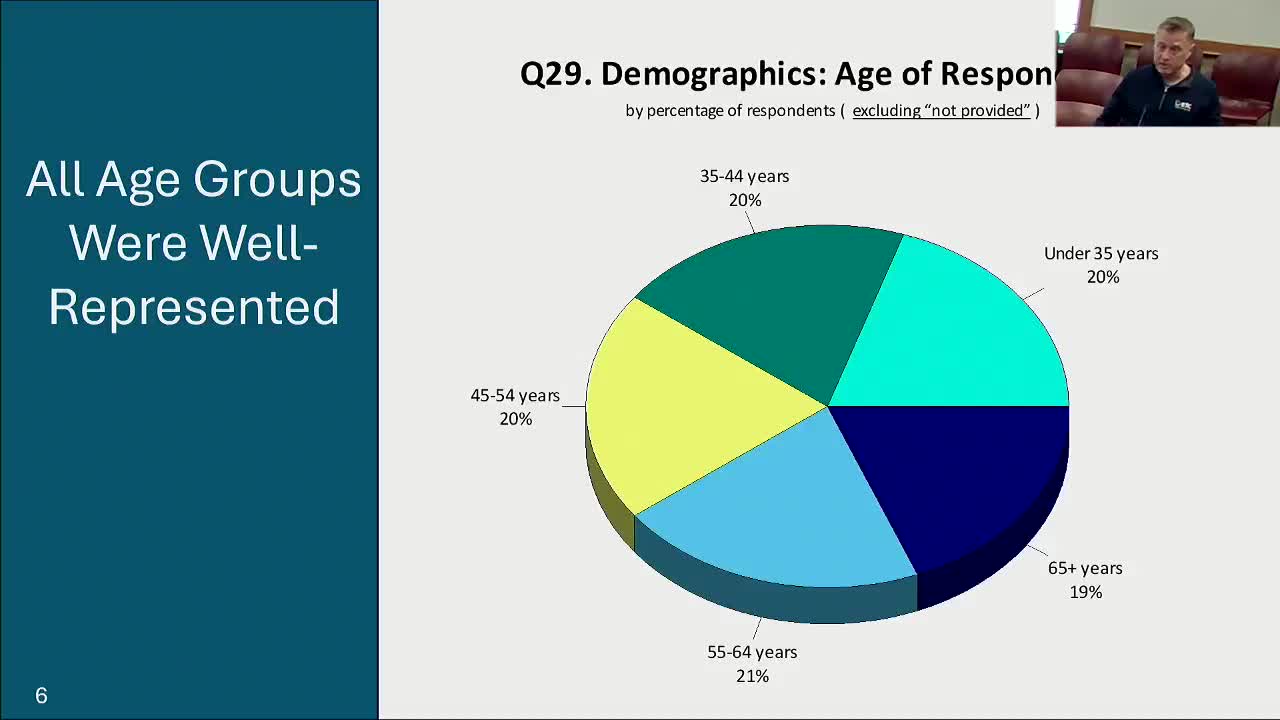
Council members and staff pressed for methodological detail. Councilmember Don asked whether 430 responses can represent a city of about 43,000 residents; Heacock and city staff said the goal of 400 completed surveys is a standard target for this type of study and that the address-based sample was designed to match U.S. Census demographics. City staff member Aaron said the survey was address-based to avoid duplicate or nonresident responses and that cross-tabbed results are available on the city’s survey dashboard.
Council members asked which issues might be driving negative responses. Heacock and council discussed traffic results possibly reflecting recent construction on Troy Pike and other short-term disruptions, and they agreed the question could be broken into more specific items in future surveys. Heacock suggested the city could drill down on items flagged as high priority—police efforts to prevent crime, enforcement of private-property cleanups and traffic management—to guide budget or communications decisions.
City staff told council the city intends to use the survey data during budget planning and operations. Council and staff also noted the city will focus a 2025 survey on the business community and return to a resident-focused survey in 2026. The full survey dashboard and cross-tabbed results are available on the city website for further review.
Ending: Council did not take formal action on the presentation itself; staff and council members said they will use the results to inform work plans and public outreach ahead of budget and program decisions in the coming year.