Get Full Government Meeting Transcripts, Videos, & Alerts Forever!
Get email alerts on the Municipal Budgets And Rates topic
No spam. Unsubscribe anytime.
Denton PUB reviews FY2026 preliminary utility budgets; water, wastewater rate increases proposed and staff weighs a convenience fee for card payments
Summary
City staff presented FY2026 preliminary utility budgets and projects a 3% residential water rate increase and an 11% wastewater increase while proposing a $2.90 flat convenience fee to recover card-processing costs; DME proposes no base-rate change but ECA/TCRF adjustments will continue.
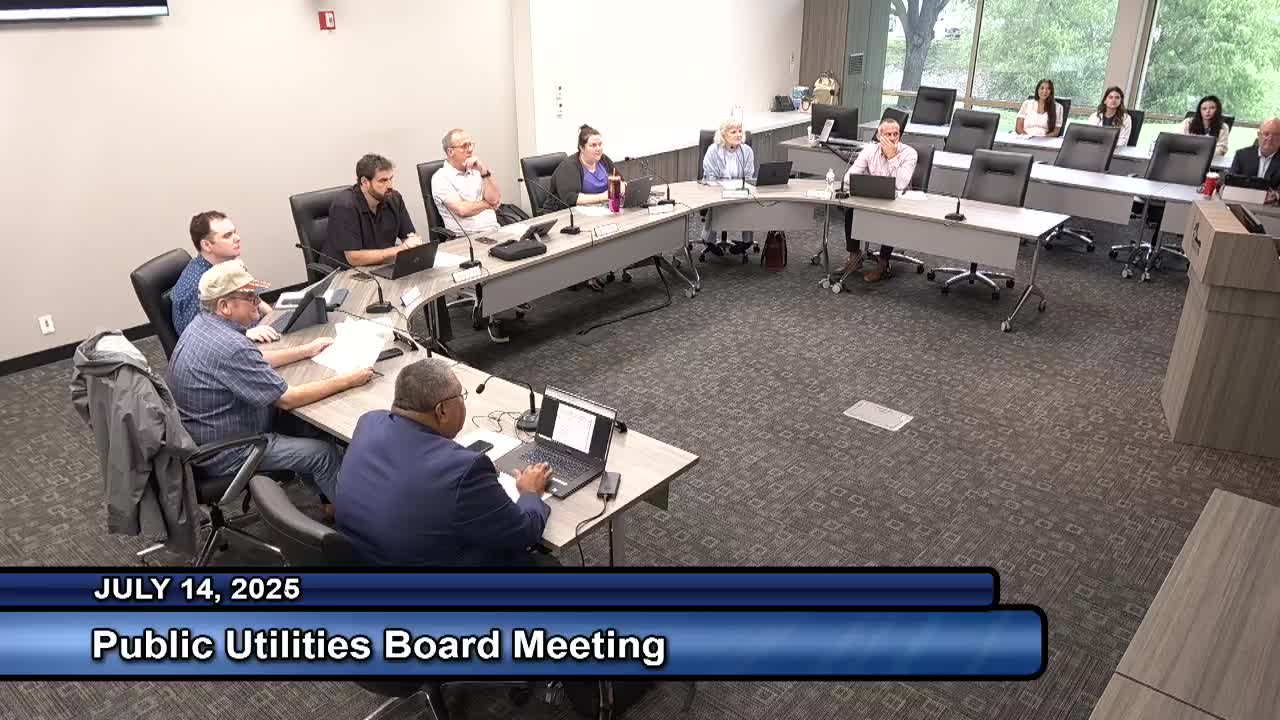
Denton City staff on Monday presented preliminary fiscal-year 2026 utility budgets to the Public Utility Board, proposing modest base-rate increases for water and wastewater while recommending a new flat convenience fee for some electronic payments to recover credit-card processing costs.
The proposal would raise residential and commercial water base rates by 3% and residential and commercial wastewater base rates by 11% for FY2026, officials said. At the same meeting staff also presented a draft convenience-fee option for online and kiosk payments: a $2.90 flat charge would recover about $1.3 million of the city's annual card- and e-check-processing expense; a $1 fee would recover about $460,000, per staff figures.
The budget review matters because proposed rate adjustments and fee decisions will affect household bills and the utilities' ability to fund planned capital projects and debt service. Staff said the water and wastewater increases are driven primarily by capital improvement program (CIP) spending and rising debt service for major infrastructure projects.
Matt Hamilton, identified in the meeting as finance staff, described this year's budgeting approach as a shift to zero-based budgeting. "This year, we decided to make a change, and move towards something called 0 based budgeting. And 0 based budget in is a technique in which the budgets start from 0," Hamilton said, explaining staff rebuilt departmental budgets from the ground up rather than roll forward prior-year amounts.
Staff gave fund and project highlights: the solid-waste fund is balanced for FY2026 with revenue and expense both projected at about $45.3 million and no base rate increase proposed; the fund plans to use reserves to revenue-fund vehicle replacements again and reduce future debt issuance. Water staff proposed $59.1 million in revenue and $62.7 million in expense for FY2026, including the 3% base-rate increase and temporary use of reserves; the water five-year CIP totals roughly $94.9 million, with about 55.6% expected to be debt-funded. Wastewater staff projected revenue of $44.5 million and expense of $44.1 million for FY2026 and recommended an 11% rate increase to pay for large treatment and system projects; the wastewater five-year CIP is about $242 million, with substantial WIFIA and other debt funding planned.
DME (the municipal electric utility) staff said they are not recommending a base-rate change for FY2026, but that the energy-cost adjustment (ECA) and TCRF rules will continue to move as conditions require. Tony Pointer, DME general manager, noted large one-time costs earlier this decade remain on the utility's books and affect fund targets: "In August of '23, you know, certainly, we incurred $31,000,000 worth of debt," he said, referring to high purchase-power expense from summer 2023 market conditions.
On customer service, staff told the board the city paid roughly $1.3 million in card- and e-check processing fees in FY2024 and does not currently recover those costs from customers. Staff presented two fee scenarios and asked the board whether to direct staff to research implementation steps and bring back an ordinance: a $1 flat convenience fee would recover less than half the cost; a $2.90 flat fee would recover nearly all of it. Staff noted recurring transactions (autopay) and point-of-sale payments would be excluded from the convenience fee under current card-processing rules.
Board members raised fairness and affordability concerns during discussion. Several members urged staff to explore ways to encourage lower-cost payment methods (for example, e-checks or recurring payments) and to consider whether commercial accounts should bear more of the fee burden than residential customers. Staff said if the board asks for a convenience-fee option, the proposal would come back to the board and then to city council for formal action.
Staff outlined next steps: staff will return to the board on July 28 with full budgets and proposed rate ordinances, then present to council at a citywide budget workshop in August and seek final budget adoption in September. The board offered feedback but did not adopt rate ordinances at Monday's meeting.