Get Full Government Meeting Transcripts, Videos, & Alerts Forever!
Get email alerts on the Community Solar topic
No spam. Unsubscribe anytime.
Garrett County board approves special exception for community solar at McHenry site, 4-1
Summary
The Deep Creek Watershed Board of Zoning Appeals approved a special exception for a community solar project at 465 Pies Road in McHenry, Md., allowing the project to proceed with conditions including screening, stormwater controls and bonding. Neighbors raised concerns about property values, road access, runoff and construction impacts.
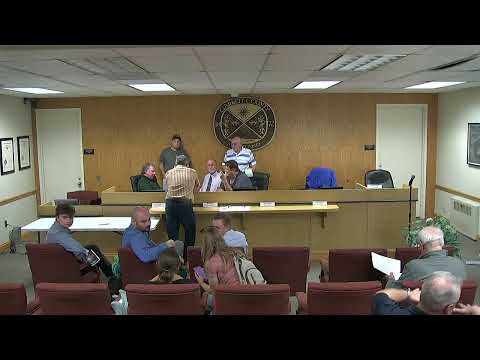
The Deep Creek Watershed Board of Zoning Appeals approved a special exception, by a 4-1 vote, to allow a community solar energy generating system at 465 Pies Road in McHenry, Maryland.
The application, submitted by Thrasher Engineering on behalf of developer UGE and landowners Alexandra and Ekaterina Koffman, was presented at a public hearing during which neighbors raised concerns about property values, road capacity, erosion and construction methods. The board said it will attach conditions requiring screening, stormwater and traffic controls, and performance and decommissioning bonds before the project proceeds.
Chair, Deep Creek Watershed Board of Zoning Appeals, opened the public hearing by explaining the legal standard for the meeting, saying the request was for a special exception and that “special exceptions ... are already allowed by the code in these districts and cannot be denied by this board except in rare instances where sufficient testimony shows the use is worse in this location than anywhere else in the zoning district.” The chair added that the board could impose reasonable additional conditions to address neighborhood concerns.
Representatives for the applicant described the proposed project and mitigation measures. William Gala, representing UGE, and Isaac Williams (UGE) and Spencer Breuschage (Thrasher Engineering) said the array would be sited behind an existing vegetative buffer, with a 100-foot setback from property lines, an access road entering from the southeast and on-site equipment (inverters and racking). Breuschage said the panels would track the sun and that “the panels at maximum tilt would be around 15 foot,” noting Maryland code requires panels to remain below 20 feet.
Project mitigation described to the board included a stockade fence placed immediately after construction to provide an initial screen, followed by planted vegetative screening. Breuschage said the plantings would be roughly 4 to 5 feet tall at installation and could grow to about 30 to 35 feet at maturity; the applicant said an existing roughly 40-foot-wide vegetative buffer along Ferguson Road would remain. The access route inside the site would be gravel and the fire marshal’s required access lane would be located outside the fence.
The applicant also described non-zoning requirements that remain after approval, including entrance and grading permits, stormwater approvals, decommissioning and performance bonds, and other county and state permits. The applicant said the project would include a decommissioning bond and that, per their understanding of county rules, a project that ceases producing energy for 12 consecutive months would be considered abandoned and subject to decommissioning requirements.
Neighborhood speakers focused on land-use compatibility and local impacts. Resident Eric Profetti said the site and surrounding land were zoned lake-residential and warned the project could set “a bad precedence” and depress nearby property values; he also questioned the board’s enforcement ability. Maria Perpetty and other residents cited concerns about glare, noise, dust, traffic on narrow roads with single access, increased runoff if trees are removed, the possibility of blasting or heavy drilling to install foundations in bedrock, and potential effects on emergency access.
The applicant responded to several technical questions: Breuschage said glare risk is reduced by the combination of the stockade fence, planned vegetative screening and the existing tree buffer, and he noted the panels tilt east-to-west so any reflection would be oriented east or west rather than north-south. On foundations, the applicant said geotechnical testing had not yet been completed; if driven posts were not feasible they could use drilled piers, ground screws or a ballast (concrete block) foundation depending on the results. The applicant said construction would include temporary sediment controls and that they expect to implement stormwater measures (level spreaders/energy dissipators) to prevent increased runoff.
After deliberation the board moved to approve the special exception with conditions addressing screening, stormwater management, traffic/road impacts (including considerations for school buses and emergency access), limits on after-hours lighting, and standard permitting and bonding requirements. The board voted 4 in favor and 1 opposed. The board indicated it would draft the written conditions and include standard performance and decommissioning bonds, vegetation screening bonds and stormwater guarantees before final administrative sign-off.
The board closed the public portion of the hearing and began deliberations in public; members said further engineering, grading and stormwater approvals would be handled by county permitting and by the Maryland Department of the Environment as required. The board noted that the special-exception review is limited to zoning appropriateness and that engineering specifics (design of stormwater facilities, detailed foundations) would be reviewed in permitting.
The board’s decision allows the applicant to proceed to the county and state permitting steps required before construction can begin. The board announced it will prepare written conditions; the next board meeting was scheduled for July 17.