
Clute council reviews FY2025–26 budget as FEMA reimbursements, rising health costs and large capital projects shape options
Get AI-powered insights, summaries, and transcripts
Subscribe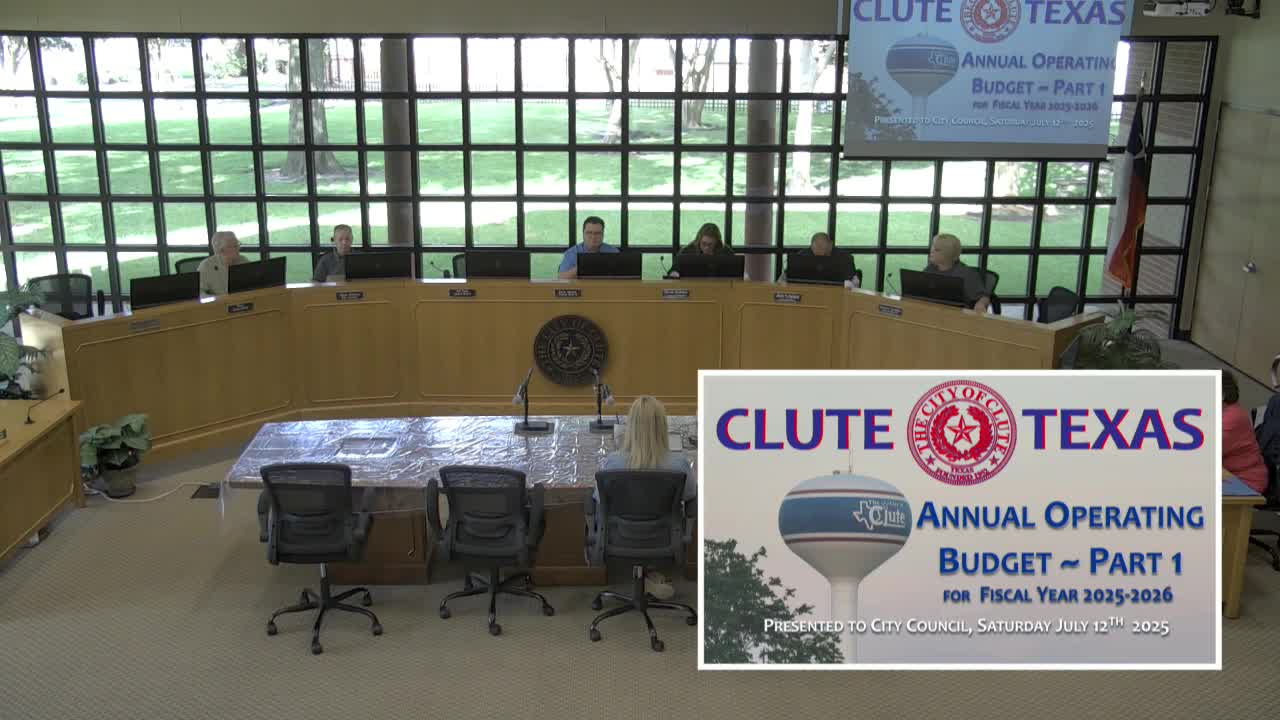
Summary
City staff presented a draft FY2025–26 budget showing steady overall revenues but significant downside risk tied to outstanding FEMA reimbursements and rising insurance and utility costs; the plan includes a 4% staff COLA, proposed utility rate increases and a long CIP that draws on reserves.
City staff presented a draft fiscal year 2025–26 budget at a July budget workshop that projects citywide revenues of roughly $12–13 million but cautioned the numbers depend on still-pending FEMA reimbursements and policy choices by the council.
The administration’s proposal includes a 4% cost-of-living adjustment for staff, an anticipated 3.5% baseline increase in ad valorem revenues, and an assumption that the city will adopt a property tax rate that increases revenue without triggering a rollback election. Staff said the city has seen an unexpected uptick in sales tax receipts but is still waiting for large FEMA Category B reimbursements that could materially improve the bottom line.
Why it matters: city leaders told the council the budget balances competing needs — personnel costs, a growing deferred capital program and rising operational costs — while preserving reserves if reimbursements arrive. If FEMA money is delayed or denied, staff said the city would face deeper draws on fund balance and would need either spending cuts or revenue increases.
Key elements and assumptions
- Revenues: staff told the council they expect between $12 million and $13 million across funds, with a general-fund reserve that begins the year around $4.72 million. The proposal assumes a modest increase in sales tax and a 3.5% increase in property-tax collections compared with the current budget year.
- FEMA reimbursements: staff reported only limited cash from FEMA so far (a small reimbursement described in the meeting as roughly $8,000) and said significant reimbursements remain outstanding; the budget therefore presents a “with reimbursement” and “without reimbursement” scenario.
- Personnel and benefits: the draft includes a 4% COLA for employees. Staff warned that health insurance renewals produced a proposed increase of roughly 43% from the city’s broker; to limit exposure staff proposed exploring a membership-based primary-care program (Next Level Healthcare’s "Prime Solution") at $60 per member per month that would be paid fully by the city and is estimated at about $88,000 annually if taken up by all employees and dependents.
- Capital and CIP: the budget packages multiple capital programs across funds (general fund, enterprise/water & sewer, streets/drainage/CIP, EDC). Staff emphasized an aggressive year-1 CIP and noted more than 50 miles of sewer lines that are past their expected life. Major line items discussed include a $1.5 million reconditioning of Lakeleton Road, a $900,000 enhancement of Kyle West to a concrete curb-and-gutter profile, and several GLO-funded drainage projects (see clarifying details). A roughly $1.2 million transfer from the EDC back to the general fund was included to account for a prior mortgage payoff.
- Debt service: staff flagged an upcoming spike tied to a 2017 bond/loan structure that will substantially increase annual debt service for several years, then fall off; that peak will constrain enterprise fund capacity in the near term.
Utilities and enterprise fund highlights
City staff said the enterprise (water/sewer) fund projects roughly $8.7 million in revenues and plans a base water-rate increase model that includes a 7.5% base increase and an overall average revenue increase of about 11% tied to both consumption and rate structure changes. Staff described the net revenue from rate changes as closer to 7% after accounting for the city’s contract purchase of water from the Brazos/other water authority (referred to in the meeting as BWA), which reduces the city’s retained share of a rate raise.
Staff also briefed the council on an AMI/AMI-compatible meter replacement program and said the full AMI rollout would likely be done in phases over multiple years; they budgeted roughly half the expected AMI cost in the enterprise fund for the coming year and proposed auditing the existing system first to identify lower-cost fixes.
Council direction and next steps
Council members asked staff to prepare alternate scenarios (including different property-tax rate choices and a range of utility-rate models) and to bring back refined options. Staff asked for direction on the amount of rate pressure the council will accept and said they will return with versions of the budget that reflect the presence or absence of the FEMA reimbursements and different rate-increase scenarios.
Ending: staff said work on the FY2025–26 budget will continue over the coming weeks and that they will return with updated financial models and supplemental information requested by council members.