Get Full Government Meeting Transcripts, Videos, & Alerts Forever!
Get email alerts on the Substance Use Prevention Recovery topic
No spam. Unsubscribe anytime.
Warren Coalition director outlines prevention, recovery and youth programs, cites funding gaps
Summary
Krista Shiflett, director of the Warren Coalition, briefed the Warren County Board of Supervisors on the coalition’s prevention and recovery programs, described several grants that fund services, and said some programs face funding shortfalls despite local partnerships and volunteer support.
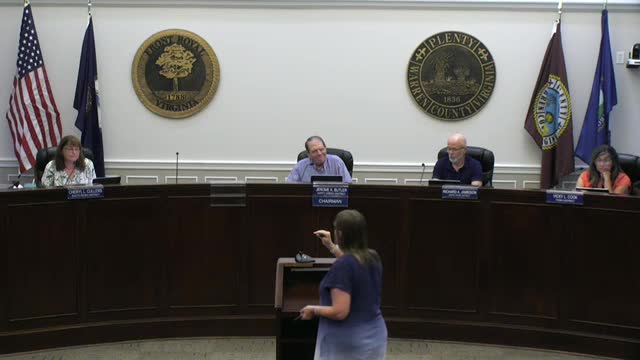
Krista Shiflett, executive director of the Warren Coalition, presented an update to the Warren County Board of Supervisors on the coalition’s prevention, youth and recovery programs, and described current funding gaps and recent grant awards.
Shiflett told the board the coalition, operating as a nonprofit since 2001 and founded in 1994, staffs nine full‑time and two part‑time employees and runs programs “from birth to death,” including Dolly Parton’s Imagination Library affiliate work, youth prevention curricula, trauma‑informed services, and recovery housing.
She said Halo Read (the local affiliate of Dolly Parton’s Imagination Library) serves about 403 children and is free to families; the coalition pays postage and fundraising currently covers those operating costs. Shiflett described Project Courage, now in its sixth year, as a Victims of Crime Act (VOCA)‑funded program serving students in grades 5–8 who have witnessed or been victims of violent crime; the program counted 83 children in service this year and had four graduates. She said VOCA and other federal funds are “winding down” and do not fully cover program costs.
Shiflett also briefed the board on Saved, a DCJS‑funded intervention for students in grades 6–12 caught with drugs or alcohol at school; she said the program is in its second year (extended through next June) and uses an evidence‑based curriculum tailored by individual assessment. Prevention work includes in‑school curricula (Too Good for Drugs, Life Skills), vaping lessons developed with Stanford Medical, and partnerships with Front Royal Family Practice and local National Honor Society students on pro‑social activities.
On alcohol prevention, Shiflett described a federal grant (named “Awesome” in her presentation) that currently provides about $60,000 annually to support youth activities, compliance checks and surveys; she said that grant is slated to end after the current year, and losing it would reduce the coalition’s ability to fund pro‑social youth events and to continue its long‑running local substance‑use survey series.
She also described WAHOO (Working to Achieve Healthy Outcomes and Opportunities), an 11‑year grant program that typically provides $30,000–$33,000 annually for community projects such as playground equipment, courts, exercise stations and the SPARK obesity‑prevention program in five schools.
On recovery services, Shiflett said the coalition runs two recovery houses (a 13‑bed men’s house on South Bridal and a six‑bed women’s house called The Nest, which will transition and create a separate nine‑bed men’s house called Colby’s House). She said the coalition operates peer support and reentry services at the county jail (Project Purpose), provides substance‑misuse assessments at RSW (not reimbursed by Medicaid), and helps arrange inpatient placements across the state.
Shiflett said the coalition had secured Valley Health funding to pursue a women‑and‑children homeless shelter and that an opioid abatement (OAA) grant had been awarded to the coalition (surprising to her during the presentation); the board noted the county contribution for direct distribution and that the OAA grant would appear on a future agenda.
Board members thanked Shiflett and several expressed appreciation for the coalition’s staff and volunteers. Shiflett closed by noting long‑term progress and the remaining need for sustainable funding.
Shiflett quoted during the presentation included: “We provide services from birth to death,” and “We are trying, but oh, and one more thing… we just got money to try to get a homeless shelter for women and children in town.” These remarks were attributed to Krista Shiflett, executive director of the Warren Coalition.
The presentation was delivered during the board’s public meeting; there was no formal board action recorded on the coalition’s update during this session.