Get Full Government Meeting Transcripts, Videos, & Alerts Forever!
Get email alerts on the Housing Policy topic
No spam. Unsubscribe anytime.
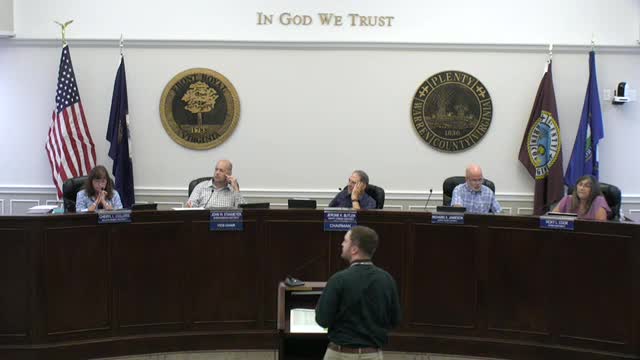
Warren County supervisors reopen debate over 100‑foot short‑term rental setback; staff to draft ordinance options
Summary
Supervisors spent an extended work session debating whether to keep, remove or revise the county—s 100‑foot setback for short‑term tourist rentals. Board members asked staff to draft options (delete the requirement; keep it; or set a different fixed distance such as 50 feet) and to refer proposals to the planning commission for public hearings.
The Warren County Board of Supervisors spent a lengthy work session reviewing short‑term tourist rental rules, focusing on a 100‑foot separation requirement in the county—s zoning ordinance that restricts approval of conditional use permits for short‑term rentals when neighboring dwellings lie within 100 feet.
Background and current rule: Short‑term rentals were added to the zoning ordinance in 2012 and were refined through later text amendments; the current ordinance requires a 100‑foot separation as a supplementary regulation, though the board has historically granted waivers. County staff said the separation provision was adopted in past years to address complaints in higher‑density residential areas.
Board debate: Supervisors expressed sharply different views. Some board members called the 100‑foot setback arbitrary, said it has created enforcement headaches, and advocated eliminating it so applicants could be evaluated under other conditional‑use criteria. Others recommended retaining the setback or moving it into the land‑use definition so it could not be waived. A number of supervisors proposed creating a stakeholder committee (HOA representatives, short‑term rental operators, realtors and county staff) to recommend specific criteria; several board members warned against deferring action indefinitely.
Data cited by staff: Planning staff reported that roughly 188 short‑term rental units currently operate in the county (about 1.05% of 17,981 dwelling units) and that those rentals generated about $1.67 million in transient lodging revenue since February 2021 (excluding hotels). Staff said the county—s definitions also limit short‑term rentals to detached single‑family dwellings (campers and multiunit buildings are not eligible) and that the county maintains a reporting and enforcement pathway for complaints.
Options and process: County staff offered three draft options for board consideration: (1) delete the 100‑foot separation requirement; (2) keep the separation but make it a non‑waivable definition requirement; or (3) keep a setback but change the distance (members floated 50 feet and 60 feet during discussion). Supervisors asked staff to draft ordinance language reflecting those options for planning commission review and a public hearing. Staff said the change would take at least several months to move through public hearings and code amendment procedures.
Enforcement and complaint process: Staff told supervisors there is an online complaint/reporting pathway and that the sheriff—s office and planning staff respond to repeated violations; staff noted one short‑term rental is currently on probation and another is in the queue for potential revocation.
Next steps: Supervisors directed staff to draft text amendments and present options to the planning commission; they asked staff to pause accepting new short‑term rental applications while the code is revised (except applications that already meet the 100‑foot separation), and they asked staff to coordinate with the local Warren County Coalition of Community Associations. The board asked that staff prepare options for a work session and planning commission review.
Ending: staff will bring ordinance drafts and a recommended pathway to the planning commission and then back to the board; supervisors said they want a firm decision rather than extended study.