Get Full Government Meeting Transcripts, Videos, & Alerts Forever!
Get email alerts on the Battery Storage topic
No spam. Unsubscribe anytime.
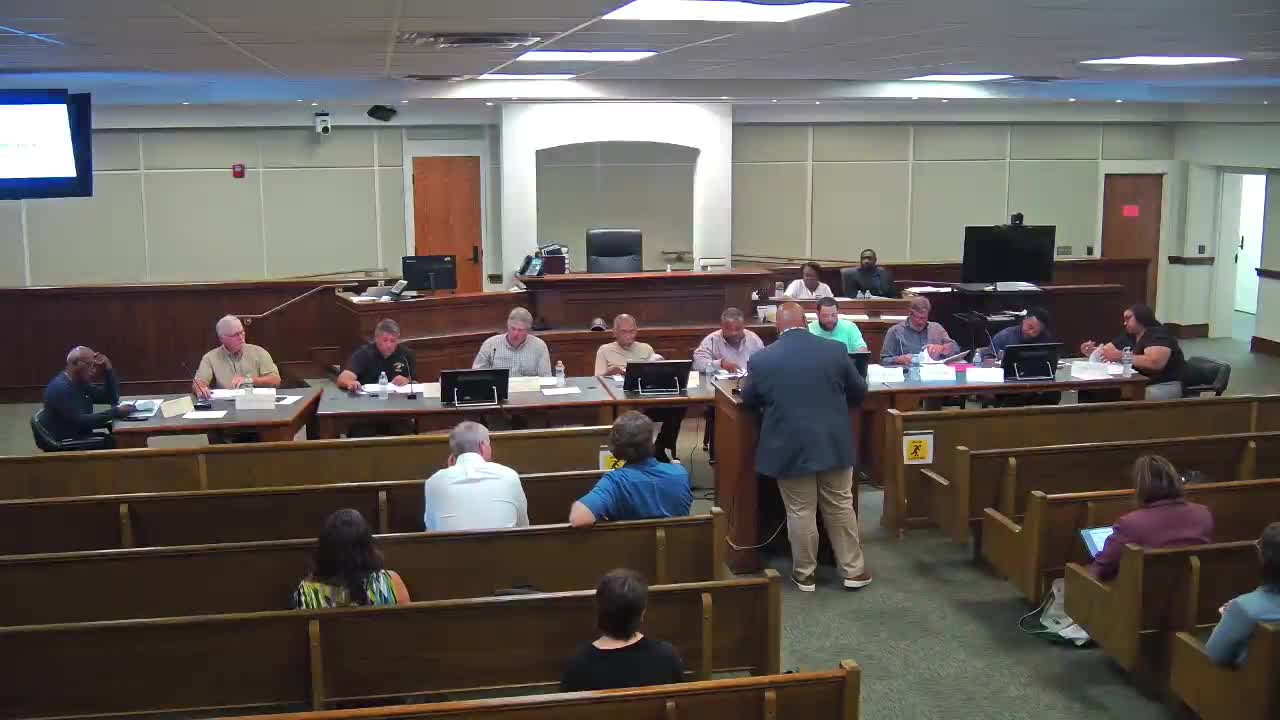
Surry County planning commission approves conditional-use permit for 89-MW Bear Island battery storage, recommends project to Board of Supervisors
Summary
The Surry County Planning Commission on an unspecified date approved a conditional-use permit for Bear Island Battery Storage LLC to build an 89-megawatt, four-hour battery energy storage system on parcel 54-1 along White Marsh Road and recommended the permit, with conditions, to the Board of Supervisors.
The Surry County Planning Commission on an unspecified date approved a conditional-use permit (CUP) for Bear Island Battery Storage LLC to build an 89-megawatt battery energy storage system (with a four-hour discharge duration) on parcel 54-1, a site described in the record as an AR‑zoned property on White Marsh Road in the Baker's Castle District.
The commission voted to approve CUP number 2025-01 and separately voted to recommend the permit, with the proposed conditions, to the Surry County Board of Supervisors. Commissioners also approved a separate “substantial accord” determination finding the proposal consistent with the county comprehensive plan.
Planning staff said the applicant proposes to place the battery and an associated switchyard and substation on roughly 32.5 acres inside the larger parcel, with the battery facility itself spanning about 10 acres. Staff described the project as an 89-megawatt nameplate system capable of delivering that output for about four hours — commonly characterized in the industry as “89 MW × 4 hours.” The proposed development lies within the Chesapeake Bay Preservation Area and contains delimited wetlands and a resource protection area; staff said any wetlands impacts would be addressed during site-plan and permitting review with DEQ.
Staff presentation (Mister Wade, planning staff) outlined required standards and mitigation measures under the Surry County zoning ordinance (Article 3, Section 3.302, subsection C) and the county comprehensive plan. The plan-alignment analysis noted the site is in a rural-preservation designation, is more than 750 feet from the nearest residence (staff said the closest home is about 2,300 feet away), and is less than 900 feet from transmission lines — meeting a county requirement to locate projects within a mile of transmission centroid.
Public-safety and operational questions dominated discussion. Planning staff estimated construction would generate roughly 100–150 vehicle deliveries, with about 2–3 heavy tractor-trailer deliveries per day for a one- to two-month window during installation. After construction the site is expected to operate remotely with minimal routine traffic.
On fire and air-safety concerns the commission heard a technical presentation from Erica, modeling team member, Fire and Risk Alliance (Rockville, Maryland). Erica described plume-dispersion modeling and industry testing, saying, “all the modeling that I've done... any plumes of the concentration that would be dangerous to life or health... would not extend past the property boundary.” She added that thermal-runaway events release gases that are comparable to a typical structural fire and that emergency-response planning and first-responder training are used to manage on-site incidents.
A public commenter, David Tucker, a professional engineer and Isle of Wight County resident, urged denial and criticized storage efficiency and ratepayer impacts, saying, “Please do not approve Bear Island BESS... BESS do not make energy but consume energy and are inefficient.” His remarks and other public concerns were noted; the commission closed the public hearing before voting.
Commissioners pressed applicants and staff on traffic controls, delivery windows, screening and buffers, noise modeling and the decommissioning timeline. Staff said the ordinance requires a 100-foot vegetative buffer around the 32.5-acre project area and that the applicant indicated it would consider expanding the buffer on the north side to 200 feet. Staff also said a noise study will be required before site-plan approval; staff estimated ambient noise at the nearest residence would be about 38 decibels based on distance and existing vegetation.
On decommissioning, commissioners noted the county’s solar/energy provisions and asked how long a nonoperational facility could remain before removal. Planning staff explained the county language triggers decommissioning when a facility permanently ceases operations and noted existing tax and decommissioning timelines in the county’s ordinance.
Applicants and their representative emphasized local ownership and ongoing operation. A company representative said the firm’s “plan is to build and own and operate these things,” adding the developer intends to “be here for the life of the project.”
The planning commission approved CUP number 2025‑01 by voice vote (chair declared “the ayes have it”) and later voted to forward the permit to the Board of Supervisors with the recommended conditions. The commission also approved the substantial-accord determination finding the project consistent with the 2040 comprehensive plan.
What happens next: if the Board of Supervisors follows the commission’s recommendation, the project will proceed to detailed site-plan review and state permitting (including DEQ reviews). Planning staff said further design details, noise and hazard-mitigation modeling (including plume modeling) and a traffic-management plan will be required at site-plan stage before construction could begin.