Get Full Government Meeting Transcripts, Videos, & Alerts Forever!
Get email alerts on the Invasive Pests topic
No spam. Unsubscribe anytime.
State forestry urges Warren County to designate coordinator, pursue grant for spongy moth aerial spraying
Summary
Virginia Department of Forestry staff briefed Warren County supervisors on a rising spongy moth outbreak, recommended a county coordinator and grouped spray contracts to reduce per‑acre costs, and outlined grant timelines and outreach duties for any local suppression program.
State forestry officials told the Warren County Board of Supervisors that spongy moths (formerly called gypsy moths) have re-emerged across parts of the valley and that local governments can use state grant funds to help landowners arrange aerial spraying at a lower per‑acre cost.
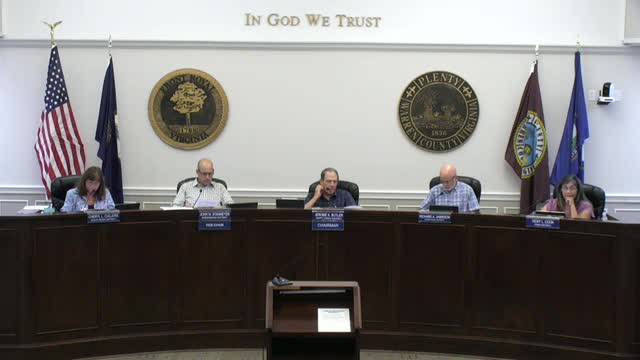
The briefing came during the board—s July work session as the agency described recent defoliation patterns, natural controls that suppress the pest, and how counties can organize spraying programs and outreach.
State forester staff showed maps of last year—s heavy defoliation (blue polygons) and this year—s activity (yellow polygons), and said the insects prefer oaks and hickories but will defoliate a wide range of species when populations are high. Aerial spraying using bacterial material commonly called Bt (Bacillus thuringiensis) is a common treatment; the forester said droughts in recent years limited natural fungal and viral controls, allowing populations to grow.
"When infestations get high enough like we're seeing now, they are completely indiscriminate," the forester said, noting severe canopy loss in parts of Bentonville last year.
Why it matters: the agency advised the county that a local coordinator is required to apply for state grant funds and to organize landowners into a single spray contract (sometimes structured as many small contracts under a county umbrella) so helicopter operators will accept the acreage. The agency cited examples: Shenandoah County secured 5,000 acres under one county contract and charged landowners about $20 per acre after state funding; another county reduced a $40/acre bill to $20/acre for landowners by aggregating parcels.
Key practical steps and timeline: the forester said counties typically start egg‑mass surveys in September and that the state grant deadline historically falls in early March. He recommended starting coordinator recruitment and outreach as soon as possible; some counties have hired part‑time or seasonal coordinators or assigned existing staff to the role. He said aerial contractors generally expect large minimum contracts (the forester estimated 500 acres as a typical minimum cost threshold for a helicopter contractor) and recommended aggregating many landowners to reduce per‑acre costs.
Local context and outreach: the forester said Warren County already has about 20 landowners on an interest list. He described prior outreach models: placing notices in local papers, maintaining contact lists, and contacting emergency services and local first responders before aerial operations. He also said counties typically notify property owners in proposed treatment and buffer areas and that counties often ask hospitals, fire stations and EMS to be informed about spray plans. The forester said state and federal agencies (U.S. Forest Service and National Park Service) have conducted spraying in adjacent jurisdictions this season.
Board reaction and next steps: supervisors expressed interest in pursuing a program and asked staff about coordinator options and grant timing. County staff said they would follow up on hiring/designation options and on coordinating a scoping discussion with the state. The forester offered to connect the county with other local coordinators and contractors who had used the state program.
Ending: county staff and state forestry agreed to continue the discussion; supervisors asked staff to return with options for a county coordinator and an outreach plan to bring additional landowners into a potential aggregated spray contract.