Get Full Government Meeting Transcripts, Videos, & Alerts Forever!
Get email alerts on the Procurement Contracts Grants topic
No spam. Unsubscribe anytime.
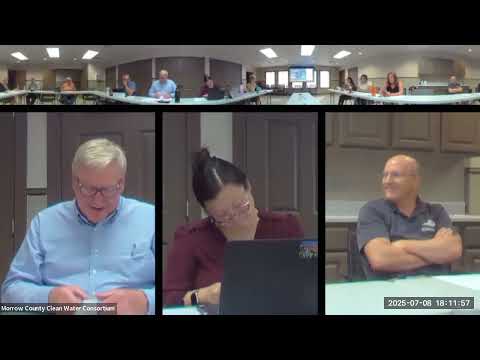
Consortium adopts Port of Morrow procurement model, OKs two consultant contracts; legislative grants could fund Westglenn work
Summary
The Volcanic Clean Water Consortium voted to adopt a procurement framework based on the Port of Morrow—s model rules and authorized two consultant contracts—one engineering ($100,000 cap) and one grant consultant ($25,000) while staff reported a likely $2.85 million state award for wastewater/water connections if the governor signs the bill.
Volcanic Clean Water Consortium members voted to adopt a procurement framework based on the Port of Morrow—s adoption of the Oregon Attorney General—s model public contracting rules and authorized two consultant contracts: a one-year engineering services contract with GSI Water Solutions not to exceed $100,000 and a one-year grant-writing contract with Nick DeCote (grant consultant) not to exceed $25,000. Staff also updated the board on a legislative funding request, SB 5531, for $2,850,000 that would fund municipal connections in the Westglenn area if the governor signs the bill.
The procurement discussion focused on thresholds and flexibility for personal services. Matt, the consortium manager, told the board that the model rules allow purchases under $25,000 to be made without competitive procurement, require three informal quotes for $25,000—$250,000, and require formal competitive procurement for amounts over $250,000. He said the model rules include an option to directly appoint architectural and engineering services up to $100,000, which the consortium would like to preserve to respond quickly to work needs. "What we're looking to do is ... finalize a resolution for adoption of the model rules," Matt said.
Board members and staff emphasized state statutory requirements that affect public projects. A participant identified as Brian noted the difference between professional services and construction bidding thresholds: "the 250,000 is for professional services. Public bidding for projects that's shoveling the ground is a 150,000 at the state law," and he also flagged prevailing-wage triggers that can apply to construction contracts. The group discussed adding language about surplus property and ensuring the procurement policy gives the consortium appropriate flexibility without unintentionally adopting provisions that do not apply to its operations.
On consultant contracts, staff asked the board to authorize the chair to sign final agreements after legal review. The engineering contract with GSI Water Solutions is a one-year, time-and-materials agreement with a not-to-exceed limit of $100,000 and an hourly rate schedule in the exhibit; staff said outstanding items are limited to standard indemnity/liability language and that legal counsel (Eileen) is reviewing those points. Matt described the arrangement as a general consulting engineer agreement that will be supplemented by task orders or scopes of work for specific projects so the consortium can track grant-reimbursable work and avoid duplicate billing with other projects the consultant already performs for county partners. The board asked that invoices include a project summary or line-item detail; staff confirmed the draft contract requires billings that "shall describe with particularity all work performed by whom it was performed and shall itemize and explain all expenses."
The grant consulting contract with Nick DeCote was presented as a one-year agreement not to exceed $25,000 to support grant identification and application work. Matt said $25,000 should cover routine application work for a year but would be insufficient for extended grant administration. Board members asked that staff bring grant application recommendations to the full board for approval, particularly for larger or politically sensitive funding opportunities.
On legislative and grant updates, Matt reported that the consortium successfully placed a CAP/LOC (CAPCOM) request for SB 5531 that, if signed by the governor, would allocate $2,850,000 (from lottery-backed bonds) to support municipal connections for Westglenn or an alternate community if outreach shows Westglenn does not proceed. He said the funds would likely be available in 2027 but that Business Oregon manages aspects of the award and there may be options for pre-spending or advance engineering and later reimbursement. Matt characterized the award as a significant step toward addressing nitrate contamination and connection to municipal systems.
Staff also reported progress on two federal funding tracks: a HUD CDS-2 (congressionally directed spending) application tied to Irrigon-area infrastructure and a CDS-3 inclusion in congressional requests. For CDS-2 the consortium has received tentative acceptances from EPA and the Oregon Health Authority (OHA) on scope; the application awaits a response from the Oregon Water Resources Department (OWRD). The board heard that these efforts are proceeding through Morrow County as fiscal agent and will require coordination with cities that may host infrastructure.
The meeting included an extended Westglenn technical-feasibility and community-outreach update. Staff and advisory members said turnout at the June 18 meeting was modest and that door-to-door outreach, bilingual outreach (through contracted teams), mailed notices and attendance at upcoming OHA/Morrow County open houses (July 30 in Riverside and July 31 in Hermiston) are planned to improve outreach. The board discussed complexities the outreach must address: shared and older domestic wells that may not be in state well logs, tenants vs. property owners (mailing lists from the county assessor may go to owners, not tenants), shared-well deed records, and the need to collect well locations and sample history for accurate planning. Board members urged legal counsel input on tenant/landlord rights and suggested using invoice and scope-of-work controls so consultants do not duplicate previously funded work.
Votes at a glance - Motion to accept minutes from prior meeting with correction (mover/second not specified): approved. Board recorded "Aye" and carried the motion. - Motion to approve following Port of Morrow model rules, with staff to return final resolution for adoption (mover/second not specified): approved. "Aye" recorded; motion carried. - Motion to authorize contracting with GSI Water Solutions, one year, not to exceed $100,000, and authorize board chair to sign after legal review (mover: board member requested; seconded): approved. "All in favor, Aye; motion carried." Staff said the chair will sign after counsel provides sign-off. - Motion to authorize contracting with Nick DeCote for grant-writing services, one year, not to exceed $25,000, and authorize board chair to sign after legal review: approved. "Aye" recorded; motion carried.
The board instructed staff to return a finalized procurement resolution that incorporates the agreed clarifications (attorney signature block, appropriate prevailing-wage / construction thresholds, and removal or modification of surplus property language if unnecessary). Staff will provide the final contract drafts to the chair with counsel—s approval before signature and will require consultants to provide invoice summaries tied to task orders or scopes of work to prevent double billing with county-funded road-map or related projects. The consortium will continue community outreach in Westglenn, coordinate technical data collection (well locations, shared-well deeds and sample data) with county offices and state agencies, and pursue the SB 5531 and CDS applications as they progress.
Staff and board members emphasized verification and accounting: invoices must identify the work performed and whether costs are reimbursable under a specific grant, and the fiscal agent (Kevin) will review billings and coordinate reimbursements. The board also requested additional legal review on tenant/landlord implications for outreach and potential service connections.
The meeting adjourned after brief announcements about upcoming outreach opportunities.