Get Full Government Meeting Transcripts, Videos, & Alerts Forever!
Get email alerts on the Criminal Justice Jail Diversion topic
No spam. Unsubscribe anytime.
CJCC adopts TCU-5 assessment; Justice Point reports jail, diversion and outreach activity
Summary
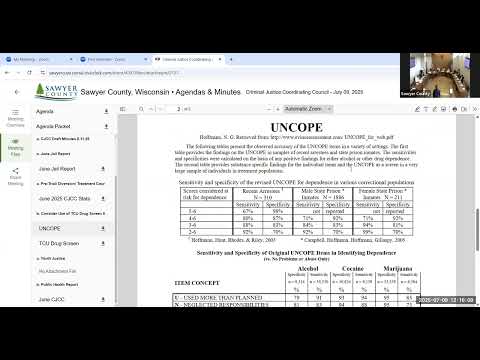
The Sawyer County Criminal Justice Coordinating Council voted to replace the UNCOPE substance-use screening with the TCU‑5 assessment. At the same meeting Justice Point staff reported jail population levels, program completions and ongoing outreach including Narcan distribution and a "reaching rural" technical-assistance opportunity.
The Sawyer County Criminal Justice Coordinating Council approved a motion to switch the county's initial substance-use screening from the UNCOPE tool to the TCU‑5 assessment during its meeting. Committee member Mark Helwig moved to adopt the TCU‑5 and Marshall Savicki seconded; members voted in favor and the motion carried.
A Justice Point representative reported jail and program statistics in the same presentation. The jail population was described as "about 60," with roughly one-third of detainees in each category: probation, presentence, and sentenced; four people were on electronic monitoring. Justice Point said pretrial active caseloads numbered 85; last month there were nine successful cases that were sentenced off pretrial and one unsuccessful case. Diversion had 11 active participants and nine in referral status; treatment court had eight active participants.
Staff reported recent hires and upcoming starts intended to increase capacity: a grama coordinator position was filled internally and remains partly caseloaded while the employee learns new duties, and a pretrial and diversion case manager with prior experience was due to begin work on the 16th (start date noted by staff). Justice Point estimated the new case manager would take about two weeks to a month before taking on clients.
Justice Point staff described ongoing deflection and outreach work: navigators are working with law enforcement on pre-arrest prevention, delivering prevention kits and staffing tables at community events. The group plans to staff a table at National Night Out (noted as Aug. 5, 5–7 p.m. in the handout). A handout labeled "reaching rural" was distributed; staff said the program offers technical assistance and grant-writing help but that the county had not yet received direct funding through that program.
Program completions reported to the council included nine completions of a writing foundations course and five completions of a math foundations course in the spring. Other jail programs listed were Native American culture and language, Pathways Home, Parenting Inside Out, on-the-job training (12 participants), Bible study (8), and AA (8). Justice Point also reported a change under consideration for substance-use risk screening: the Department of Justice recommends TCU‑5 for TAD-funded sites, and staff asked the council to approve switching from the UNCOPE to the TCU‑5. Council members approved that request.
Justice Point reported community outreach and harm-reduction activity: 99 doses of Narcan were distributed at Muskyfest, and staff handed out roughly 600 information packets on fentanyl, vaping and THC during the event. Staff said there are plans for Narcan boxes on local bus lines and additional public-awareness activity around National Overdose Awareness Day.
No roll-call vote totals were recorded in the meeting minutes for the TCU‑5 motion; the clerk recorded the motion, a second and that members replied "Aye" with no recorded opposing votes. The council did not set an implementation timeline for the switch in the meeting record; staff said they would proceed to implement the assessment now that the council had approved it.
The council discussion also referenced recommended screening practices from the Department of Justice and TAD funding status for the county's treatment and diversion programs.