Get Full Government Meeting Transcripts, Videos, & Alerts Forever!
Get email alerts on the Conservation Easement topic
No spam. Unsubscribe anytime.
Sawyer County committee hears proposal for 18,000-acre working-forest conservation easement; action tabled
Summary
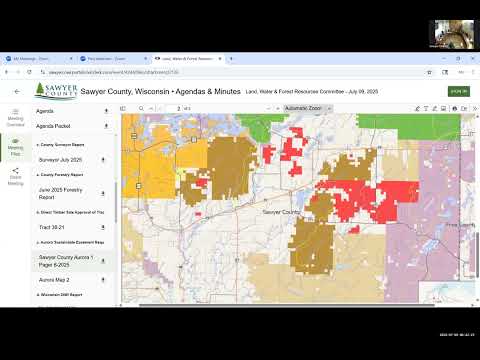
Representatives from The Nature Conservancy, the Wisconsin Department of Natural Resources and Aurora Sustainable Lands briefed the Sawyer County Land, Water and Forest Resources Committee on a proposal to place roughly 18,000 county acres under a working-forest conservation easement and seek Forest Legacy funding.
Representatives from the Nature Conservancy, the Wisconsin Department of Natural Resources and Aurora Sustainable Lands presented a proposal to place roughly 18,000 acres of privately owned forest in Sawyer County under a working-forest conservation easement and seek federal Forest Legacy funding.
The proposal, described as early-stage by presenters, would use the Federal Forest Legacy Program to fund up to 75% of an easement purchase; the department said a market-analysis–based request could be in the neighborhood of $6 million in federal funds, requiring a roughly 25% match from other sources if awarded. “This project lands in Sawyer County, about 18,000 acres of the project, in this county,” said Matt Dahlman of The Nature Conservancy.
Why it matters: supporters said a perpetual conservation easement would protect large blocks of working forestland from subdivision and fragmentation while keeping the land on the tax rolls and retaining public access negotiated in easement terms. Opponents and some committee members pressed presenters about likely harvest levels, economic effects for local timber markets and which rights the landowner would retain.
DNR role and process Ron Gropp, who manages Wisconsin DNR’s conservation-easement work including the Forest Legacy Program, said the Forest Legacy Program is a landowner-driven tool that buys development rights while leaving ownership private. “This is really a landowner decision to protect their property, and the manner in which they, decide to do that, is through a conservation easement,” Gropp said. He said the DNR would work through the Wisconsin Private Forestry Advisory Committee (WIPFAC) for ranking and that a successful federal award typically requires a later county-board resolution supporting use of Knowles-Nelson stewardship funds as match.
Funding and access Gropp described how the Forest Legacy Program typically covers up to 75% of an easement acquisition; match sources can include Knowles-Nelson stewardship funds, prior acquisitions, or private contributions. He said a DNR market analysis — not a full appraisal at this stage — was being prepared to estimate an ask. On public access, Gropp said prior easements in the county negotiated specified designated open-access roads and that easement protections “stay in place and all those public benefits that are identified in an easement stay in place and it rides with the sale of the land as well.”
Developer/owner perspective Forrest Gjibo, senior director of portfolio management at Aurora Sustainable Lands, said Aurora is a timber investment company, not the carbon-development firm Anew/BlueSource. “We are not a new affiliated back to BlueSource. We are our own entity,” Gjibo said. He said Aurora manages lands for traditional forest products and carbon revenue, described Aurora as active in timber sales in the area, and said the company is enrolled in certification programs that require road maintenance and sustainable practices.
Concerns from committee members Committee members asked whether conservation easement requirements would lock in low or passive harvest levels and how that would affect local mills and jobs. One county member said they were “shocked” to learn the county already contained very large easements and asked whether past easements had delivered measurable financial benefits to local taxpayers. Another member asked whether an easement would bar town uses such as gravel extraction and was told such uses can be negotiated at the easement drafting stage; Gropp said some prior easements allowed a limited number of gravel sites.
Next steps and committee action DNR staff said the department intends to submit a Forest Legacy application in October and that local supporting resolutions would be sought later if the project advances. Committee members said they wanted additional briefings and time for related county committees (forestry, mapping, highways) to review details including access and road-maintenance arrangements. One committee member moved to table the matter for further review; the motion carried. Presenters and staff said there would be additional opportunities for local input if the application advances toward national consideration.
Provenance: the committee’s discussion and the presenters’ descriptions appear across the meeting transcript, beginning when Nature Conservancy staff introduced the proposal and ending when the motion to table was made and carried.
What to watch: whether the DNR’s market analysis firm estimate and the department’s WIPFAC ranking prompt a formal county-board resolution to provide match funding and how negotiated easement terms (access, gravel, road-maintenance endowments, harvest expectations) are documented if the project advances.