Get Full Government Meeting Transcripts, Videos, & Alerts Forever!
Get email alerts on the Mobility Plan topic
No spam. Unsubscribe anytime.
South Salt Lake mobility plan update emphasizes safety, sidewalks, trails and short-term priorities
Summary
City mobility planner Carl Osberg presented a mobility plan update that highlights rising crash trends, recommends focused five-year actions and proposes two addenda to the city’s 2020 mobility plan. The public outreach-informed update prioritizes pedestrian safety, sidewalk/trail gaps, curb management and localized traffic-calming measures.
Carl Osberg, South Salt Lake’s mobility planner, briefed the Planning Commission on a mobility plan update at the commission’s July 10 work meeting, summarizing outreach, existing conditions and proposed short-term priorities. Osberg described the approach as producing two addenda to the 2020 mobility plan—one documenting data and outreach and the other a focused “next five years” guidance document—rather than rewriting the entire plan.
Osberg said newer regional data changed the team’s priorities since 2020: regional safety analysis and the Utah Household Travel Survey (2023) helped identify that serious and fatal crashes have risen in recent years, counter to earlier trends. He said the update will re-prioritize items the community still values but where the city has made little progress, and advance items that are actionable in the next five years.
Public input summarized by Osberg included requests for more bike lanes, traffic calming, improved lighting and a downtown landscaped walking loop. He said the update’s outreach included in-person booths, online survey responses and technical data sources; Osberg noted the city’s population skew—large millennial and Gen Z cohorts—but also a significant senior and mobility-limited population, which affects transportation needs.
Planned near-term work includes a city-specific safety study funded with federal funds administered through WFRC, updates to the land development code to support transportation and housing goals, bus stop improvements (UTA), and design work on the Mill Creek trail section through Fitts Park. Osberg said the city has a consultant on the safety study and is awaiting federal agreements that will release the funds and allow work to begin.
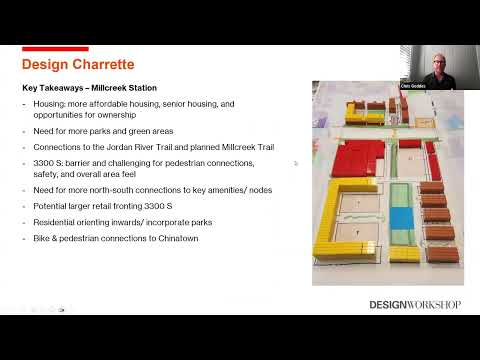
Commissioners and staff raised specific operational issues: pedestrian safety and crossings near Mill Creek Station and 3300 South (echoing the earlier station-area discussion); lighting on 30 Third and State Street; curb and parking management; and enforcement for vehicles blocking lanes by parking too close to the curb. Osberg said staff are exploring enforcement options, possible alterations to road cross-sections for new developments, and a targeted set of traffic-calming pilot measures (e.g., speed cushions with emergency vehicle cutouts, chicanes, pavement striping) while the broader safety study is completed.
Osberg described the city’s intent to make the plan actionable: one appendix compiles the technical sources and outreach responses and the other provides a prioritized set of policies and projects for the next five years. He invited commissioners and residents to submit comments; staff offered printed comment cards and said transportation questions and smaller operational issues (parking, lighting, streetlights) can be directed to Osberg or staff working groups.
Notable details from the briefing included: Osberg’s summary that about 70.5% of residents who commute drive alone to work; that some corridor improvements (for example, sections of Main Street) have been bid but will be phased because of higher-than-expected bids; and that a proposed transportation utility fee under consideration by the city council is expected to raise roughly $3.5 million a year, with most commercial and industrial users paying the fee and single-family homes largely exempted. Osberg said that dedicated funding, targeted enforcement and design updates are the mechanisms the city is pursuing to implement the mobility recommendations.