Get Full Government Meeting Transcripts, Videos, & Alerts Forever!
Get email alerts on the Municipal Finance topic
No spam. Unsubscribe anytime.
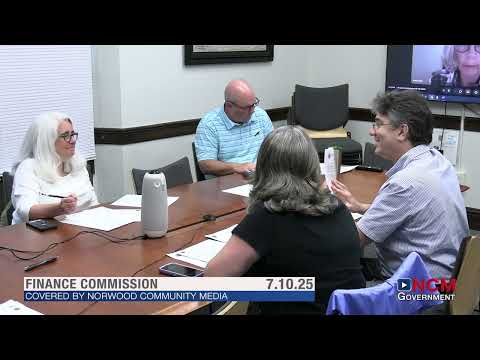
Norwood finance commission approves end-of-year transfers, reviews financial policies and forms structural‑deficit working group
Summary
The Town of Norwood Finance Commission unanimously approved four year‑end budget transfers on July 10, 2025, and spent the rest of the meeting reviewing outstanding financial policies, free-cash treatment and the creation of a structural‑deficit working group to inform next year’s budget process.
The Town of Norwood Finance Commission unanimously approved four end‑of‑year budget transfers at its July 10, 2025 meeting and discussed updates to financial policies, free‑cash treatment and a newly proposed structural‑deficit working group to help shape next year’s budget.
Jeff, a finance staff member who circulated a memo in advance, outlined the four transfers the commission had expected and said the adjustments were routine. He said one transfer reflects higher collection agent fees tied to increased revenue, calling it “where bad news is good news because . . . we are collecting more money, more revenue.” The commission then voted to approve the transfers as presented.
The transfers the commission discussed and approved included: a $65,000 adjustment to treasurer expenses tied to collection agent fees; about $22,000 related to additional election costs (offset in part by roughly $23,000 in state reimbursement that will be treated as general revenue); an additional snow‑and‑ice expense (approximately $23,706) driven by an extra payroll period; and a roughly $196,000 increase in waste‑removal expenses. Jeff said the town’s total waste‑removal budget is about $2,800,000 and that the commission and staff will track contract performance as the town moves into the third year of a five‑year waste‑removal contract.
Commission members asked clarifying questions about where state election reimbursements are recorded and how the transfers affect free cash. Jeff said state reimbursements are recorded as miscellaneous general revenue and that the year’s free cash will be certified by the Department of Revenue (DOR) in October; he estimated the town’s unspent balances rolled forward from the prior year are “roughly . . . 11,000,000.” The commission discussed using parts of any large free‑cash balance for capital or to pay down debt, consistent with existing town policy language.
After the vote on transfers, commissioners reviewed the town’s financial policies. The chair said the capital‑outlay policy remains outstanding and suggested raising the item again with the Board of Selectmen, noting policy updates may be needed as the commission frames recommendations to address a structural deficit. Commissioners flagged several items for follow up: clarifying the size and purpose of the assessors’ overlay and a special‑purpose stabilization fund for revaluation; confirming the town policy floor for free cash (discussed as $500,000) and the treatment of balances above larger thresholds; adding the tax‑collection rate (a 99.5% goal) to the scorecard; and simplifying treatment of revolving funds by referencing applicable state law rather than restating it.
Commissioners also discussed health‑insurance surplus treatment and OPEB (other postemployment benefits). Jeff said the town has been moving surpluses toward OPEB in recent years but that timing and DOR guidance require some transfers to be placed on a town‑meeting warrant for final approval.
The commission reviewed scheduling for the coming year and agreed to add a recurring update from the proposed structural‑deficit working group. The working group, proposed by administration and described in an email from Donnelly, is expected to include members of the administration and a representative each from the Finance Commission, the school committee and the Board of Selectmen; it will meet regularly and aim to produce initial findings by late September or mid‑October to inform the FY27 budget process. The commission asked members to let the chair know if they would serve on that working group.
Other business included liaison updates (Community Preservation Committee and capital committee meeting schedules), a status update on the FY23 single audit (still awaiting DOR release) and plans to meet with auditors after the FY24 audit is finalized. The commission also reviewed next‑year meeting dates and placeholders for pre‑town‑meeting informational handouts (the “pink sheet” and related materials).
Votes at a glance - Approve minutes of the June 12, 2025 meeting — Approved (unanimous). - Approve end‑of‑year transfers as presented — Approved (unanimous).
The commission set follow‑up actions: staff will confirm fund balances and specific account totals, the chair will contact the Board of Selectmen about the capital‑outlay policy, and the commission will appoint a member to the structural‑deficit working group ahead of the next meeting.