Get Full Government Meeting Transcripts, Videos, & Alerts Forever!
Get email alerts on the Trees Enforcement topic
No spam. Unsubscribe anytime.
Carmel-by-the-Sea commission debates larger tree-damage fines, deposit and bond options, and formation of ad hoc committee
Summary
At a July meeting, the Forest and Beach Commission discussed raising the city's low tree-damage penalties, possible permit deposits or bonds for construction near trees, and recommended creating an ad hoc committee to draft code changes for city council.
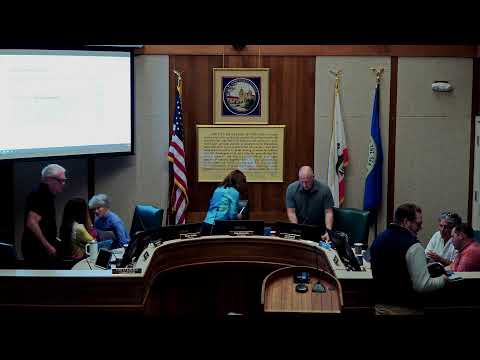
The Forest and Beach Commission of Carmel-by-the-Sea spent much of a July meeting debating changes to the city's tree-damage penalties and enforcement tools, and agreed to pursue an ad hoc committee to develop recommendations for city council.
Commissioners and staff discussed that the municipal code currently sets minimal penalties for construction-related tree damage — "$250 for damage to a tree in the first infraction per tree" and $500 on a second offense — and said those amounts do not deter avoidable loss of mature trees. "The municipal code section 17.48 0.15 b, it it only calls out $250 for damage to retrieve in the first infraction per tree," Justin, a Public Works forestry staff member, told the commission. He outlined several alternatives used in other California cities: flat rates by diameter class, permit deposits or bonds held during construction, and fines tied to property value.
Why this matters: commissioners said rising construction intensity on small lots, combined with high local property values, is increasing the frequency and consequence of tree loss. Justin cited local planning data that building applications climbed from 77 in February 2013 to a peak of 414 in 2016 and said Carmel property price-per-square-foot is unusually high, a factor he said may encourage developers to remove trees to maximize building footprint.
Options discussed
- Diameter-based flat fines: Commissioners reviewed a chart model (used in other jurisdictions) that scales fines by trunk diameter; one example cited was La C—ada Flintridge, where a 36-inch-plus class carried an $18,000 base fine in that city's schedule. Justin presented that approach as a straightforward option to encode in the municipal code.
- Permit deposits/bonds: Justin described a Saratoga model requiring a construction deposit tied to a third-party valuation of protected trees; he said a sample case resulted in about $250,000 of tree valuation and recommended holding a 25'to 100 percent deposit. The money would cover administrative costs and remediation if protected trees are damaged.
- Flat fines plus property-value multiplier: Commissioners also examined a hybrid: a flat baseline fine (for example $10,000) plus an additional percentage of the parcel value (1'to 5 percent) for egregious losses. Justin cautioned this could invite complex valuation disputes at appeal.
Enforcement and scope
Senior Planner Evan Court flagged a procedural issue: the commission and planning department sometimes receive incomplete project plans at different stages. "The code says that Forest and Beach Commission shall hear a project prior to action by the planning commission or consideration," Court said, and urged clearer timing so commissioners see complete project materials before taking a recommendation.
Commissioners raised jurisdictional wrinkles: fines and remedies can differ for damage to city-owned or right-of-way trees versus private-property trees. Staff acknowledged some cases (including an incident involving city trees) produced higher damages or treble damages where trespass occurred; other disputes were resolved through city council appeals.
Subcommittee and next steps
Commissioners repeatedly said the current $250/$500 penalties were clearly insufficient and urged a rapid recommendation to city council while a broader master-plan review continues. Multiple commissioners supported forming an ad hoc policy subcommittee to draft specific ordinance language and return with a recommended approach; public works staff and legal counsel would be asked to participate. The commission did not adopt an ordinance at the meeting but reached consensus to develop firm, defensible proposals for council consideration.
Public comment and community concerns
Maria Sutherland of Friends of Carmel Forest called attention to construction compaction and the need to protect root zones during work. Another public commenter urged stronger enforcement and said past appeals have reduced fines. Commissioners said they also want incentives for good behavior, such as reduced permit fees for proper pruning or replanting requirements.
What the commission recorded as possible near-term actions are: (1) draft code amendments to raise fines and consider a deposit/bond option, (2) coordinate with planning staff on process timing so Forest and Beach reviews occur when plans are complete, and (3) form an ad hoc commission subcommittee with staff to prepare a draft for city council.
Ending
Commissioners said they view changes to tree fines as an urgent item that can and should move forward while the larger forest master plan continues. Staff estimated any immediate code change to replace the $250/$500 fines could be taken to the city council within a few months; a more comprehensive package would take longer to study and would include legal review and community input.