Get Full Government Meeting Transcripts, Videos, & Alerts Forever!
Get email alerts on the Education Budget topic
No spam. Unsubscribe anytime.
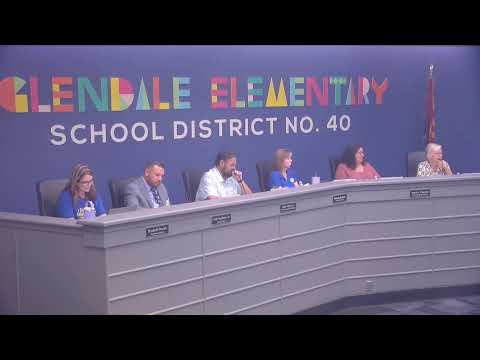
Glendale Elementary District adopts preliminary FY26 expenditure budget as enrollment declines
Summary
The Glendale Elementary District Governing Board approved the district's preliminary expenditure budget for the 2025-26 school year after a public hearing that highlighted declining enrollment, shifted capital funding into maintenance and operations, and ongoing facilities repairs awaiting state approval.
The Glendale Elementary District Governing Board on July 10 approved the district's preliminary expenditure budget for the 2025-26 school year following a public hearing and brief public comment.
The adopted budget keeps the proposed and adopted figures identical because the state had not supplied final work papers; the administration said it will file a revised budget in September once state numbers are available. Assistant Superintendent Mr. Barragan and budget presenter Valerie Caraveo explained the district moved funds normally held for capital into maintenance and operations to maintain continuity of services amid declining enrollment.
Why it matters: district leaders said falling student counts and fixed costs such as special education, staffing, transportation and facilities are widening a gap between revenue and expenditures. The board approved the budget so the district can operate while administrators continue to monitor state and federal funding developments and prepare a revised set of forms in September.
Caraveo, who led the budget presentation, described the proposal as a preliminary set of forms and told the board, “the fiscal year 20 26 budget, the proposed and adopted budget are still on the preliminary forms. The state did not have the past budget in time for us to put them on final forms.” She said a revised budget will be provided in September with updated state numbers.
The administration reported several key numbers and changes included in the budget presentation: the district's revised average daily membership (ADM) for 2024 was 8,173 and the last revised ADM for 2025 was 8,034; the ADM used to calculate the FY26 budget is 7,720 (the slide originally showed a transposition as 7,702). The district's revenue control limit was listed at about $59,800,000. A $5,000,000 budget balance carryforward was shown; the district moved roughly $4,400,000 that would normally sit in capital (DAA) into maintenance and operations for FY26, reducing capital from roughly $14,800,000 in FY25 to about $10,900,000 in the FY26 preliminary figures. Caraveo said these shifts were made "in order to maintain continuity of services."
Caraveo and Barragan also explained estimated tax-rate changes included a 10-cent increase in the primary rate but a net overall reduction of nearly nine cents because other override components and the secondary bond rate declined; because the district did not levy for adjacent ways this year, the administration did not publish a Truth in Taxation notice in the newspaper for that fund.
Board members asked about external pressures on revenue. Barragan said the district was "closely monitoring" federal-level developments and that "if there were any reductions, as we understand it, those would be in this current fiscal year," and staff were meeting weekly to track changes. The board also noted an upcoming January 1 minimum-wage increase that would have an impact on district costs.
Public comment at the hearing included a question about possible school closures. Margo del Rosario, who identified herself as a former district employee, said she had heard rumors that additional schools might close and asked whether that was true. Barragan and other administrators reiterated that the administration was monitoring demographic trends and that potential right-sizing or downsizing options had been discussed at prior meetings and would be evaluated over the coming months. As Barragan said during the meeting, the district would continue to "evaluate and give the board what we believe is the best recommendation under the circumstances that we find ourselves in."
During the discussion of facilities and operations, district staff reported mid-summer work across campuses: concrete floor repairs and polishing at six campuses, exterior painting at at least one site, media center carpet replacement and repairs, replacement of outdated fuel tanks at the support center, and chiller repairs or replacements. Several projects are awaiting approval and funding from the School Facilities Oversight Board; Barragan said some requests have been pending for up to a year.
Board member Jaramillo praised district fiscal staff: "we have world class people that are working on this... I really appreciate the the amount of work that went into it," and thanked the finance team for transparency in a difficult funding environment. Other board members reminded the public about heat safety and noted upcoming calendar items, including the next board meeting on July 24.
The board approved the budget motion by roll call vote. The motion to adopt the expenditure budget for the 2025-26 school year passed with four named board members voting aye and the chair voting aye.
Votes at a glance: The board voted unanimously to adopt the agenda, recessed to hold the public hearing as required by statute, approved the consent agenda, adopted the expenditure budget for the 2025-26 school year as presented, and then reconvened regular session. The expenditure budget motion passed on a roll call with board members Miss Wilson (aye), Miss Pimentel (aye), Miss Bartels (aye), Mr. Jaramillo (aye) and the chair (aye).
Outlook: administrators will produce revised budget documents in September when the state provides final forms and will continue to monitor federal funding actions and the district's declining enrollment before making any recommendations about district size or school consolidations.