Get Full Government Meeting Transcripts, Videos, & Alerts Forever!
Get email alerts on the Portal Project topic
No spam. Unsubscribe anytime.
TJPA says portal cost estimate falls; $713 million funding gap remains
Summary
The Transbay Joint Powers Authority reported a $683 million reduction in its portal capital cost estimate to roughly $7.6 billion, but staff said the project still needs about $713 million in local funding to reach a full funding grant agreement with the Federal Transit Administration.
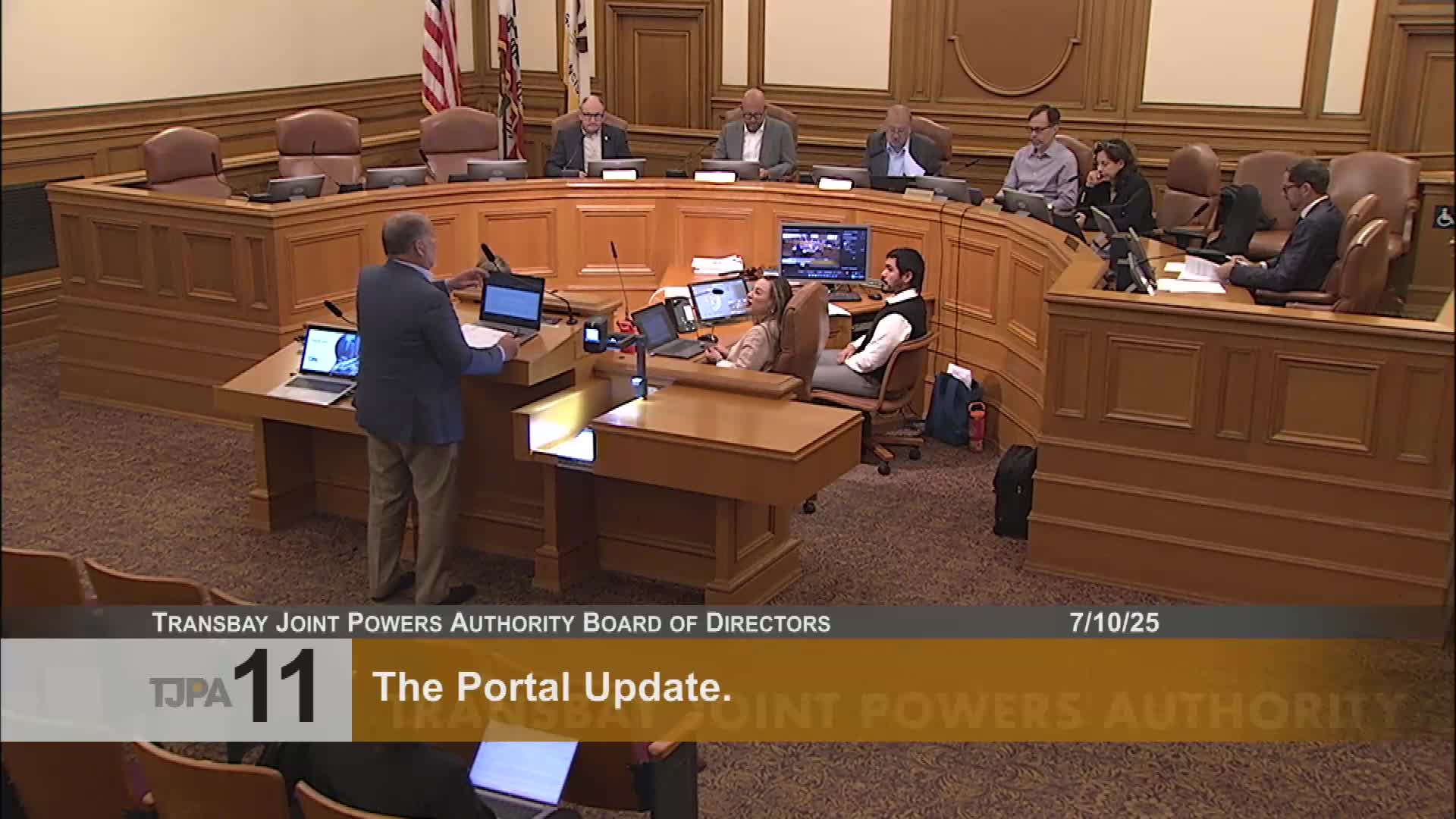
The Transbay Joint Powers Authority reported on July 10 that updated project work and risk analysis reduced its portal capital cost estimate from about $8.3 billion to about $7.6 billion, but the agency still expects to need roughly $713 million in additional local funding to complete its funding plan and request a full funding grant agreement from the Federal Transit Administration.
The portal project director, Alfonso Rodriguez, told the board the reduction — about $683 million — came from several sources, including value engineering, actualized escalation in the early program years, revised real estate valuations and a new quantitative risk assessment that lowered contingency by just over $100 million. "We were able to reduce our overall contingency after running a quantitative risk assessment and looking closely at our risk register," Rodriguez said.
The reduction lowers the amount of local match the authority must identify, but Rodriguez and other staff repeatedly cautioned that schedule risk, inflation and funding timing remain key risks. Rodriguez said the authority is targeting a full funding grant agreement with the FTA that would cover about 41% of the total project cost; securing that federal capital investment grant remains a major milestone for the program.
Why it matters: the portal is a major Bay Area transit infrastructure project that the TJPA and regional partners have prioritized for state and federal capital grants. Adam (Executive Director), speaking in his executive director role, said the board and staff are advancing right-of-way work, real estate acquisitions and utility relocation design to reduce program risk and keep the project shovel-ready. "We are commencing preparatory tasks for our right-of-way program and advancing the first tranche of real estate acquisitions this fall and winter," Adam said.
Staff described a funding plan made up of federal, state and local sources and identified the largest remaining pieces. Rodriguez said the state funding slice that is still needed totals about $1.053 billion in the authority's pie chart; that number includes a $550 million capital contribution that has been included in past California High-Speed Rail Authority business plans but has not been secured. Rodriguez said the agency and its Bay Area partners are seeking reauthorization of cap-and-trade (referred to in testimony and materials as "cap and invest") and multiyear awards as part of the state's budget and potential trailer bill work this summer.
Board members and the executive director told the board that reauthorization of cap-and-trade and the allocation of competitive statewide programs could materially affect the authority's ability to secure the remaining local/state share. Rodriguez and other staff named several specific sources: the Federal Railroad Administration CRISI award (the authority is administering a $24,600,000 CRISI grant announced last year), a proposed capital contribution from the California High-Speed Rail Authority, and competitive programs such as the Transit Intercity Regional Capital Program. The Metropolitan Transportation Commission has endorsed a $500 million competitive award recommendation for the portal in its major project priorities, Rodriguez said, which would help pair the state funds with federal matching grants if those programs receive cap-and-trade proceeds.
Right-of-way actions and schedule: staff described a multi-tranche right-of-way strategy. The first tranche identified five parcels with boundary surveys and environmental site assessments underway and appraisals expected this fall, followed by negotiations this winter. The authority has identified regional bridge toll (RM3) funding for an initial portion of acquisitions and noted action by MTC to allocate $100.7 million of a $325 million bridge toll allocation toward the work.
Design choices: Rodriguez told the board that some scope changes produced cost savings, including removing a high-speed rail stop at Fourth and Townsend and value-engineering other elements. Rodriguez and staff said the train box will still be able to accommodate a double-consist high-speed train set operationally, though in some configurations the last cars may be off the platform and require operational work-arounds. The TJPA Citizens Advisory Committee earlier reported that the train box platform extension had been value-engineered out, and staff said there is space for all but one car to be on the platform under current assumptions and that agreement has been discussed with high-speed rail and the Federal Railroad Administration.
Public comment and stakeholder concerns: two members of the public raised related points. A caller who had attended a California High-Speed Rail Authority meeting said cap-and-trade auction revenues have dropped, and that refinery closures could reduce proceeds further. Mr. Le Brun, a public commenter, urged the authority to reconsider limiting train lengths, arguing the current approach shortens platform length and could halve terminal capacity in the long term. He suggested rethinking the tunnel alignment to potentially reduce cost and restore platform length.
Budget and next steps: Rodriguez said the authority plans to continue advanced design and risk mitigation work and to issue procurement documents, including an upcoming RFP for the heavy civil tunneling contractor anticipated in the late summer/early fall window once outstanding prep work is complete. Staff also said they expect to administer the $24.6 million CRISI award by the October board meeting and continue to pursue state cap-and-trade funding and other local sources to close the remaining gap.
The board asked staff for a concise one-page factsheet to support advocacy with the Bay Area delegation, labor and other stakeholders; staff said they have versions of that material and will distribute updated talking points to members. The authority characterized the portal update as an information item and did not take any formal funding action at the July 10 meeting.