Get Full Government Meeting Transcripts, Videos, & Alerts Forever!
Get email alerts on the Charter Review Process topic
No spam. Unsubscribe anytime.
Miami-Dade charter review task force selects chair, hears ethics and home‑rule briefings and sets schedule
Summary
The newly formed Miami‑Dade Charter Review Task Force elected Dennis Kurbell as chair and Mike Redondo as vice chair, received a presentation on Sunshine, public‑records and ethics rules, heard a public comment about election‑office duties, and agreed on a set of priority topics and a meeting schedule leading to a preliminary report in November.
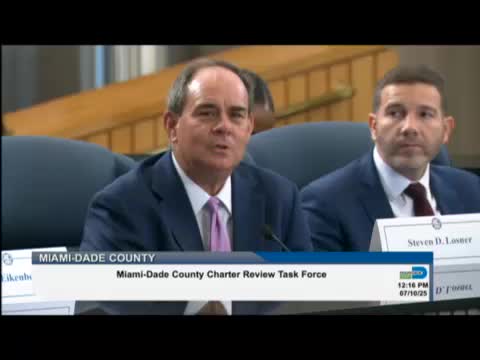
The Miami‑Dade Charter Review Task Force elected Dennis Kurbell as chair and named Mike Redondo vice chair during its first meeting on July 11, 2025, then heard briefings on Sunshine Law, public‑records obligations and the county ethics code and set an initial schedule of topics and deadlines.
The task force, created by a board resolution to review the Miami‑Dade Home Rule Charter following constitutional changes that added elected constitutional officers, will prepare an initial report by Nov. 4, 2025, and a final report timed to allow the county commission to consider proposed charter amendments in spring 2026, staff said.
The work matters because the charter operates like Miami‑Dade County’s local constitution and the task force’s recommendations could lead to ballot questions affecting county structure, elections and how newly elected constitutional officers interact with county government.
At the outset, the group elected Dennis Kurbell, an attorney appointed to the panel, to serve as chair; Kurbell said, “I accept. Thank you.” Members then nominated and approved Mike Redondo, described during the meeting as the speaker‑designate at the Florida House, as vice chair. Both appointments were approved by voice vote with no recorded roll‑call tally in the transcript.
Task force members then heard a detailed ethics and transparency briefing from Etta Kony, associate general counsel for the Miami‑Dade Commission on Ethics and Public Trust. Kony summarized key obligations under Florida and county law for task‑force members, including rules that meetings must be open to the public and that two or more members may not privately discuss board business. “No formal action of a public board shall be binding unless taken at a meeting open to the public,” she told the panel, and she reviewed Sunshine Law limits on private communications, requirements on notice and minutes, and penalties for violations.
Kony also reviewed Florida public‑records law (citing Florida Statutes chapter 119) and county ethics provisions on gifts, exploitation of official position, voting conflicts and lobbying. She told the group that public‑records violations can carry criminal penalties and civil liability and that county ethics sanctions — including fines and disclosure obligations — may apply. She noted gift reporting deadlines for county officials and staff and warned members that private device communications that relate to public business may be public records.
During public comment, Oren Rosenthal, general counsel to the Miami‑Dade Supervisor of Elections, told the task force the charter contains language that conflicts with state rules about candidate qualification. He said the charter currently assigns the task of accepting qualifications for county office to the clerk of the courts, while Florida statute assigns that duty to the supervisor of elections. Rosenthal urged the task force to “work collaboratively with representatives from each of the constitutional offices” to ensure any charter amendments align with the Florida Constitution and statutes.
The panel also received a legal overview of the county’s Home Rule Charter and its unique status under the Florida Constitution. County legal staff explained that Miami‑Dade derives authority from three sources: the Home Rule Amendment in the 1885 constitution (preserved in the 1968 constitution), the charter‑county provisions of the 1968 constitution, and state statutes. The presentation reviewed powers reserved to the county under the Home Rule provisions and noted Amendment 10 (2018) superseded certain earlier charter language.
Staff from the mayor’s office and the county’s communications department described logistical support: a public website to archive materials (miamidade.gov/charter), broadcast and archiving of meetings, and options to solicit public feedback. The task force decided to offer a hybrid participation option when meetings are held, provided a physical quorum is present for votes.
On schedule and scope, members agreed the first meetings should focus on the newly elected constitutional officers and that the task force should also address county governance structure (including districting, term limits and compensation), annexation and incorporation, land use and resilience (including sea‑level rise), and budget and finance issues. The resolution sets the task force’s term to run from June 1, 2025, through May 30, 2026; staff noted the group may provide interim reports if it chooses.
The task force set its next meeting for 10 a.m. on Aug. 1, 2025, at Miami‑Dade’s main library auditorium, and members instructed staff to prepare briefing materials on constitutional officers and comparative county examples. Members also directed staff to prepare a set of technical or “cleanup” revisions to the charter for the panel’s early review. Several members emphasized the importance of public regional meetings later in the process to solicit input across the county.
The meeting closed after procedural items and scheduling; the panel will reconvene to begin substantive hearings on constitutional officers and related governance issues.