Get Full Government Meeting Transcripts, Videos, & Alerts Forever!
Get email alerts on the Planning Commission Plat Approval topic
No spam. Unsubscribe anytime.
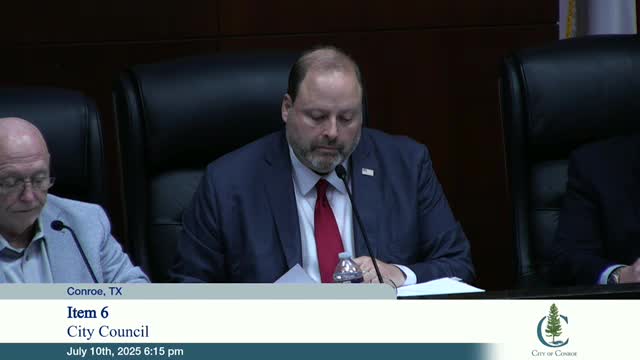
Conroe council narrows role of planning commission in 3-2 vote after public objections
Summary
The Conroe City Council voted 3-2 on July 10 to amend Chapter 94 of the city code, moving some plat approval duties away from the Planning Commission and triggering public criticism about transparency and citizen input.
The Conroe City Council on July 10 approved an ordinance amending Chapter 94 of the city code to change how plats are administered and approved, a move critics called a reduction in public oversight.
The ordinance, described on the agenda as an amendment to Chapter 94, article 2 (administration) and article 3 (approval of plats and platting), passed on a 3-2 roll-call vote after more than an hour of public comment and council discussion about transparency and efficiency.
Why it matters: The Planning Commission has long been a public venue where residents and developers present subdivision plats and staff recommendations. Speakers at the meeting said the proposed change would remove a layer of public review and shift authority to staff-level review, which they warned could reduce notice, accountability and public input on development decisions.
Public commenters pressed the council to keep the commission’s role. Mike Stecker, a local real estate developer, said the commission is “about checks and balances” and urged the council to “show us the problems that have been caused by this process.” John Sellers, who identified himself as speaking for Conroe residents, said the proposal “would fundamentally change how we grow and who gets a voice in that process” and called the item “a step in the wrong direction.”
City staff and council members debated whether the commission’s recent docket justified the change. City staff reported there were only a small number of instances over the past three years in which the Planning Commission’s decision differed from staff recommendations; staff said there were three deferrals in that period that later passed with staff recommendations. Norma McGuire (staff) told the council those figures came from her review and said staff would include pipeline reports in regular memos to the council if the ordinance passed.
Council discussion focused on balancing efficiency and transparency. Some council members described recent Planning Commission meetings as brief and largely approving staff recommendations, while others said the commission served as an important visible check between the public and city government. One council member asked for monthly and quarterly reports from staff outlining what matters were in the pipeline and what had been decided.
The roll-call vote was recorded as 3 in favor and 2 opposed. The ordinance passed and council members said staff would prepare thank-you letters to outgoing Planning Commission members for their service.
What the ordinance does not resolve: Several speakers, including Sellers and Stecker, asked for clearer notice to commission members and the public and for stronger public reporting about what items are pending. City staff said they would provide additional reporting and follow-up materials. The ordinance text as passed and specific administrative procedures to implement it were described on the agenda packet but were not read into the public record at length during the July 10 meeting.
The item began under the action agenda as item 7 and concluded with the roll-call vote; related public comments came during the public comment period and during the item’s discussion.
The council’s action does not itself change other approval paths not covered by Chapter 94, such as separate departmental approvals for certain multifamily or site-specific permits; speakers cautioned not to conflate plat approval authority with other land-use review processes.