Get Full Government Meeting Transcripts, Videos, & Alerts Forever!
Get email alerts on the Digital Preservation topic
No spam. Unsubscribe anytime.
Microsoft account manager demonstrates generative AI tools for Flower Mound historic sites
Summary
Patrick Martin, a Microsoft customer‑success manager and retired U.S. Army lieutenant colonel, showed the Flower Mound Historical Commission how generative AI could be used for artifact interpretation, multilingual access, transcription and docent training, while staff warned the technology must be validated before use in official documents.
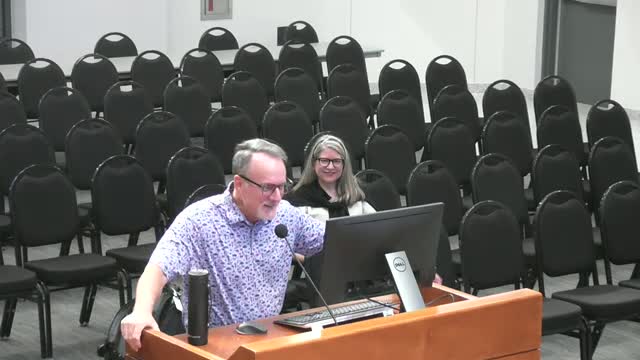
Patrick Martin, a senior customer‑success account manager at Microsoft and a retired U.S. Army lieutenant colonel, told the Flower Mound Historical Commission on a June meeting night that generative AI could expand how the town documents and interprets local history.
Martin outlined practical uses for AI at local sites such as the Gibson Grant House: QR codes beside artifacts that visitors could scan to bring up contextual narratives and images; automated transcription and translation of oral histories; metadata tagging for collections; and AI‑assisted grant writing and social‑media materials. He also demonstrated image analysis and said agents (bots) could be “grounded” with local archival material so researchers could query a single, guided repository.
The commission’s staff and several commissioners said the tools could help with research and public programs but urged caution in how AI is used for authoritative records. Sarah (staff liaison for the commission) said the commission should treat AI primarily as a research assistant, not a substitute for primary‑source verification, and warned against using AI‑generated content for federal or other formal applications without human review.
Martin described several use cases that commissioners could pursue immediately: making short, age‑tailored educational handouts and quizzes for nearby schools; adding multilingual audio or talking‑head content accessible by QR code; creating scripted docent training; and converting older or degraded handwritten records to searchable text. He also showed examples of using an agent to answer visitor questions about local sites and to compile efficient driving routes for historic‑site tours.
Martin stressed that tools differ in safety and guardrails and that outputs must be validated. “It’s Copilot, not autopilot,” he said, summarizing his viewpoint that the technology assists human researchers rather than replacing them.
During Q&A, a commissioner asked about how AI could annotate and cite sources for a Recorded Texas Historic Landmark application. Martin demonstrated that some systems can list sources, but that staff must verify those citations against primary records (deed books, general land office records, county archives). Sarah added the commission is cautious about submitting AI‑authored narratives for official marker applications because some agencies screen for AI‑generated text.
The presentation concluded with commissioners discussing pilot possibilities, including QR codes at the Gibson Grant House and further digitization of oral histories held by Denton County. Martin offered to share his presentation and resources with the commission for follow‑up.
Ending: The commission did not take formal action at the meeting on AI projects but directed staff to consider pilot projects and to return with further recommendations and cost estimates if needed.