Get Full Government Meeting Transcripts, Videos, & Alerts Forever!
Get email alerts on the Landfill Expansion Coffin Butte topic
No spam. Unsubscribe anytime.
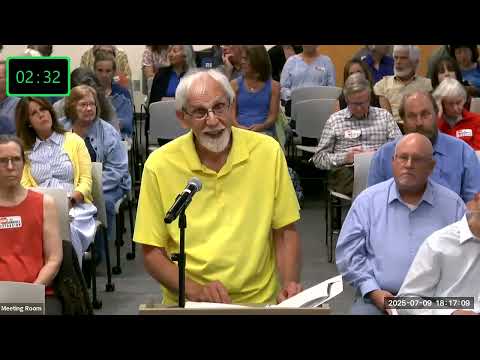
Benton County hearing draws hours of testimony over Coffin Butte landfill expansion
Summary
The Benton County Planning Commission held a continued public hearing July 9 on LU‑24‑027, Republic Services’ request to expand Coffin Butte Landfill, hearing roughly 54–55 signups and hours of technical and personal testimony before leaving the record open for written responses to new evidence and setting deliberations for July 22.
The Benton County Planning Commission heard roughly three hours of new public testimony on July 9 in a continued quasi‑judicial hearing on LU‑24‑027, an application by Republic Services (applicant) and Valley Landfills (property owner) for a conditional use permit to expand Coffin Butte Landfill.
The hearing drew about 54–55 people who had signed up to speak and included technical testimony, personal accounts from nearby residents, and legal and environmental analysis. Commissioners agreed to leave the record open until July 16, 2025 at 4 p.m. for written responses to new evidence submitted at the continued hearings and scheduled commission deliberations for July 22, 2025 at 6 p.m.
Community members and organized groups testified on groundwater and well impacts, PFAS, arsenic, fractured‑rock hydrogeology, methane and odor emissions, noise and blasting, fire risk, litter, truck traffic and visual impacts. Proponents and long‑term residents cited the landfill’s regional role and said local hauling costs and illegal dumping would rise if Coffin Butte closed. Opponents and environmental groups said the record lacks sufficient, independently verifiable data and questioned whether the county or state enforcement mechanisms can reliably prevent or correct harms.
Supporters, including Linda Brewer, a Benton County resident and certified professional soil scientist, argued the landfill provides a regional waste service and urged the county to balance costs if it decides to host the facility. Brewer said, “I expect to see the cost of trash services in Benton County to double or triple when the waste stream currently going into Coffin Butte is hauled out the Columbia Gorge to Arlington.”
Opponents focused on scientific and enforcement gaps. Fractured‑rock hydrogeologist Joel Geier told commissioners “the applicant has provided new arguments on groundwater, but not much in the way of new data,” and recommended further hydrogeologic investigation focused on the potential for blasting and excavation to affect nearby wells. Environmental advocates raised concerns about PFAS and leachate pathways into the Willamette River and local drinking sources.
Speakers cited recent air‑monitoring and satellite analyses to challenge the applicant’s odor and methane modeling. Citizen scientist Ken Eklund presented satellite‑derived methane imagery produced by CarbonMapper and said, “This image plume is not an outlier,” and reported CarbonMapper estimates of roughly 2.4 metric tons per hour from a visible methane plume in April 2025. Others noted the applicant’s odor model uses a 930,000‑ton annual organic input parameter while some permit filings referenced larger intake figures; Mason Levitt of Beyond Toxics said the model input and waste definitions were unclear.
Several speakers and attorneys argued that conditions of approval proposed by staff and the applicant cannot substitute for proof the applicant can meet county criteria now. Jeff Kleinman, counsel for Valley Neighbors for Environmental Quality and Safety, told commissioners that monitoring and conditions alone do not demonstrate feasibility of compliance and questioned whether enforcement mechanisms are likely to prevent recurring impacts.
County and applicant representatives addressed enforcement and compliance questions in rebuttal. Applicant counsel disputed a claim of continuous, historical noncompliance and said the company aims to bring operations into compliance with state and federal regulators. Counsel asked the commission to leave the record open so the applicant could respond in writing to new evidence presented at the continued hearing.
Procedure and next steps: commissioners voted to extend public testimony on July 9 to finish the speakers list. After finding that new written evidence had been submitted at the continued hearings, the commission left the record open until July 16, 2025 at 4 p.m. for written responses limited to that new evidence. The applicant may submit final written argument (not new evidence) by July 22, 2025 at 12:00 noon; the commission will deliberate at a public meeting on July 22 at 6 p.m. No additional public testimony will be taken at deliberations.
The hearing did not include a final decision or a vote on the permit application; commissioners will consider the entire record, the supplemental staff report, and the new submissions before voting at the scheduled deliberations.