Get Full Government Meeting Transcripts, Videos, & Alerts Forever!
Get email alerts on the Budget Dpnr topic
No spam. Unsubscribe anytime.
DPNR presents $146.9M FY2026 budget, seeks $2M in supplemental funding for permits and libraries
Summary
Jean Pierre Oriole, commissioner of the Department of Planning and Natural Resources, told the Legislature’s budget committee on July 10 that DPNR’s recommended fiscal 2026 budget totals $146,949,100 and that the department needs two supplemental appropriations — $575,143 for the permits division and $1,416,159 for libraries — to avoid position cuts and restore territory‑wide library services.
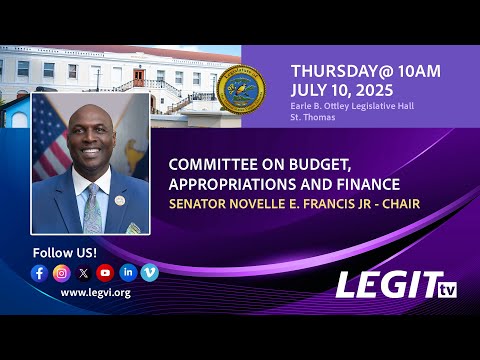
Jean Pierre Oriole, commissioner of the Department of Planning and Natural Resources, told the Committee on Budget, Appropriations and Finance on July 10 that DPNR’s recommended fiscal year 2026 budget totals $146,949,100, composed of $7,009,487 in general fund support, $10,861,427 in non‑appropriated local funds and $129,078,186 in federal grants.
Oriole told the 36th Legislature that roughly $100 million — about 77% of the department’s federal funds — are pass‑through awards for land acquisition and infrastructure that do not support departmental operations. He also outlined two supplemental requests needed to avoid layoffs and reopen library services: $575,143 to support six months of funding for 13 positions in the permits division and $1,416,159 to fund the Division of Libraries, Archives and Museums for a full year. Both are requests to the executive branch and legislature, not approved actions.
Why it matters: DPNR manages permitting, coastal and watershed projects, historic sites, libraries, territorial parks and natural‑resource programs that rely heavily on federal awards. Senators pressed the department on shortfalls that could interrupt services — from building inspections to library reopenings — and on delay risks tied to federal reimbursements and internal vacancies.
Major budget and program details - Personnel and core operating split: The FY2026 general fund request of $7,009,487 is unchanged from FY2025 and is allocated as $4,894,087 for personnel and fringe (61 positions), $238,302 for supplies, $1,271,514 for other services and charges, and $605,584 for utilities. DPNR reported 151 active employees across 12 divisions as of June 30, 2025. - Federal grants: Federal awards total $129,078,186 for FY2026. Oriole said capital outlay under federal grants is budgeted at $29,320,449 and other services and charges at $87,276,800. About $50 million of recent inflows are for water, wastewater and related infrastructure projects to be implemented by WAPA and the Waste Management Authority. - Non‑appropriated local funds: DPNR projects $10,861,427 from fees, fines and rentals. Collections reported as of May 31, 2025 were $3,435,196; total non‑appropriated collections in FY2024 were $8,452,461.
Division initiatives highlighted by Oriole - Comprehensive and Coastal Zone Planning: Advance the comprehensive land and water use plan and propose zoning law amendments (sections 2‑25, 2‑28, 2‑35, 2‑40, 2‑42), provide zoning training and produce a visual user guide for residents and developers. - Coastal Zone Management: Use an approximately $22 million NOAA award to advance priority watershed projects and complete design and implementation phases; pursue permitting enhancements to align earth‑change reviews across divisions. - Environmental Enforcement and Protection: Launch electronic boating registration “ecards,” equip field officers with tablets and digital forms, and transition permitting to the Municity e‑permitting platform; DEP continues to work to remove a federal “high risk” designation that limits reimbursement flexibility. - Fish and Wildlife: Expand facilities and outdoor resilience centers, renovate the Red Hook office, repurpose the former Elena Christian Junior High School as a hatchery, and submit the updated State Wildlife Action Plan electronically to broaden federal funding eligibility. - Libraries, Archives and Museums (DLAM): Anticipate reopening the Doctor Charles W. Turnbull Regional Library and other facilities after FEMA‑funded repairs; DLAM seeks supplemental staffing to restore territory‑wide services and noted the Institute of Museum and Library Services federal office closure in April 2025 affected future federal support. - Territorial parks and protected areas: Advance a comprehensive conservation plan (Act 86‑09 cited by the department), develop management plans for acquired properties and expand public engagement; post planned park maps online at dpnr.vi.gov/parks.
Staffing, allotments and vendor payments - Vacancies and staffing: Oriole said the department has 151 active employees and reported roughly 60 vacancies across divisions; several senators pressed on enforcement officer shortages and the need for on‑the‑job training or cadet programs to sustain patrol capacity. The permits division reported about 20 inspectors and the department estimated a need of about 25 inspectors plus more plan reviewers to handle increasing permit flows. - Allotments and arrears: April Henry, director of business and administration, told senators DPNR has received nine monthly allotments but was missing the tenth, eleventh and twelfth allotments (estimated shortfall ~ $2.1 million); outstanding obligations as of July 2 were $827,994.46. Henry said some invoices stall at the Department of Finance after DPNR approves them. - Supplemental requests: Oriole characterized Supplemental Request #1 ($575,143) as necessary to fund 13 permit positions for six months and Supplemental Request #2 ($1,416,159) to fully staff DLAM; he said without the library supplement, several libraries could remain closed or underused.
Federal grants, reimbursements and DEP high‑risk designation Oriole and staff said DPNR has increased business and administrative capacity to manage federal awards, but they flagged ongoing constraints: DEP remains under a federal “high risk” designation that complicates reimbursement, particularly for salary allocations requiring a time‑accounting “true up.” Oriole said DPNR hired external accounting contractors and increased grant administration staff to reduce reimbursement delays and recover prior draws. Senators repeatedly pressed for clarity on which grants are at risk and how DPNR is handling expiring awards and extensions.
Technology and permitting DPNR said Municity e‑permitting has launched in phases (permits, some divisions live) and plans remain to add Environmental Protection, Fish & Wildlife and SHPO; Oriole and staff said roll‑out delays were driven by staff turnover and the need for division point persons. DPNR plans to add plan‑review automation and a plan‑review tool to improve processing times and accountability.
Libraries and cultural programs Oriole stressed DLAM’s role in early literacy and STEM education; DLAM plans partnerships with NASA for educational programming and expects to modernize exhibits at Fort Christian and Fort Frederick funded in part by FEMA and US EDA grants. The department said federal library support reductions mean local funding or supplemental appropriation is needed to sustain digital subscriptions and outreach programs.
Concerns raised by senators Senators asked about: the 52% general fund spend rate reported in a recent post‑audit, reasons for a projected 23% increase in utilities (partly tied to bringing renovated buildings online), why certain vendor invoices remain pending for months, the status of FEMA‑funded capital projects and the risks from potential federal budget cuts to programs that fund DPNR work. Several senators urged creative hiring strategies (cadet/auxiliary models) to maintain enforcement staffing and asked for clearer breakdowns of which vacancies are federally funded vs. locally funded.
What DPNR called accomplishments Oriole pointed to completed work including adoption of the comprehensive land and water use plan, launch of electronic permitting for some functions, $70 million in conserved/green space funding secured, upgrades to enforcement vessels, $8 million in subrecipient historic disaster recovery agreements executed and ongoing public engagement programs such as Science Saturdays.
Where things stand The presentation was informational: DPNR submitted its FY2026 request and two supplemental requests; neither supplemental was approved during the hearing. Senators signaled bipartisan interest in stabilizing vendor payments, supporting permit and enforcement staffing, and prioritizing library reopenings, while urging DPNR to accelerate federal grant closeouts and reimbursement packages.
Looking ahead Committee members requested follow‑up material including: a breakdown of the 60 vacancies by funding source; the age profile of outstanding vendor obligations; a list of expiring federal awards and extension requests; and specifics on staffing funded by the supplemental requests. Oriole said some project closings (trust/park acquisitions) were expected before Labor Day and pledged continued engagement with the committee on supplementals and grant management.