Get Full Government Meeting Transcripts, Videos, & Alerts Forever!
Get email alerts on the Wildfire Mitigation topic
No spam. Unsubscribe anytime.
Monterey County panel details defensible‑space rules, emergency tree‑clearance path after Palisades fire
Summary
County officials, CAL FIRE and local conservancy representatives briefed residents in Pebble Beach on home‑hardening, defensible‑space standards (0–5/30/100 feet), the governor's emergency clearance proclamation and how land‑use rules and permits apply to hazardous tree removal.
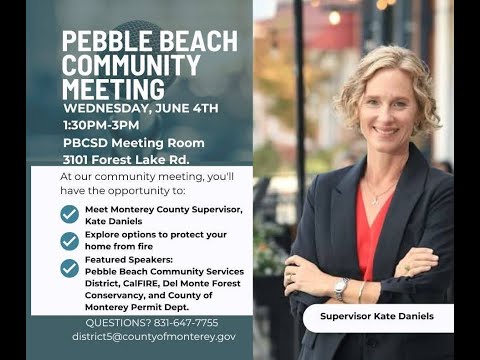
Monterey County Supervisor Kate Daniels convened a public meeting in Pebble Beach to explain how residents can address “problematic trees” and reduce wildfire risk in the Del Monte Forest, and to outline the state and county processes for removing hazardous vegetation.
The discussion assembled local fire officials, foresters and land‑use staff who emphasized layered steps residents can take: home hardening, maintaining defensible space in three zones (0–5 feet, 30 feet and 100 feet from structures), and following county permit pathways or the state's emergency clearance process when appropriate.
Why it matters: the Del Monte Forest is a dense wildland‑urban interface where aging Monterey pines, downed timber from recent storms and close‑proximity development raise the risk that embers or a crown fire could ignite homes. County and state officials said coordination among CAL FIRE, the Del Monte Forest Conservancy, Pebble Beach property stewards and the county allows faster fuel‑reduction work than in jurisdictions with many separate private owners.
CAL FIRE's San Benito‑Monterey unit chief George Nunez described the practical steps that reduce structure loss. “If you clear 0 to 5, and you have that as your fire resistant, you have no fuels,” he said, summarizing research and demonstration footage shown at the meeting. Nunez repeated the three‑band defensible‑space approach used in guidance for structure survivability: an ember‑resistant zone immediately adjacent to the building (0–5 feet), a modification area out to 30 feet, and a wider fuels‑management area out to 100 feet.
Nunez also described operational resources: the unit's aircraft and local engine capacity, and work to keep access roads passable for engines and hand crews. He pointed attendees to state law and implementing guidance, naming Public Resources Code 4291 and sections of Title 14 of the California Code of Regulations as the statutes and regulations that establish defensible‑space obligations and recommended practices for lands where CAL FIRE has responsibility.
Local residents and experts described current fuel‑reduction activity. Mike Nickham, a former general manager of the Pebble Beach Community Services District, reviewed multi‑decade infrastructure and fuel‑reduction investments after the 1987 Morris fire, noting upgrades to water storage and pumps and a rising annual budget for fuel management. “We started at $250,000, then $500,000, then $750,000 — next year I think it's a million dollars,” Nickham said, describing ongoing roadside clearance, goats and masticators used to mimic fire disturbance.
The Del Monte Forest Conservancy and its registered forester Bill Vaughn explained non‑fire treatments used to simulate natural fire cycles where prescribed burning is not used: masticators to reduce brush and selective removal of non‑native species such as French broom and acacia. Vaughn said the conservancy holds fee‑owned open space and easements used to coordinate work across property lines and to support education and habitat protection.
Regulatory paths to remove hazardous trees Craig Spencer, director of Monterey County Housing and Community Development (planning, building and code enforcement), described the county's permitting options for homeowners and when a permit is not required. For established homes, Spencer said the county generally allows removal or limbing of trees that are shown to be hazardous, and that the department will accept professional hazard evaluations. “It is a two‑page hazard rating form. Anything 9 or above, typically we will give… a waiver of a permit,” Spencer said. He added that simple home‑hardening measures — screens on gutters, removing combustible material adjacent to the house — do not require permits.
Separately, the governor's emergency proclamation after the Palisades and Altadena fires created a statewide, expedited pathway for larger fire‑clearance projects. Jeff Froak, a Pebble Beach Community Services District board member and forest ecologist, said two applications in Pebble Beach were approved under the Natural Resources Agency process and that approvals can be completed quickly: “It's a 30 day process maximum, and those 2, took 22 days to approve. And that approval is good for 2 years.” He and other speakers cautioned that the emergency path still requires a site‑specific plan and supervision by qualified personnel and contractors.
How neighborhood disputes and downed timber are handled Residents asked practical questions about private property lines, branches overhanging neighboring houses, and downed trees on trails or fire roads. Spencer and CAL FIRE staff advised homeowners that they may limb branches overhanging their property and that trimming up to about 30% of foliage is generally tolerated without damaging a tree; beyond that, an arborist evaluation is advisable. CAL FIRE battalion staff said they will contact property owners when a tree presents an immediate access or safety hazard, and urged residents to report blocked fire roads or imminent risks.
“If you see something close to a road that could affect our access, please call it in,” a CAL FIRE battalion chief said, describing recent storm response and a countywide effort to clear hundreds of downed trees after high winds.
Other practical notes offered at the meeting - Home‑hardening and ember‑resistant construction make a material difference in survivability; video demonstrated a home with a cleared 0–5 foot ember zone surviving a ground fire that destroyed an otherwise similar house. - Private insurance contractors sometimes operate Type‑6 vehicle units that will perform limited structure protection for subscribing policyholders; CAL FIRE staff said coordination is required so private units do not impede emergency responders. - Replanting recommendations are handled case‑by‑case; county staff said replanting seedlings from native stock is encouraged but may be waived if replanting would create overcrowding.
The meeting closed with county staff offering to provide flyers and online links to the county and CAL FIRE resources discussed at the event. No formal votes or regulatory actions were taken at the meeting; speakers focused on operational guidance, permit pathways and where to seek professional assistance for hazard assessments.