Get Full Government Meeting Transcripts, Videos, & Alerts Forever!
Get email alerts on the Wireless Infrastructure Cell Tower topic
No spam. Unsubscribe anytime.
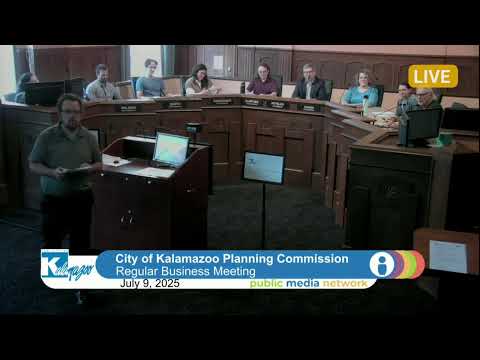
Planning commission approves 150-foot monopole to replace aging tower at 1516 Rockledge Court
Summary
The commission granted a special-use permit for a 150-foot monopole wireless communications tower at 1516 Rockledge Court, accepting a city-planner waiver of several setback and separation standards after staff and the applicant demonstrated network need and engineering containment of the tower's fall zone.
The Kalamazoo City Planning Commission approved a special-use permit to replace an existing lattice communications tower at 1516 Rockledge Court with a 150-foot monopole, accepting staff's recommendation that a city-planner waiver be granted because engineering and network evidence demonstrated a compelling public-coverage need.
Planning staff and the applicant described the site as a long-established, nonconforming communications location whose elevated topography and historical use make it uniquely positioned to fill a gap in wireless coverage across the north-side neighborhoods. Commissioners voted in favor of the permit on a roll-call vote with all members present voting yes.
City staff summarized the application background: the existing lattice tower sits at the northeast corner of a private lot at the end of Rockledge, occupies a compound that has been leased for communications uses for decades, and currently supports a single carrier. The applicant and engineering materials argue the existing structure, built in the early 1970s, lacks the foundation and structural capacity to support modern upgraded equipment and additional carriers. Replacing the lattice with a monopole would allow co-location of multiple carriers and improve coverage where AT&T and other carriers identify a gap.
Staff explained that the zoning ordinance generally prohibits new towers in residential zones and sets separation and setback standards, but that the code contains a city-planner waiver process (section 4.2(w)) for exceptional cases supported by technical evidence. The Zoning Board of Appeals had previously granted a use variance allowing a new tower in this R-zone parcel; tonight's special-use-permit decision considered the waiver(s) and the ordinance's ten criteria for approval. Staff said it had coordinated with public safety, engineering and site-plan review staff and that detailed structural, chemical-containment, landscaping and access issues would be finalized during site-plan review if the special-use permit were approved.
Applicant representative Katie Harms of Diamond Infrastructure told the commission the existing 53-year-old tower cannot support upgraded equipment and must be replaced to allow modern carriers to co-locate: "The foundation there cannot hold any of the equipment that's needed to add to it, as well as adding T-Mobile, Verizon, and any other carriers that wanna be on there." Harms said the monopole would be sited roughly 12 feet from the existing tower footprint, use the same compound and equipment room, and be delivered and assembled in sections as standard practice. She presented an engineer's letter and stamped plans showing the tower's "collapse" or fall zone would remain within the fenced compound.
Staff and the applicant presented propagation maps from AT&T showing improved signal coverage with the new structure and argued the tower serves not only the immediate Rockledge neighborhood but fringe north-side areas including Douglas and Westwood; staff also noted future downtown and institutional construction (larger concrete structures) will further affect coverage demands.
Commissioners asked detailed questions about alternatives and the feasibility of shorter towers; staff and the applicant said a shorter structure or relocation would materially reduce coverage and that the combination of elevation and the site's position made it uniquely valuable for the network. The owner of the lot participated earlier in the zoning process and supported the proposal; staff reported mailed notice generated no adverse public comments.
The commission approved the special-use permit with a roll-call vote in which every commissioner present voted yes (Audette Bauman; Curtis; DeCenzo; Kosheva; Patelco; Smith; Swan; Wilson). Planning staff noted that site-plan review and conventional building-permit inspections must still be completed before construction and operation.
No additional binding conditions beyond standard site-plan requirements were recorded in the motion; staff will issue a formal waiver letter and coordinate site-plan review and any required chemical containment, landscaping, fencing and access improvements.
Commissioners who spoke said the location was not ideal in residential context but reflected unique technical necessity for citywide wireless coverage.