Get Full Government Meeting Transcripts, Videos, & Alerts Forever!
Kalamazoo City Utility Policy Committee adopts amended neighborhood water-extension policy, recommends franchise change and reviews audit and rate study
Summary
The Utility Policy Committee approved revisions to the neighborhood water-extension policy, asked the city to finalize a Galesburg/Comstock franchise amendment that affects some Kalamazoo-served parcels, reviewed an unqualified audit and interim finances, and heard Stantec27s preliminary water cost-of-service work ahead of 2026 rate decisions.
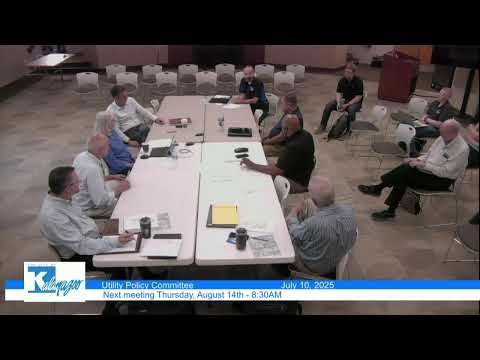
KALAMAZOO, Mich. — At its July 10 Utility Policy Committee meeting, members adopted amendments to the committee27s neighborhood non-emergency existing-development water-extension policy, voted to ask the City of Kalamazoo to pursue a Galesburg North 30 Fifth Street franchise amendment with Comstock Township, reviewed the city27s quarterly financials and audit, and received a preliminary cost-of-service briefing from consultant Stantec ahead of 2026 water-rate work.
The policy change shortens the service-connection cost that an occupied parcel would pay where a neighborhood project builds a service lead to the property line, reducing the customer-side connection charge from $6,000 to $3,000 for that situation; new home construction would still be charged the full $6,000. Committee members also inserted an administrative provision that any township subsidy for private-side connection costs should be paid at the time connection fees are paid, to keep subsidy accounting clear.
Why it matters: the adopted amendment changes how much individual homeowners might owe when neighborhoods gain water service infrastructure and clarifies when external subsidies must be applied. The committee recommended the change to the city for implementation and approved the amendment as modified.
Committee discussion and details Tom (Utility Policy Committee member) explained the subsidy timing change during discussion and said, "if there's any township subsidy, it shall be paid at the time of connection fees are paid." The committee clarified that the $3,000 charge applies when a project has already constructed a service lead to the property line; where no lead exists, for example on new construction, the $6,000 full connection charge would apply.
Members also discussed an apparent discrepancy in the system capacity buy-in figure. Committee materials show a large, recent system-capacity buy-in payment that contributed nearly $400,000 in the period…
Already have an account? Log in
Subscribe to keep reading
Unlock the rest of this article — and every article on Citizen Portal.
- Unlimited articles
- AI-powered breakdowns of topics, speakers, decisions, and budgets
- Instant alerts when your location has a new meeting
- Follow topics and more locations
- 1,000 AI Insights / month, plus AI Chat