Get Full Government Meeting Transcripts, Videos, & Alerts Forever!
Get email alerts on the Brown Act Open Meetings topic
No spam. Unsubscribe anytime.
Lake County counsel reviews Brown Act rules, teleconferencing limits and public-comment procedures
Summary
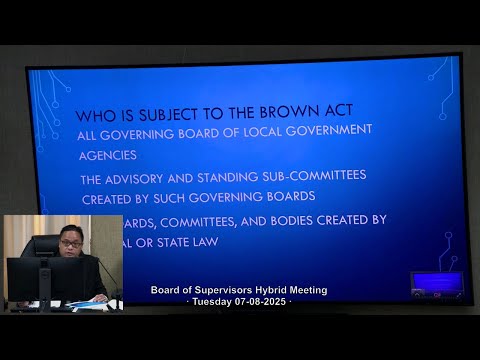
County Counsel Lloyd Gintivano told the Lake County Board of Supervisors that the Brown Act exists to keep meetings open and accessible to the public and reviewed key statutes and procedural rules that govern board business.
County Counsel Lloyd Gintivano told the Lake County Board of Supervisors that the Brown Act exists to keep meetings open and accessible to the public and reviewed key statutes and procedural rules that govern board business.
The presentation summarized the Brown Act (Government Code sections 54950–54963), explained what constitutes a “meeting,” outlined agenda and noticing timelines, described teleconferencing rules under AB 361 and AB 2449, reviewed closed-session categories and penalties for violations, and answered supervisors' and members of the public's questions.
County Counsel Lloyd Gintivano said the law’s “default purpose . . . is to keep as much as possible all meetings to be open in public, and all persons shall be permitted to attend any meeting of the legislative body of a local agency.” He told the board the presentation and slides are available on the county’s Granicus site for reference.
Gintivano summarized how the Brown Act defines a meeting as the presence of a majority of a legislative body acting to “hear, discuss, or deliberate” government business; for the board, that means three of five supervisors. He noted exceptions such as conferences, trainings or social occasions but warned those exceptions do not apply if a majority discusses matters within the board’s purview.
The presentation covered noticing timelines: 72 hours for regular meetings, 24 hours for special meetings and one hour for emergency meetings, and said agendas must briefly describe every item so the public can determine whether to participate.
Gintivano reviewed teleconferencing guidance. He described two teleconferencing regimes referenced in the presentation: relief under AB 361 and the rules under AB 2449. On AB 2449, he said at least a quorum of members must participate in person (for a five-member body, at least three in person) when another member appears remotely; remote participation is allowed for “just cause” (childcare, contagious illness, disability, travel on official business) or emergency circumstances, subject to limits on frequency and duration. He said the office will update the board if the Legislature modifies those rules.
Supervisor Sabatier pressed the point that ultimate liability for Brown Act compliance rests with the supervisors rather than staff. Sabatier said the board “cannot go after a staff member for violating the Brown Act” and urged refresher education for board members and department heads to avoid inadvertent polling or disclosures of other members’ views.
A member of the public, Tom Lasik, asked the board to recheck whether a recently formed drought/water-shortage task force was correctly designated. Lasik said the March 25 item called the group a “standing ad hoc committee” and noted a legal difference: “A standing committee requires Brown Act, and an ad hoc committee does not.” Gintivano said his office would look into that specific example.
The presentation also reviewed closed-session categories that permit confidentiality (personnel matters, labor negotiations, pending litigation, real property negotiations and security of public facilities), and noted that statute-prescribed language should be used when agendizing closed-session items. Gintivano summarized potential consequences of Brown Act violations, including invalidation of actions, civil liability, payment of challengers’ attorney fees and potential misdemeanor criminal exposure.
Gintivano described a recently enacted state measure (Senate Bill 1100) that permits the presiding officer to remove a disruptive individual from a meeting after a warning and outlined the statute’s definition of “disruption.”
The presentation and subsequent discussion produced two immediate follow-ups: Gintivano's office will provide any legislative updates affecting teleconferencing permissions, and staff will review the drought task-force classification Lasik raised. No formal board action or votes were taken on the presentation itself.