Get Full Government Meeting Transcripts, Videos, & Alerts Forever!
Get email alerts on the Mental Health Behavioral Health topic
No spam. Unsubscribe anytime.
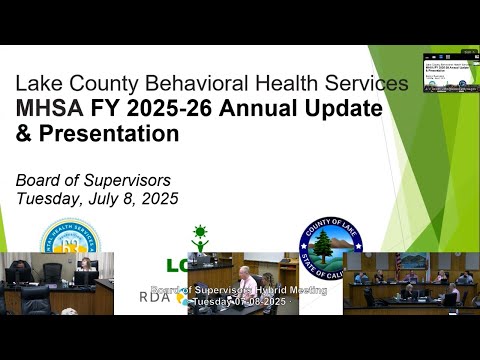
Lake County Board adopts FY 2025–26 Mental Health Services Act update, approves plan modifications
Summary
The Lake County Board of Supervisors accepted a presentation on the county's Mental Health Services Act programs, approved minor modifications to the current three-year plan and adopted a resolution formalizing the fiscal year 2025–26 update amid discussion of data gaps and state changes under the Behavioral Health Services Act.
The Lake County Board of Supervisors on an unanimous 5-0 vote accepted a presentation on the county's Mental Health Services Act (MHSA) programs, approved modifications to the current three-year plan and adopted a resolution formally approving the fiscal year 2025–26 update to the Lake County MHSA program and expenditure plan.
Scott Abbott, program manager for Mental Health Services Act and housing for Lake County Behavioral Health Services, told the board that MHSA — established by voter-approved Proposition 63 — is funded by a 1% tax on incomes above $1,000,000 and is distributed to counties by population. Abbott said 76% of MHSA funding is intended for community services and supports (CSS), roughly half of which typically funds Full Service Partnership (FSP) programs for people at risk of incarceration, institutionalization or homelessness. He said prevention and early intervention (PEI) accounts for about 19% and innovation for about 5% of the allocation; workforce, training and capital needs can be funded by diverting up to 20% of CSS dollars.
The presentation included program data and a community planning summary. Abbott said the county's community assessment included a 49-response survey and two public meetings in January and March. Responses, he said, were mixed on whether Lake County Behavioral Health meets community needs: respondents viewed peer support centers favorably but reported that prevention and early intervention services were less visible. Abbott said survey respondents and meeting participants identified gaps in suicide prevention, substance-use follow-up, services for mild-to-moderate needs, and outreach to young children, teens, older adults, people experiencing homelessness and historically marginalized groups including Native American and LGBTQ residents.
Board discussion focused on data completeness and access. Supervisor Sabatier questioned the large share of clients with unknown or unreported race/ethnicity in the county's records and asked for stronger measures to reduce that category; Supervisor Pfeiffer noted the limits of self-reported data and said creating more welcoming environments could encourage reporting. Abbott acknowledged the gap and said the department intends to improve data capture, including better use of existing tools and dashboards tied to the county's electronic health record.
Abbott described outcomes from the county's FSP program, saying it increased the number of participants living in traditional residential settings, reduced emergency-room visits and reduced arrests for the cohort described in the slides (from three to zero in the presented period). He also outlined budget mechanics: MHSA revenue is volatile because it depends on statewide taxable income, Lake County receives a small share of statewide MHSA revenue (Abbott said "about 0.18%"), and the program benefits from a five-year expenditure window that allows carryover.
The presentation previewed changes under the Behavioral Health Services Act (BHSA), a change Abbott tied to last year's Proposition 1. He said BHSA renames MHSA to include substance-use services, revises distribution priorities to allocate a substantial portion for housing interventions, and establishes expanded oversight and requirements for an integrated mental health and substance-use plan. Abbott noted that counties with populations under 200,000 can apply for an exemption from the immediate 30% housing set-aside, a provision Lake County will consider during the next planning cycle.
Supervisor Sherrill moved to accept the presentation and approve modifications to the MHSA annual update plan for fiscal year 2025–26; the motion was seconded and passed 5–0. Sherrill then offered a resolution adopting the fiscal year 2025–26 update to the three-year Lake County MHSA program and expenditure plan; the board voted aye in roll call for Supervisors Owen, Sabatier, Esnason, Steph and Crandall.
The board asked staff to provide the full slide set used in the presentation and signaled that the department will return with further discussion and planning around implementation of BHSA-related changes in the next planning cycle.