Get Full Government Meeting Transcripts, Videos, & Alerts Forever!
Get email alerts on the Community Choice Aggregation topic
No spam. Unsubscribe anytime.
Sonoma Clean Power presents feasibility study for Lake County expansion; supervisors ask for legal review and public outreach
Summary
Sonoma Clean Power (SCP) presented an updated feasibility study to the Lake County Board of Supervisors on a possible expansion of SCP service to unincorporated Lake County and the cities of Clearlake and Lakeport.
Sonoma Clean Power (SCP) presented an updated feasibility study to the Lake County Board of Supervisors on a possible expansion of SCP service to unincorporated Lake County and the cities of Clearlake and Lakeport. SCP staff said their analysis shows “total bill savings for customers under most market conditions,” but warned those savings cannot be guaranteed because of frequent regulatory changes and energy-market volatility.
The feasibility study and presentation laid out how a CCA works, potential local benefits including investment in geothermal and other local renewable resources, outreach and enrollment procedures, and risks the board should weigh before deciding whether to accept an offer of service. Ben Rickelman, Deputy County Administrative Officer, introduced the item and noted the county’s predecessor board adopted Ordinance 3,026 on June 23, 2015, authorizing the county to consider Community Choice Aggregation.
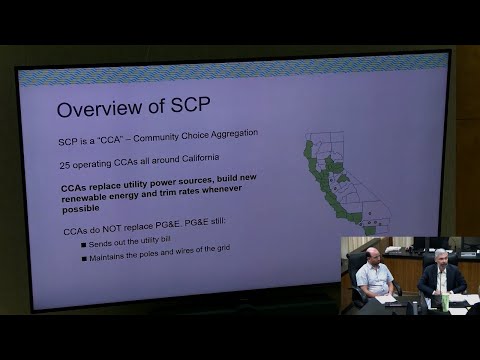
Jeff Cyphers, representing Sonoma Clean Power, and Ryan Tracy, SCP director of planning and analytics, described SCP’s model, governance and fiscal safeguards. Cyphers said SCP runs generation and contracts for power while PG&E continues to operate and maintain distribution and billing. He noted SCP is organized as a joint powers authority with 11 board directors and a staff of about 55. Cyphers said SCP’s board voted in June to begin a 60‑day review process and intends to consider extending a formal offer to Lake County at its August board meeting.
SCP staff summarized customer experience and timelines: if Lake County accepts an offer and the parties complete the required filings, SCP said outreach and enrollment work would start next year and service could begin in May 2027 at the earliest under current CPUC timelines. SCP said each customer would receive five mailed notices over a five‑month enrollment window and that customers who opt out during that window would not pay an opt‑out fee; after the enrollment window, SCP said residential opt‑outs would incur a $5 administrative fee and commercial opt‑outs a $20 fee.
SCP also described a local, optional premium product called Evergreen, which the presentation said provides “100% local, 24‑hour renewables” and would add roughly $13 per household per month. Cyphers emphasized SCP’s historical performance: SCP has produced bill savings in roughly 80% of years in its current territory, with the largest recent savings around 7% in 2024, but stressed that savings vary year to year and are affected by CPUC decisions and PG&E fees.
Supervisors and staff focused questions on several risks and implementation details: the long‑term nature of power‑supply contracts (often 10–20 years), exposure that could arise if a future board sought to force all county customers out of SCP while long contracts remained in place, SCP’s financial reserves (Cyphers said SCP expects roughly $100 million in rate‑stabilization reserves by year‑end), and how SCP would serve Lake County’s comparatively winter‑heavy load. Ryan Tracy said SCP currently has an excess of required long‑term renewable contract capacity and can absorb Lake County’s load without immediately procuring additional long‑term capacity, although spot market purchases would be needed to meet real‑time demand.
Multiple supervisors asked that county counsel and SCP counsel meet for a formal council‑to‑council review of legal and financial risks before any binding action. Supervisors also pressed for robust local outreach: SCP said it would run town halls, community events and targeted communications and that staff had already prepared flyers and planned presentations to both incorporated cities. Amanda Martin, CEO of the Lake County Chamber of Commerce, told the board the chamber is willing to help organize town halls and noted Lake County’s geography requires tailored outreach.
Public commenters were split. Tom Lasik, who said he is “on the fence,” urged separating the question of creating the customer choice option from the county’s involvement in SCP’s GeoZone geothermal planning, arguing that coupling the topics could reduce public support. Bill Wilson asked for clarification about SCP’s “reserves”; Cyphers replied, “When I speak of reserves, I’m speaking of financial reserves.”
No Lake County Board vote was taken at the meeting. Supervisors directed staff to start a detailed risk analysis and to coordinate counsel‑to‑counsel discussions with SCP. SCP reiterated its board’s intent to consider a formal offer in August; if an offer is extended and the county later adopts the required local ordinance and resolution, SCP said it would file an updated plan with the California Public Utilities Commission (CPUC) and then proceed with the statutorily required enrollment and notice process.
Why it matters: Joining a CCA would make SCP the default generation provider for all customers in the designated territory (residents and businesses would be automatically enrolled and could opt out), and it could change how and where new local renewable resources are developed. Supervisors signaled interest in further study and public engagement but did not commit to joining SCP at this meeting.
Provenance: Sonoma Clean Power presented the feasibility study during agenda item 6.7; SCP staff and county supervisors discussed timeline, scope, outreach and legal review throughout the item.