Get Full Government Meeting Transcripts, Videos, & Alerts Forever!
Get email alerts on the Cannabis Regulation topic
No spam. Unsubscribe anytime.
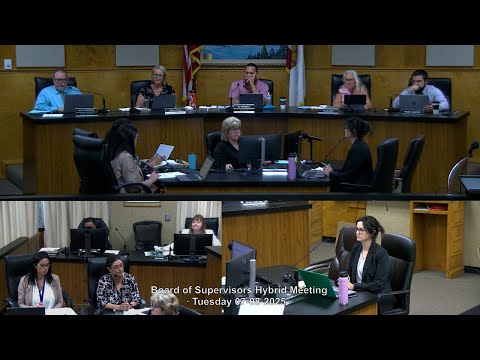
Lake County supervisors direct staff to draft updated cannabis ordinance, emphasize water and odor controls
Summary
At a public meeting on item 6.9, Lake County supervisors heard a staff summary of cannabis policy recommendations and directed staff to draft a revised land‑use ordinance that emphasizes hydrology standards, odor mitigation, setbacks and alignment with state rules; the board requested the draft return for review later this year.
The Lake County Board of Supervisors reviewed a summary of recommended updates to the county’s cannabis land‑use rules and instructed staff to begin drafting a revised ordinance that prioritizes water‑use analysis, stronger odor controls and better alignment with state regulations.
Community Development Director Maria Turner presented the report, saying the recommendations come from two recent cannabis ordinance task force meetings and comments from the Planning Commission and the public. “We will bring back a vetted draft ordinance for you by the end of this calendar year,” Turner told the board.
Turner and staff recommended a set of technical and process changes: require hydrology studies for projects that propose surface or groundwater use; standardize canopy measurement to match recent state methodology; add a voluntary surrender procedure so a permittee may terminate a use permit; synchronize ownership‑identification requirements with state licensing to help the treasurer’s office; consider setbacks between hemp and cannabis canopy; and consider whether revocation recommendations should go directly to the Board of Supervisors rather than begin with the Planning Commission. The staff report noted the state requires a $5,000 site‑reclamation bond and the task force was amenable to including the same minimum in county rules; the Planning Commission later recommended the county consider a higher bond (the commission cited $50,000).
The report also described permit processing workload: staff said there are 65 pending cannabis applications, of which about 30 are considered complete; once a project is deemed complete the Permit Streamlining Act requires roughly 180 days for analysis before it is presented to a deciding body, Turner said.
Supervisors and the public focused much of the discussion on water and odor. Supervisor Paiska pressed staff on hydrology standards and on improving the consistency and public readability of hydrology reports; Turner said the department plans to require hydrology studies for projects using groundwater or surface water and to standardize units and content so the public and reviewers can more easily interpret results. “We have continued to require hydrology studies for use permits that do not propose use of municipal water sources,” Turner said.
Residents and agricultural stakeholders urged stronger setbacks and enforcement. Bill Wilson, a resident, urged larger setbacks to reduce odor impacts and said a thousand feet “would give most protection” in typical wind conditions. Several speakers representing farms, the Lake County Farm Bureau and the Lake County Cannabis Association argued that overly broad new exclusions — for example an expansion of the farmland protection zone or listing homeschools in setback protections — would eliminate permitted farms and harm the local economy. Reading a letter on behalf of the Lake County Cannabis Association, Andrew Dobbs Kramer said local cannabis tax revenue “a $3,400,000 contribution last year alone.”
Planning staff summarized the Planning Commission’s June 12 input: the commission recommended requiring anchor points instead of full concrete slabs for greenhouses when appropriate; stronger odor‑mitigation options; reconsidering farmland protection zone boundaries (including additions in Supervisorial District 1 near Middletown); and reviewing whether revocation recommendations should go straight to the board. Senior planner Mary Claybond said the California Department of Food and Agriculture (CDFA) told staff that “premises means a separate area, not a separate property,” and that CDFA requires hemp premise delineation (signage/fencing) rather than parcel exclusions.
Board members gave staff several direction points rather than adopting new rules on the spot. Multiple supervisors expressed interest in increasing the minimum setback from off‑site residences above the existing 200 feet; Supervisor Sabatier suggested a 500‑foot guideline as a starting point, saying “I would like to see it at least, at around the 500 mark.” Other supervisors said they wanted work on a cap for maximum canopy per operation, changes to the revocation/appeals process, clearer treatment of developed versus undeveloped public lands for setback purposes, and stronger hydrology requirements and annual compliance monitoring.
Speakers on different sides urged different tradeoffs: residents and public‑health advocates asked for larger setbacks and stronger enforcement of odor and water violations; many farmers, industry representatives and farm advocates asked the board not to add new, large exclusion zones and to grandfather existing, compliant operations. Several commenters requested that existing licensed farms be explicitly recognized as legal nonconforming uses under any updated ordinance.
Turner noted county practice includes annual compliance site visits for cannabis permits and that complaints accompanied by photos and specifics help enforcement and follow‑up. The board did not adopt new ordinance language during the meeting; instead members gave clear policy direction to staff on the topics above and asked for a draft ordinance to return for review.
The county’s next steps, as stated by staff, are to draft ordinance language reflecting the task force and Planning Commission recommendations, coordinate internal and stakeholder review (including the Agricultural Advisory Committee), and schedule the draft for public hearings at the Planning Commission and then the Board of Supervisors.
For now the board left standing several specific staff recommendations to be resolved in drafting: the county’s alignment with state canopy calculation methods; the voluntary surrender mechanism for use permits; the question of a site‑reclamation bond (state minimum $5,000 vs. commission proposal of $50,000); how to treat hemp premises vs. parcels; whether revocation recommendations should go directly to the board; and the size of any increased setbacks and maximum canopy limits. The board also asked staff to return with clarified, written language and exhibits for definitions the public found ambiguous, such as “public lands” and the treatment of homeschools.