Get Full Government Meeting Transcripts, Videos, & Alerts Forever!
Get email alerts on the Cannabis Regulation topic
No spam. Unsubscribe anytime.
Lake County supervisors review package of cannabis policy recommendations; staff to draft ordinance
Summary
After a series of task-force and planning commission meetings, staff summarized recommendations on hours, setbacks, water studies, bonds and other regulations and asked the Board of Supervisors for final input before drafting a new cannabis ordinance.
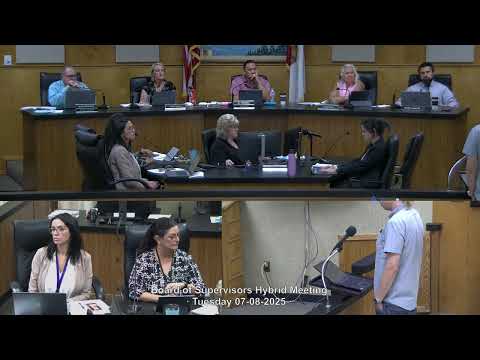
Community Development Director Maria Turner told the Board of Supervisors on the cannabis ordinance update that staff will compile the task force and Planning Commission recommendations and begin drafting a proposed county ordinance, with a goal to return a vetted draft to the board by the end of the calendar year.
The update summarized recommendations from two recent cannabis ordinance task force meetings and Planning Commission input on operational hours and delivery windows, voluntary termination of use permits, hydrology requirements, canopy measurement alignment with state rules, setbacks between hemp and cannabis, and possible changes to site-reclamation bond levels.
Turner said the task force generally favored aligning local rules with state regulations where possible, including records retention and business operational hours, and recommended limiting scheduled deliveries to daytime hours. “The goal for today’s meeting … is that the board wanted us to come back to you with all of the recommendations, so that you could have your final input before we start writing the draft ordinance,” Turner said.
Staff recommended adding a voluntary surrender process so a cannabis use permit could be canceled before expiration; currently the county’s use permits “go with the land” unless revoked or they expire (cannabis use permits were noted as having a 10-year term). The department also proposed syncing the county’s ownership identification requirements with the state application to help the Treasurer–Tax Collector identify the responsible licensee for tax purposes.
On water and hydrology, Turner told the board that the county had required hydrology studies for use permits during a prior drought emergency and has continued to require them for projects proposing groundwater or surface-water use. Staff said they plan to refine guidance so applicants’ reports use standardized units and formats to make technical review and public digestion easier. Turner noted the department will continue to require hydrology studies when municipal water is not used.
Several supervisors and members of the public emphasized water security as a top concern. Supervisor Sabati reiterated that bringing in water trucks outside narrow emergency definitions is illegal under current county rules and warned of impacts on neighboring wells. Public commenters and Supervisors pressed for hydrology studies that reflect dry-season conditions rather than tests taken in wet months.
The task force discussed canopy measurement changes at the state level and recommended the county align its canopy-calculation method with the state to avoid conflicts where operators meet one metric but not the other. Staff also raised revocation for off-site unpermitted activity as a potential ground for permit revocation and asked whether recommendations for revocation should go directly to the Board rather than first to the Planning Commission; staff said current practice typically starts at the Planning Commission, with appeals to the Board.
Planning Commission recommendations reported by staff included preferring anchored greenhouses rather than full concrete slabs unless site conditions require a slab, stronger odor-mitigation measures for nearby residences, revisiting farmland protection zone boundaries (noting particular interest in additions within Supervisorial District 1 around Middletown), and consideration of a larger site-reclamation bond (the commission cited a $50,000 bond versus the $5,000 state-level bond).
Staff reported there are 65 pending cannabis applications in the county, of which 30 are deemed complete; Turner reminded the board that under CEQA and the Permit Streamlining Act the county generally has 180 days after an application is deemed complete to process the project and present it to a deciding body.
Public comment covered setbacks and odor. Two commenters urged a 1,000-foot setback from occupancies (including schools and homeschools) to reduce odor impacts; Bill Wilson cited plume studies and urged larger setbacks for outdoor grows, while industry representation (reading a letter from the LCCA) urged the board to retain current setback standards, opposed adding homeschools to setback lists, and opposed raising the reclamation bond to $50,000 as an undue burden on small and mid-sized growers. "A thousand foot setback ... would give most protection about odors traveling in ... normal days," Bill Wilson said. Industry representatives warned that larger exclusion zones and added fees would discourage licensed businesses and favor unlicensed operations.
Senior Planner Mary Claybond told the board that the California Department of Food and Agriculture (CDFA) told staff that “premises” is defined as a separate area rather than a separate property, and that at the state level hemp and cannabis can be on the same parcel if the premises are delineated with signage and fencing; staff said the county may still propose local setbacks if the board prefers additional delineation.
Turner asked for board direction and input on the compiled recommendations; she said staff will begin drafting an ordinance after this meeting and that the draft will go through internal and stakeholder review, the Agricultural Advisory Committee, and noticed Planning Commission and Board hearings before final action. The board did not take a formal vote on policy changes during the meeting.
The update included several items for the board’s input and further staff work: refining hydrology-report requirements (including season/time-of-year considerations), deciding whether to require setbacks between hemp and cannabis or between hemp and residences, whether revocation recommendations should come directly to the Board, and whether to pursue a higher site-reclamation bond. Staff also noted technical inconsistencies in memos about delivery hours and will clarify the recommended delivery window in the draft ordinance.
Local officials and members of the public asked that the new ordinance address recurring enforcement gaps—annual-report review, enforcement of conditions of approval, and timeliness of odor complaint responses—rather than only changing land-use rules. Several public speakers recommended developing a comprehensive county cannabis policy to guide ordinance language and enforcement rather than producing piecemeal rule changes.
The board provided input during the discussion but did not adopt any ordinance language at the meeting; staff will return with a drafted ordinance for public and stakeholder review later in the year.