Get Full Government Meeting Transcripts, Videos, & Alerts Forever!
Get email alerts on the Fence Variance topic
No spam. Unsubscribe anytime.
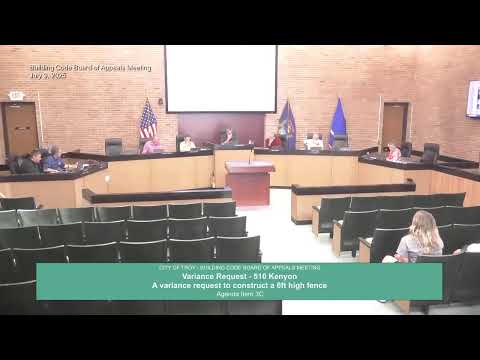
Board approves split vote to allow modified fence at 510 Kenya with sight-line condition
Summary
By a 3-2 vote the Troy City Board of Appeals granted a variance for multiple fence sections at 510 Kenya, requiring an 8-foot diagonal sight-line and a minimum 1-foot offset from the sidewalk; staff and the petitioner described much of the work as replacing existing fence sections damaged by a fallen tree.
The Troy City Board of Appeals on June 4 granted, by a 3-2 vote, a variance for fence work at 510 Kenya that will allow replacement and reconfiguration of existing fence sections, subject to an 8-foot diagonal sight-line along a driveway approach and a minimum 1-foot offset from the sidewalk.
Dominic (city staff) told the board the lot is a corner parcel in the R-1E zoning district, where the front-yard setback is 25 feet and the ordinance normally limits front-yard fence height to 30 inches (or up to 48 inches if non-obscuring in certain rear-yard relationships). The petitioner sought two distinct fence profiles: "Section A" — a proposed 6-foot-high wood privacy fence totaling about 58.5 linear feet in the Kenya-designated front yard (29 ft + 24 ft + 5.5 ft) — and "Section B" — a 4-foot-high wood privacy section of about 32 feet. Dominic said the total proposed fence length was about 127.5 feet, with 37 feet complying with the ordinance.
Kimberly Fence representative Gordy Muskelly explained that an earlier storm toppled a large tree and damaged an existing fence; the contractor said panels remain on site and that replacing the fence as proposed is largely a restoration and cleanup of the yard. Gordy said the tree stump is substantial and removing it would be costly, which affected the location of the replacement sections. He described construction methods (driven steel posts and cover boards) and confirmed the plan would not include re-installing a gate across the driveway because of the stump and post stability concerns.
Board members focused on sight lines where the driveway meets the sidewalk and how a replacement could affect pedestrian/vehicle visibility. The petitioner provided measurements indicating the closest distance from the driveway to the proposed fence corner was about 12.5 feet, and another small section would be 14.5 feet from the driveway approach. Board members discussed using an 8-foot by 8-foot (or 10-by-10) vision triangle or removing a corner panel to improve sight lines; the petitioner’s representative offered to accommodate a vision-triangle approach. Several members observed that much of the fence is replacement of a prior installation and that if the board denied relief the owner could attempt to replace the fence as it existed.
A motion to grant the request with the safety caveats — an 8-foot diagonal sight-line at the driveway approach and a minimum 1-foot offset from the sidewalk — passed on a 3-2 roll call (Mister Abathira, Miss Brooks and Mister Dezerman in favor; Mister Friesen and Mister Nastasi opposed). The board’s action included language finding exceptional property characteristics that make strict compliance substantially more difficult. Staff will process permits consistent with the sight-line requirement and confirm final placement with the petitioner.