Get Full Government Meeting Transcripts, Videos, & Alerts Forever!
Get email alerts on the Stormwater Variance Driveway topic
No spam. Unsubscribe anytime.
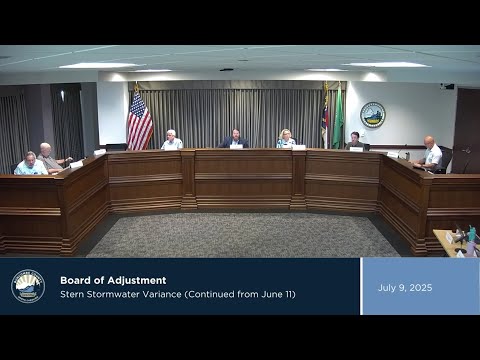
Buncombe Board of Adjustment approves variance for Stern driveway into vegetated stream setback with stormwater conditions
Summary
The Buncombe County Board of Adjustment approved a variance allowing construction of a driveway that encroaches into a vegetated stream setback on Tax Lot 0607‑71‑9996, subject to stormwater-treatment conditions and remediation of outstanding erosion-control violations.
The Buncombe County Board of Adjustment voted to grant a variance allowing a driveway that encroaches into a vegetated stream setback on Tax Lot 0607‑71‑9996, subject to three staff‑approved conditions and remediation of outstanding erosion‑control violations. The board voted in favor after hearing technical testimony, public concern about stormwater and slope stability, and discussion among staff, the applicant and neighbors.
The variance was approved with three conditions: minimize direct discharge of untreated stormwater runoff within the vegetated setback to the maximum extent practicable as determined by the county stormwater administrator; provide water‑quality treatment of stormwater from built‑upon area within the vegetated setback to meet high‑density water‑quality standards to the maximum extent practicable as determined by the stormwater administrator; and withhold issuance of any stormwater permit until all erosion‑control violations identified by county staff are remedied.
Neighbors and several residents told the board they feared increased runoff and slope instability if the project proceeded. “I don't want my property to be bare rock,” said Gina Miceli, a homeowner who said she lives downstream of the site and described property damage the community suffered during Hurricane/Helen‑era storm events. Dorothy Styles, who said she has lived near similar slopes for decades, told the board that “the more impervious surface and land disturbance on the slopes, the more water comes down and the more destruction is visited on the people and property below.” Ginger Horton also described observed sinkholes and instability in the aftermath of recent storms.
The applicant presented engineering testimony describing the proposed access and an alternative alignment across an adjoining parcel that would require a longer, steeper road. County‑qualified engineer Wyatt Edsall described a conceptual alternate route offered by the adjoining landowner: a roughly 1,100‑foot road that rises about 230 vertical feet and reaches centerline slopes approaching 30 percent in the concept as drawn. By contrast, the applicant's current proposed roadway profile shown in the record measures roughly 1,350 linear feet and was described in testimony as not exceeding a 17 percent centerline grade. Edsall emphasized the schematic nature of his alternate alignment and that slopes and disturbance could be reduced by lengthening the road at the cost of greater limits of disturbance.
Staff explained the limits of standard water‑quality measures on steep roadbeds and said many traditional high‑density stormwater control measures are not readily feasible in compacted road sections. County staff recommended a two‑part condition: (1) minimize direct discharge into the vegetated setback from built‑upon areas to the maximum extent practicable, and (2) implement high‑density water‑quality treatment within the vegetated setback to the maximum extent practicable, with the county stormwater administrator to determine practicability in consultation with the project's engineer. Staff gave examples of feasible treatments they would evaluate, such as permanent check dams in ditches, outlet protection, and pipe storage or other proprietary systems where feasible.
Board members and staff repeatedly distinguished the scope of the variance (a request under the county stormwater ordinance related to vegetated setbacks and water quality) from broader hazards such as landslides. Several residents urged the board to consider public safety broadly; staff and board members responded that the ordinance's water‑quality and stormwater provisions govern this decision and that other concerns (for example, slope stability or building approvals) are addressed through separate regulatory processes.
The record also included prior enforcement action: an original notice of noncompliance (NOV) from 08/09/2023 and a more recent inspection and NOV referenced in testimony from county erosion control staff (05/25/2025). A neighbor submitted 12 photographs and additional images (dates cited in testimony: 05/12/2025 and 06/22/2025) showing turbid water entering Echo Lake and erosion and silted silt fences within the right of way. The board made remedying the outstanding erosion‑control violations a condition for issuance of any stormwater permit.
After deliberation the board instructed staff to prepare an order reflecting the findings and the three conditions and approved the variance; staff will not issue a stormwater permit until the county has confirmed remediation of the listed erosion‑control violations. The board also directed staff and the applicant to work together to identify feasible stormwater measures to the “maximum extent practicable,” with the stormwater administrator making final determinations about practicability.
The order and conditions returned to the board as drafted will be reviewed and executed by the acting chair or a designated person on behalf of the board.