Get Full Government Meeting Transcripts, Videos, & Alerts Forever!
Get email alerts on the Stormwater topic
No spam. Unsubscribe anytime.
Stern stormwater variance hearing continues amid dispute over social‑media contacts and alternate access options
Summary
The Buncombe County Board of Adjustment continued its evidentiary review of a requested stormwater setback variance for property owned by Betsy and Allen Stern after testimony and cross‑examination revealed public contacts to board members, unresolved questions about alternative access routes, and pending engineering work.
The Buncombe County Board of Adjustment continued its evidentiary review of a requested stormwater setback variance for property owned by Betsy and Allen Stern after extended testimony and cross‑examination revealed public contacts to board members, unresolved questions about alternative access routes, and pending engineering work.
At the start of the continued hearing on ZPH2025‑00005, staff disclosed that a Reddit post and Facebook postings about the case had appeared and that some board members’ phone numbers had been published; several members acknowledged receiving phone calls and text messages. Chair Andy Ball and staff emphasized the quasi‑judicial nature of the board and reminded members that “only evidence presented at the hearing can be considered” in a variance decision.
Savannah Glantz (planning staff) and Victoria Hoyland (county stormwater engineer) then provided technical context. Hoyland explained the distinction in state and county stormwater rules between low‑density and high‑density water‑quality standards and said the key question is whether impervious surface inside the vegetated 30‑foot setback may be allowed only if the site meets the higher (high‑density) treatment standards. As Hoyland summarized, “treatment is where the water passes through what’s called a primary stormwater control measure,” which can include bioretention, sand filters, infiltration systems or wet ponds.
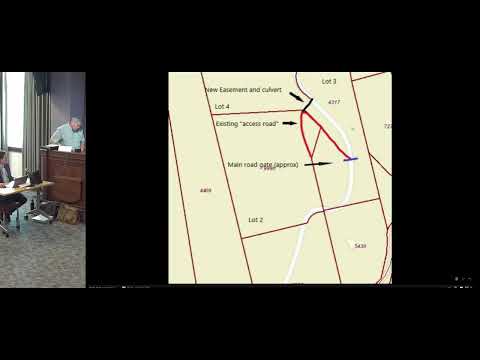
The variance request seeks permission for a driveway to encroach into a 30‑foot vegetated setback adjacent to a stream; under low‑density rules the setback generally must remain vegetated, while high‑density rules allow built upon area in a setback only if the new impervious runoff is treated to the higher standard.
Neighbors and interested parties offered testimony and cross‑examination about alternate driveway alignments. Paul David Mount, a contractor who testified he has 42 years of grading experience, described two alternative access alignments he and others showed the applicant years ago and said both would avoid the stream setback and be feasible to construct. Mount testified that he met with the applicant to discuss routes and that he reported pricing for one option to the applicant. Mount said one alternative would run up a ravine and another would switchback up a ridge; “they both was good options,” he said.
A neighboring property owner who has raised concerns about erosion and silt fencing on-site testified that he had offered a strip of his land to provide an alternate easement at no charge, and that he had sent the applicant a certified letter informing him he had hired an engineer to map a new route (the witness told the board the engineering estimate is roughly six weeks). The letter was admitted into the record as an exhibit; the witness said he had not received a response.
Applicant counsel and other parties objected at times to particular lines of questioning, and the board made several evidentiary rulings on the record. Counsel for the applicant told the board the applicant was monitoring remotely and that he could be contacted to accept conditions if the board moved to a decision. County staff cautioned the board that whether an alternate access would solve the stormwater issue cannot be determined without engineering and surveying work because the county’s steep‑slope and disturbed‑area limits (no more than 15% disturbance and 8% impervious for lots over 2 acres) might preclude some alternative routes.
No final ruling was made at the July hearing. Several participants asked for additional time to produce engineer‑prepared route maps and disturbance calculations; one party said an engineer estimated about six weeks to prepare a plan. The board did not announce a final decision and continued the matter for further evidence. Staff and parties were instructed to present any new survey or engineering exhibits when the case is resumed.
The board also made a formal record of the ex parte disclosures that several members received calls or saw social‑media posts; members who had been contacted stated on the record that no substantive information from those contacts would be considered and that they had not read the social‑media posts in full. The board restated that its decision must be based on the evidence admitted in the hearing.
The Stern case raises two distinct technical questions going forward: whether an acceptable engineered stormwater treatment measure can be installed to allow impervious surface within the vegetated setback under high‑density standards, and whether an alternate access route outside the buffer can be designed that complies with Buncombe County steep‑slope and disturbance limits. Parties present said they would return with additional engineering and survey data.