Get Full Government Meeting Transcripts, Videos, & Alerts Forever!
Get email alerts on the Arpa Funding topic
No spam. Unsubscribe anytime.
Skagit County details roughly $25 million in ARPA spending on public health, shelters, broadband and behavioral health
Summary
County staff told commissioners on July 8 that about $25 million in American Rescue Plan Act funds were allocated across public health, emergency management, social services, behavioral health, housing and broadband; roughly $4.3 million remained unspent at the end of 2024 and is earmarked for commissioner priorities.
SKAGIT COUNTY, Wash. — Skagit County officials on July 8 outlined how roughly $25 million in federal American Rescue Plan Act (ARPA) funds were spent to respond to COVID-19 impacts and to shore up public-health, emergency-management, housing and behavioral-health capacity.
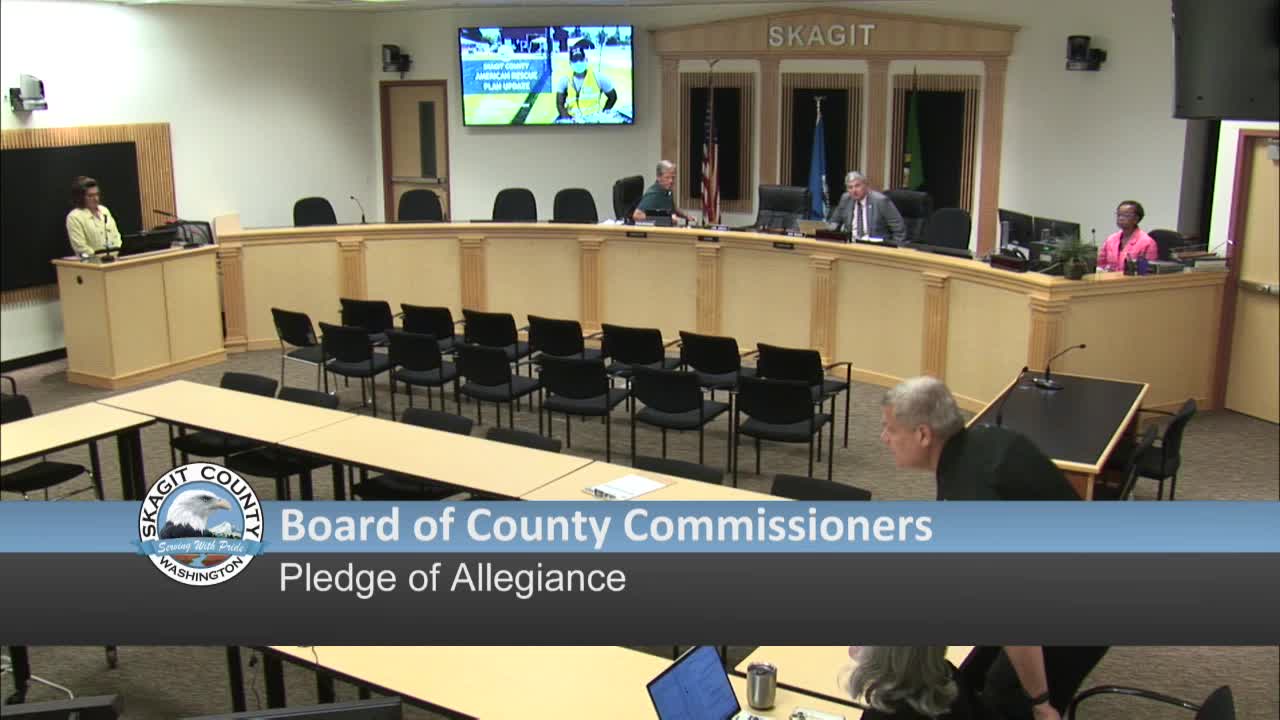
Jennifer Johnson, deputy administrator for Skagit County, briefed the Board of County Commissioners on investments made from the State and Local Fiscal Recovery Funds provided under the American Rescue Plan Act and related U.S. Department of the Treasury guidance. She said the county received about $25 million in two payments and used the funds across a set of commissioner-established priorities.
The presentation, delivered at the commissioners’ regular meeting, described major spending areas: public health workforce and mobile vaccination/testing clinics; roughly $1.1 million for emergency-management equipment and an incident-command van; more than $5.7 million directed to social-safety-net programs; over $5.7 million toward behavioral-health programs; roughly $2 million for court and probation backlog relief; investments in business and workforce support; nearly $1 million for broadband planning and mapping; and about $2 million spent on shelter and motel programs for people experiencing homelessness.
Johnson said the county used ARPA dollars to expand public-health staffing and infrastructure, operate low-barrier testing and vaccination sites (including at Skagit Valley College, the Skagit County Fairgrounds and a Burlington mall location), and to create a local Medical Reserve Corps (MRC) after initially relying on volunteer support from Snohomish County. The county also funded a mobile vaccination unit and supported long-term-care and school-based services.
Emergency-management investments included radios, mobile radio equipment, technology upgrades to the emergency operations center, two Zodiac boats for water rescues and a consultant-funded feasibility study for a proposed regional “safety campus” to provide training locations and potential co-location for 9-1-1 and emergency-management functions. The spending plan allocated “a little over $1,100,000” to this area, according to Johnson.
On housing and homelessness, commissioners directed more than $2 million of ARPA funding to shelter-related programs. Johnson described startup funding for a 45-unit pallet shelter in Burlington (First Step Shelter), a motel voucher program operated by Friendship House that sheltered 44 households (average stay about 60 days), four winter shelters run by community providers, bridge motel funding ahead of the opening of Martha’s Place (a 70-unit permanent supportive housing project), and $600,000 used to backfill a shortfall in document-recording fee revenue that supports nine local homeless-service providers.
Johnson described a broad $5.7 million-plus investment in social-safety-net initiatives identified in a COVID recovery plan developed with the Population Health Trust. Those programs included childcare retention and expansion (a roughly $520,000 investment that the presenter said created 162 new child-care slots and supported 15 new child-care businesses), perinatal behavioral-health supports, a data-driven food-security plan that created a Food Policy Council, and targeted learning-recovery supports that delivered case management to students.
Behavioral-health funding accounted for another major share of ARPA investments, Johnson said. Programs financed with ARPA dollars included a bilingual promotora community-health worker to help Spanish-speaking residents navigate behavioral-health services, expansion of a syringe-exchange and behavioral-health resource hub, on-site mental-health services at the First Step Shelter, a toxicology testing machine for the coroner to speed local postmortem screening, school-based social workers (four new positions that conducted more than 5,800 sessions), and a crisis-response team pairing licensed social workers with deputy responders. Johnson said the county invested almost $700,000 in design and planning for the voluntary “Star Center,” a facility adjacent to the county’s existing TeleCare-operated evaluation and treatment center; the Star Center is intended to add 46 voluntary beds for acute detox, mental-health stabilization and co-occurring treatment and to allow direct law-enforcement drop-off instead of taking people to emergency rooms or jail. Johnson said the Star Center was under construction and scheduled to open in January.
Economic-recovery spending included retention bonuses for the sheriff’s office to slow attrition (a retention program the county implemented in November 2022 after high deputy turnover), support for small-business mental-health pilot programs, workforce fairs and the Northwest Innovation Resource Center, and an agricultural-business technical-assistance program to promote Skagit Valley producers.
Johnson said the county was permitted to use up to $10 million of the allocation as “revenue replacement” (a general fund–style use under Treasury rules). She said the county designated about $5 million of that revenue-replacement allowance for the priorities presented and that approximately $4.3 million remained unspent at the end of 2024 but was still earmarked for commissioner priorities.
Commissioners thanked staff for the compilation and presentation. Commissioner Browning called the response “very, very thoughtful,” noting the county had worked to ensure spending clearly related to COVID impacts. Commissioner Janicki praised the staff work and the ability to track accomplishments.
Why this matters: The ARPA spending described by county staff supported service delivery (testing, vaccination and clinic capacity), short-term shelter and motel programs, behavioral-health expansion and emergency-response equipment — areas commissioners said were directly tied to pandemic-related harms. Johnson repeatedly framed investments as one-time funding choices intended to leave lasting capacity where possible while avoiding long-term staffing obligations that would outlive the federal funding.
What’s next: Johnson said remaining ARPA dollars were earmarked for commissioner priorities; the county will continue planning and implementation steps for projects such as the Star Center and the safety-campus feasibility work.
(Reporting based on a July 8, 2025 Board of County Commissioners meeting presentation.)