Get Full Government Meeting Transcripts, Videos, & Alerts Forever!
Get email alerts on the Sidewalks topic
No spam. Unsubscribe anytime.
Oregon City commission directs staff to draft code changes for sidewalk reimbursement, enforcement and grinding eligibility
Summary
Oregon City public works staff laid out discrepancies between written city code and enforcement practice on sidewalk repairs, reviewed the city's reimbursement program and asked the commission for direction on new eligibility and timeline changes.
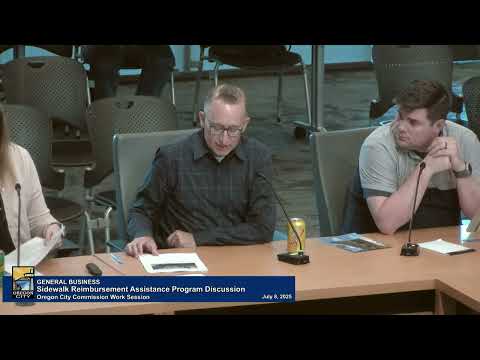
Oregon City – Oregon City public works staff on July 8 briefed the city commission on the city’s sidewalk reimbursement program, differences between written city code and current enforcement practice, and options to expand the city’s grinding and replacement eligibility amid a recent wave of complaints from older neighborhoods such as McLaughlin.
City staff described how the city’s current practice gives property owners more time and staff flexibility than the city code’s 90‑day compliance deadline, reviewed the reimbursement program’s eligibility limits, and outlined proposed revisions—among them amendments to align code with practice, new options for thin (“2‑inch”) sidewalks and broader use of grinding where physically possible.
The discussion matters because Oregon City’s code makes adjacent property owners responsible for maintaining sidewalks in “good repair,” and failure to comply may result in the city performing the work and placing a lien. The commission heard that increasing inspection precision and stricter measurement tools have produced more tripping‑hazard findings, prompting a larger number of notices and questions about fairness, timelines and program funding.
Josh Wheeler, the city’s assistant city engineer, told the commission that “good repair means that it shouldn’t…contain a tripping hazard,” and that the city uses the Americans with Disabilities Act of 1990 definition — a vertical separation of one quarter inch or greater — to identify defects. Wheeler explained the program’s operational details and limits: the reimbursement pilot began in February 2022 and was made permanent with revisions in late 2022 and 2024; eligible applicants must document efforts to obtain two contractor bids; reimbursements require a W‑9 because the program is treated as taxable income; and the current reimbursement cap is $1,500 per site (a site being the area affected by a street tree).
Wheeler said staff’s data show about 171 applicants and approximately $407,000 paid under the program from February 2022 through June 2025, with roughly 243 related code cases during that span. He also said the city estimates roughly 3,368 curb ramps in town, has inspected 1,337 to date and found 780 that do not meet current (2025) ADA standards. Staff flagged that older neighborhoods sometimes have 2‑inch‑thick sidewalks (original standard) while the current construction standard is 4 inches; that makes many panels ineligible for grinding under the program’s existing rules (which require minimum remaining thickness or that a panel not have been ground previously).
Commissioners questioned timelines, eligibility and equity. Mayor Denise McGriff and several commissioners said current staff practice — a first notice that allows 120 days, a second notice adding 60 days (180 days total) and then a code enforcement referral — is less punitive than the 90‑day compliance period in code and better accommodates seasonal contractor availability and household hardship. Commissioner Rocky Smith said, “If practice and code are not aligned, they probably should be.” Commissioner Adam Marl described residents’ concerns that neighbors are using the system to file multiple complaints and asked staff to consider how to prevent punitive or serial reporting.
On policy options, staff proposed: (1) amending code or official policy to match the 120/60 implementation timeline currently used; (2) continuing the $1,500/site reimbursement tied to street trees but considering an upper cap per property (staff suggested $9,000 as an example); (3) offering a new per‑panel reimbursement option for thin sidewalks in older areas if the panels are not grind‑eligible (staff proposed $400 per panel as a starting point); and (4) allowing grinding more broadly where physically feasible, with clear disclosure that grinding can be a temporary fix and may not be structurally permanent.
Commissioners voiced different views. Several commissioners supported aligning code with current practice and expanding grinding options to buy property owners time to plan and save. Several opposed expanding routine reimbursement beyond tree‑related sites on equity and precedent grounds, arguing that the city should not broadly underwrite privately owned sidewalks that were not caused by prior city policy. Commissioners asked staff to return with proposed language, cost estimates, options for a property cap, a recommended public‑notice letter script and fiscal impacts on the city’s program budget (currently $125,000 for the fiscal year).
Staff also described enforcement steps and permit requirements: any active work in the right of way requires a permit; grinding is allowed under limits (quarter‑inch to a half‑inch always grindable; between a half‑inch and 1.5 inches only in some circumstances); “pasting,” injection lifting and partial panel replacement are not allowed without specific permit approvals; and group permits are available when several neighboring properties coordinate work under a single contractor.
On the McLaughlin neighborhood cases cited by commissioners, staff presented a field inventory: of 69 flagged locations in McLaughlin, 5 were completed and 64 remained in the code pipeline; in a sample of 42 addresses staff surveyed, 21 had street tree impacts and 21 did not, 31 had some grind eligibility and 33 required some removal and replacement, with panel counts per property ranging from 1 to more than 20 in severe cases. Staff estimated that, on the sample list, tree‑site reimbursements could total roughly $73,000 and a per‑panel non‑tree reimbursement at $400 would total roughly $38,000 — together exceeding $110,000 and approaching the program’s annual budget.
What commissioners directed staff to do: staff was asked to draft code and policy language that (a) aligns the written timeline with the 180‑day practical process currently used by public works, (b) lays out clear notice language emphasizing assistance and available options, (c) expands grinding as an allowed remedy where physically appropriate but clarifies its temporary nature, and (d) returns cost estimates and options for property caps or per‑panel reimbursement for thin sidewalks. Commissioners asked for an explicit recommendation on whether any non‑tree, thin‑panel reimbursement should be added and, if so, how to preserve program solvency.
Staff said it will return to a future commission meeting with proposed ordinance or policy language, updated enforcement letters, a budget impact analysis and draft program rules for any new per‑panel reimbursement or cap. No formal ordinance was adopted at the July 8 session; commissioners gave staff direction to prepare proposed amendments for a future public meeting.
Sources: presentation and discussion led by Josh Wheeler, assistant city engineer, with Dana Webb, public works director, and other staff; commissioners’ on‑record statements during the July 8, 2025 work session.