Get Full Government Meeting Transcripts, Videos, & Alerts Forever!
Get email alerts on the Water Supply topic
No spam. Unsubscribe anytime.
East Bay Municipal Utility District director tells San Ramon council water supply is stable while infrastructure costs rise
Summary
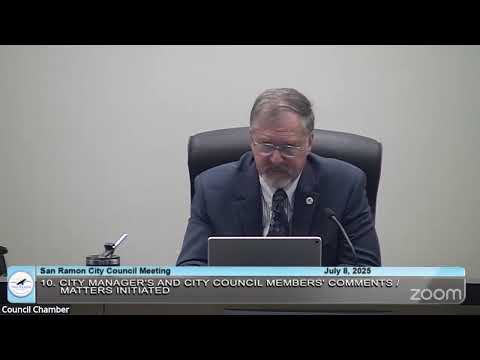
Luz Gomez, East Bay MUD director for Ward 2, told the San Ramon City Council on July 8 that the district’s reservoirs are near normal levels and the district is expanding recycled-water and climate programs even as pipeline replacement and treatment-plant upgrades push costs higher.
Luz Gomez, director for Ward 2 on the East Bay Municipal Utility District board, told the San Ramon City Council on July 8 that the district’s water supplies are in good condition but that long-term reliability requires continued capital investment and expanded conservation and recycled-water programs.
Gomez said East Bay MUD serves about 1.4 million customers across Alameda and Contra Costa counties and that roughly 90% of its supply comes from the Mokelumne River watershed collected at Pardee and Camanche reservoirs. “We are very happy to say that we’re doing quite well,” she said, noting that Pardee was near 98% of average and Camanche above average for the year.
The presentation outlined the district’s portfolio approach to future drought and climate risk: increase recycled-water deliveries, expand groundwater banking, conserve more water and maintain partnerships that allow purchases in dry years. Gomez said EBMUD expects to increase recycled water to about 20 million gallons per day by 2050 (from roughly 8–9 million now) and to conserve an additional 70 million gallons per day by 2050.
Why it matters: San Ramon receives most of its retail water from suppliers that purchase treated water from EBMUD or regional partners. The district’s projects and rate-setting decisions affect long-term supply, water quality and the cost passed along to retail agencies and customers.
Most important facts
- Supply and storage: Gomez said Pardee Reservoir is near 98% of its historical average and 88% of capacity; Camanche was at about 112% of average and 81% of capacity; overall East Bay reservoir storage is close to normal for the water year.
- Aging infrastructure and replacement costs: EBMUD operates roughly 4,200 miles of water pipe. Gomez said about 15–20 miles fail each year; last year the district replaced roughly 25.5 miles. She said replacing pipeline costs on the order of $4,000,000 per mile and that the district is shifting to ductile-iron pipe expected to be more earthquake-resilient and longer-lived.
- Treatment and water quality upgrades: The district is investing in treatment-plant upgrades—including additional filtration, ozone treatment and flocculation at the Walnut Creek plant—to address algae, wildfire-related turbidity and other quality challenges driven by climate change.
- Portfolio changes and pilots: The district is expanding recycled-water delivery (purple pipe), completed a groundwater-banking pilot that performed as expected, and maintains agreements such as access to Freeport/Central Valley supplies for dry years.
- Climate and energy programs: Gomez said EBMUD aims for carbon neutrality and is expanding solar capacity, including a major photovoltaic installation below Briones Reservoir that she said will generate about 10,000,000 kilowatt-hours annually and produce roughly $24,000,000 in energy cost savings over a 25-year contract. The district is also piloting microturbines in distribution pipelines (estimated ~130,000 kWh/year) and participating in other low-carbon projects.
Questions from council members focused on funding, wildfire preparedness, technology and customer programs. Council member Rubio asked how the district secures funding; Gomez said EBMUD relies primarily on rate revenue and debt financing and noted only limited federal grant reliance. Vice Mayor Burrows asked about cyber and sensor technologies; Gomez described fiber-optic leak detection pilots, robotics for internal pipe inspection and ongoing cybersecurity training for staff and board members.
On rates and affordability, Gomez said the board recently adopted rate increases required to support capital work; she said she and one other board member voted no on the package, citing concerns about pacing and long-term affordability. She described the district’s customer-assistance program, which can cover up to half of water-service and flow charges for qualifying customers.
Public comment during the item included a question from resident Shirod Kathrani about PFAS and groundwater-banking locations; Gomez said EBMUD testing has shown PFAS levels in the watershed to be “negligible” and said the groundwater pilot site tested similarly.
Ending
Gomez told the council the district is in a solid initial position for the water year but cautioned that climate-driven shifts in runoff and wildfire risk mean EBMUD must continue investing in treatment, storage right-sizing, pipeline replacement and diversified supplies. She encouraged customers to use available rebate and leak-detection programs.