Get Full Government Meeting Transcripts, Videos, & Alerts Forever!
Get email alerts on the Public Art Murals topic
No spam. Unsubscribe anytime.
Committee clears bill exempting commissioned muralists from contractor‑licensing requirement
Summary
SB 456 would add a muralist exception to the Business and Professions Code so commissioned fine‑art murals are not treated as construction requiring a contractor license; the committee passed the bill to Appropriations after broad support from cities, arts groups and artists.
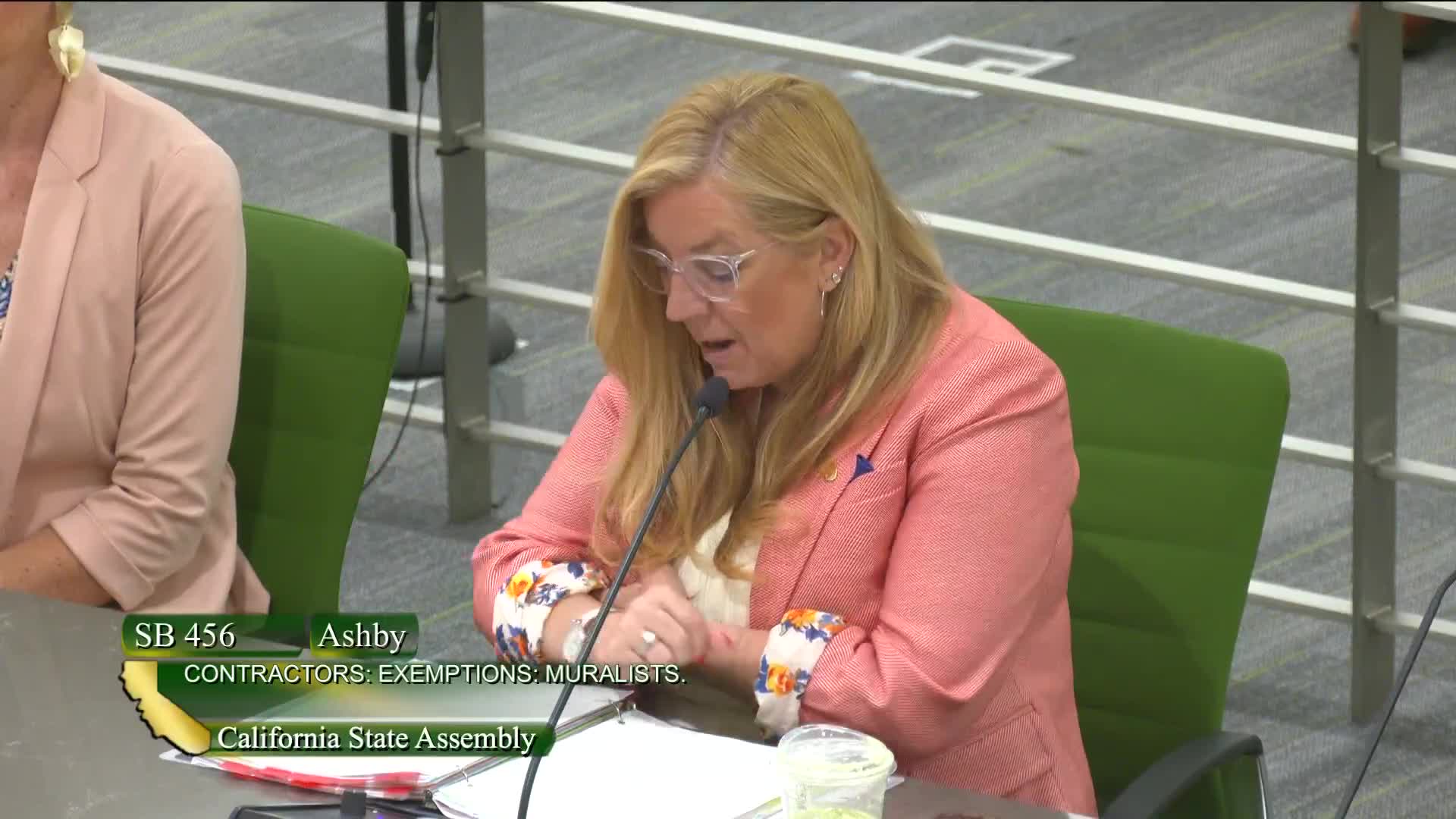
Senator Ashby presented SB 456 to the Assembly Business and Professions Committee on Oct. 26, 2025, describing the bill as the “community beautification act” that would exempt commissioned muralists from the requirement to hold a contractor’s license when performing fine‑art murals.
Ashby and witnesses said a recent interpretation by state regulators had chilled mural projects across the state because municipalities and artists feared a contractor‑licensing requirement would apply to painted murals. The bill would clarify that the exemption applies to works of fine art, does not waive safety regulations, and does not apply to painted wall signs.
Donald Gensler, Sacramento’s art and public places manager, testified that mural projects are “part of the city’s vital economic development,” and that the recent licensing interpretation led several cities to pause or cancel mural projects. Artist Jaya King testified about her public mural projects and said the current licensing approach “forces us into a system that was never meant for us” and that the change would preserve artists’ livelihoods and community expression.
Support for the bill included many cities, county boards of supervisors, arts organizations and tourism groups. The Painters and Allied Trades expressed safety concerns initially but said conversations with the author mitigated most issues and moved the group toward a neutral or “tweener” position.
The committee moved SB 456 as amended to the Committee on Appropriations.