Get Full Government Meeting Transcripts, Videos, & Alerts Forever!
Get email alerts on the Urban Forestry topic
No spam. Unsubscribe anytime.
Residents, conservation groups urge 12-inch tree-protection threshold in Century Code update
Summary
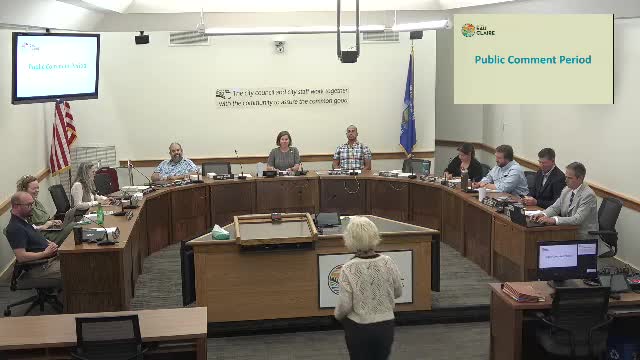
On Monday, July 7, during the public comment portion of an Eau Claire City Council meeting, residents and conservation advocates urged the council to adopt a 12-inch diameter-at-breast-height (DBH) threshold for tree protection in the Century Code update, saying an 18-inch threshold would protect fewer than one in five mature urban trees.
On Monday, July 7, during the public comment portion of an Eau Claire City Council meeting, residents and conservation advocates urged the council to adopt a 12-inch diameter-at-breast-height (DBH) threshold for tree protection in the Century Code update, saying an 18-inch threshold would protect fewer than one in five mature urban trees.
The appeals came from a range of speakers, including neighborhood residents, members of local conservation groups and a university student. Jane Moller, chair of the Chippewa Valley Biodiversity Partnership, said she reviewed urban forestry research and found that “most of Eau Claire's mature urban trees fall between 10 inches and 24 inches … trees 18 inches and above account for less than 20% of our urban forest.” She added that a single 12-inch tree “removes 70% more air pollution, 1,500 gallons of storm water, cools neighborhoods by up to 10 degrees Fahrenheit, and provides three times more wildlife habitat than a new 2-inch sapling.”
The concern was echoed by other speakers. Ellen Terwilliger, a Master Gardener volunteer, called mature trees “a huge economic value” and urged the council to “keep the century code as it's written now.” Steve (last name not specified) criticized moving from a 100% replacement standard to the 30% figure that he said appeared during internal deliberations, and warned that many replacement saplings die early: “By the time a tree is 13 to 20 years old half of them are dead.”
Some speakers connected tree protection to housing and planning issues. Jeff DeGraves, a resident of the Randall Park neighborhood, said Randall Park already has high population density and questioned a one-size-fits-all approach to zoning and tree rules. Helene (last name not specified), speaking for the Historic Randall Park neighborhood, pointed council members to chapter 9 of the city comprehensive plan and said it already aligns with multiunit (GR) zoning placements and affordable housing goals.
Scott Rogers, vice president of governmental affairs at the Eau Claire Area Chamber of Commerce, urged balance, saying the Century Code’s critical purpose is to “produce more housing supply, diversity of choices, and affordability” and that “every part of the code should be evaluated and balanced based upon its effect on that critical purpose.”
Student and sustainability advocates framed tree protection as an equity issue. Kristen O'Brien, a member of the City Sustainability Advisory Committee, the UWEC Student Office of Sustainability and the Urban Forest Board, said trees provide “money saving services” and that “people of any class are deserving of nearby nature, shade, and the money saving services that trees provide.” Another resident, identified as Erin, said limited-income households have historically borne disproportionate environmental burdens and argued that protecting trees is part of addressing environmental injustice.
No council action on the Century Code occurred during the public comment period. The council did extend the public comment period by 20 minutes at the request of Vice President Worthman, and later moved to a separate closed session on unrelated negotiation items.
Speakers' viewpoints included technical claims about canopy benefits, concerns about replacement-sapling survival, and appeals to existing comprehensive-plan language for neighborhood-specific approaches. Council members did not debate or vote on the Century Code during the meeting; the comments were presented during public comment only.