Get Full Government Meeting Transcripts, Videos, & Alerts Forever!
Get email alerts on the Residential Traffic Calming topic
No spam. Unsubscribe anytime.
Board allocates TNC tax funds to clear SFMTA traffic‑calming backlog and pauses application intake pending reforms
Summary
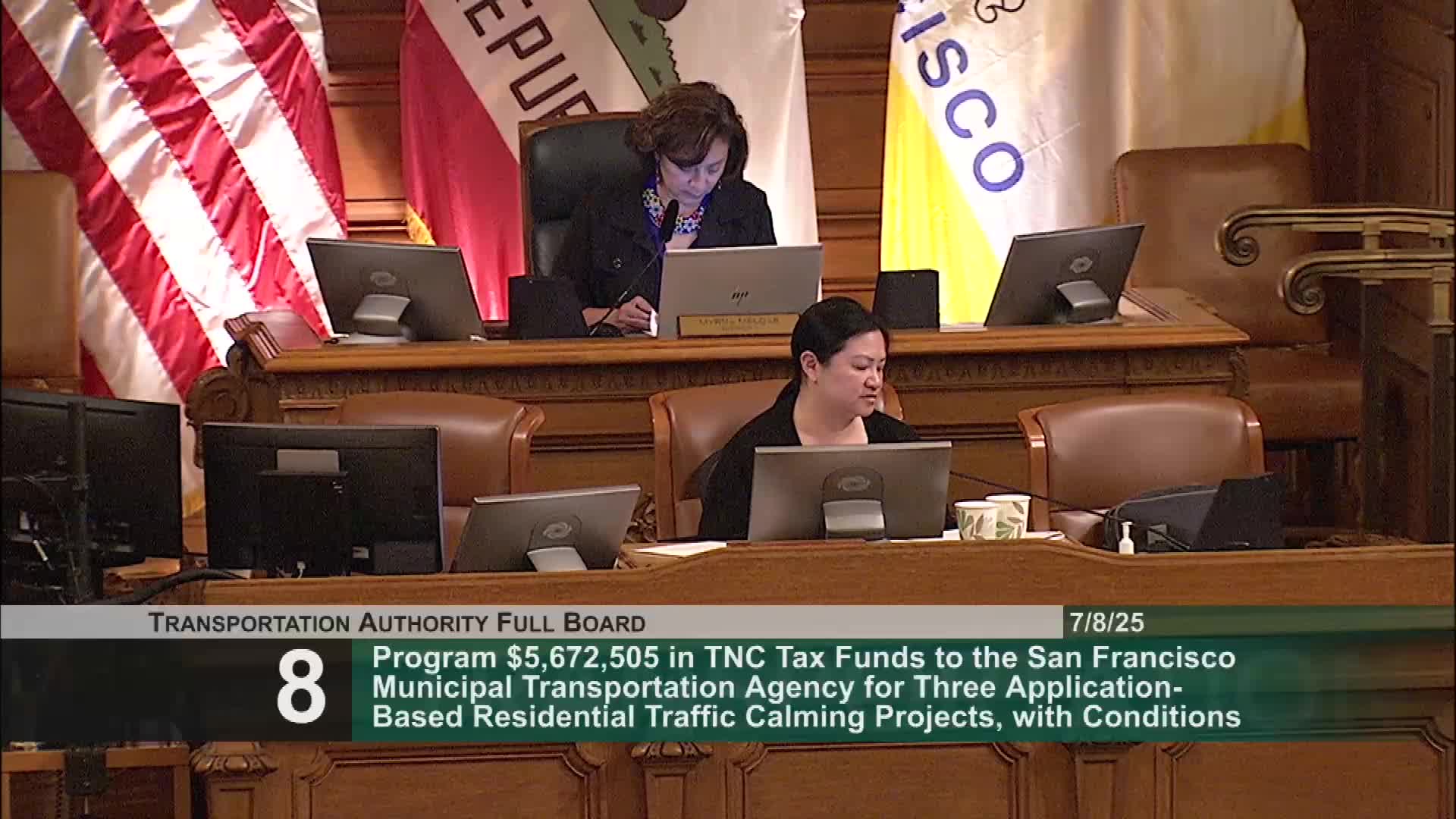
The Transportation Authority approved programming of $5,672,505 and allocation of $6,887,505 in TNC tax funds to SFMTA to complete pending residential traffic‑calming projects and to design improvements from earlier cycles.
The San Francisco County Transportation Authority approved programming and allocation of TNC tax revenues to help SFMTA clear a backlog of residential traffic‑calming projects, and the board accepted staff conditions requiring enhanced monitoring and reporting while SFMTA pauses new applications to redesign the program.
Staff presented two linked actions: a programming item to program $5,672,505 in TNC (Prop D) funds for three application‑based residential traffic calming projects, and an allocation item to release $6,887,505 in TNC funds for project construction and design. The funds target remaining work from fiscal years 2021, 2022 and design for 2023 projects.
Missy Burg of the Transportation Authority described problems that contributed to the backlog: during the COVID period SFMTA removed the petition requirement for applicants, producing a surge of applications in 2021–22 without commensurate funding or staffing; inflation and construction cost increases then widened the gap between design and available construction funds. SFMTA’s Chief of Planning and Implementation, Sean Kennedy, said the agency now proposes a temporary pause on the application‑based program, a cleanup of the backlog, and a reassessment of delivery methods (including a possible shift to a proactive, corridor‑driven approach).
As conditions of both programming and allocation, the authority approved an enhanced monitoring, reporting and oversight protocol. Examples of conditions included monthly progress reports from SFMTA, monthly meetings with TA staff, and a requirement that by December 2025 SFMTA report back on whether to shift from an application‑based program to a proactive selection process.
Commissioners raised policy concerns. Commissioner Sauter urged retaining resident input and recommended a balanced redesign rather than returning to an onerous signature requirement; Commissioner Mahmood asked whether objective safety measures could be prioritized. Anna LaForte, Deputy Director for Policy and Programming at the Transportation Authority, said the authority has funded application‑based traffic calming with the TNC tax since 2023 and that decisions were influenced by prior citywide budget tradeoffs.
Public comment included an endorsement from Melena Mackey Kebada of Walk San Francisco, who said speed humps and tables are proven tools and urged the board to approve the allocations while pursuing program reforms to make delivery faster and more equitable.
The board approved the programming motion (moved by Commissioner Dorsey, seconded by Commissioner Mandelmann) and then approved the allocation motion (moved by Commissioner Mandelmann, seconded by Commissioner Dorsey); clerks announced the motions approved.