Get Full Government Meeting Transcripts, Videos, & Alerts Forever!
Get email alerts on the Ag Tourism topic
No spam. Unsubscribe anytime.
Council narrows ag‑tourism ordinance, requires cultural consultation for activities representing indigenous traditions
Summary
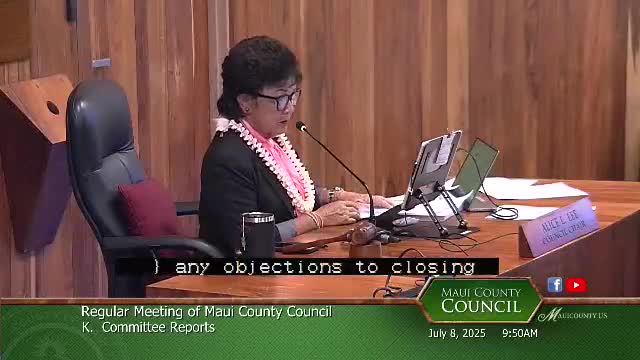
Maui County Council on July 8 approved amendments to the county zoning code to allow agricultural tourism as an accessory use on working farms while adding a requirement that activities representing indigenous cultures consult the Department of OUV Resources and new enforcement language following repeated violations.
Maui County Council on July 8 approved changes to the county comprehensive zoning ordinance (Title 19) to establish agricultural tourism as an accessory use on working farms, while adding new procedural safeguards for activities that present indigenous cultural traditions.
The council adopted a finalized version of the bill after two committee-level amendments: one requiring consultation with the Department of OUV Resources when a proposed agricultural‑tourism activity represents indigenous cultures, traditions or customs, and another suspending a producer’s registration for three years after three violations of the chapter. Council members approved the final substitute version of the bill by an 8‑1 vote; the two committee amendments passed earlier without dissent.
Why it matters: supporters said the changes update Maui’s zoning to reflect state law and help farms earn supplemental income; opponents and some council members said the bill needed stronger, enforceable protections against cultural appropriation. The discussion included multiple public testimonies from farmers and food‑truck operators who said prior planning‑department enforcement had disrupted livelihoods.
Council debate and votes
Council Member Gabe Johnson, who carried the measure, framed the bill as an economic and food‑security measure, saying the change would "give our farmers more options to make their farming operations viable." The measure began in committee as a response to state statute changes in Chapter 205, Hawaii Revised Statutes, and committee work that produced an initial CD1 draft.
The CD1 draft had included a proposed role for the Department of OUV Resources in the registration process and a director's power to revoke registrations for repeated violations. After legal review and further drafting, the council substituted an FD1 version that deleted an automatic approval or veto role for OUV Resources and removed a commissioner-level revocation standard that had permitted up to a five‑year removal of registration. Deputy Corporation Counsel Andrew Nelson told the council he had not consulted with every affected department while preparing the FD1 language and acknowledged the constitutional concerns that motivated some deletions.
Members pushed and passed two amendments on the floor. Council Member Nancy Paulton successfully moved language that requires consultation: when an activity would "represent the indigenous cultures, traditions and customs," the Department of OUV Resources must be consulted for guidance. Paulton's amendment passed 9‑0. She also moved an enforcement amendment to suspend a producer’s registration for three years after three violations; that motion also passed 9‑0.
Public testimony and concerns
Witnesses who spoke during the public comment period included Sydney Smith, identified as chair of the Ag Working Group, who urged approval and described the working group's multiyear study of the county code. Smith told the council the working group "spent countless hours late into the evening after hard days on the farm to craft meaningful ordinances to improve the viability of our farms and ranches."
Multiple testifiers recounted enforcement actions by the planning department that they said had closed food‑truck operations on agricultural parcels. One Hana food‑truck operator, who identified himself only as Jacob, said the planning department had shut his business overnight in 2023 and left him "hundreds of thousands of dollars in debt," adding, "this gives me a lot of hope and a lot of light at the end of the tunnel." Several speakers representing the Maui Chamber and local growers urged the council to pass the bill to restore certainty and support farm income diversification.
Legal, enforcement and process tradeoffs
Corporation Counsel and some council members warned that provisions directly tying registration decisions to OUV Resources review could raise constitutional or due‑process questions; those legal risks led to the FD1 language that frames OUV Resources as a required consultant only when the activity explicitly "represents" indigenous cultural traditions. Deputy Corporation Counsel Andrew Nelson said he had tried to resolve legal issues while preserving protections against cultural misappropriation but did not consult every affected department in drafting the FD1.
Several members said they wanted a clearer enforcement path for intentional, repeated violations but also recognized that enforcement of zoning violations is governed by the broader enforcement provisions in Article 5 of the Maui County Comprehensive Zoning Code (chapter 19.53). Member Naomi Rollins Fernandez said she would not support the substitute unless stronger protections were added; member support ultimately hinged on the Paulton amendments that added the "must consult" trigger and a three‑strike suspension.
Where this goes next
The council substituted and adopted the FD1 version of the bill as amended. Sponsors said they intend to continue refining implementation details with county staff and Corporation Counsel before subsequent readings to reduce the legal risk of enforcement provisions.
Ending note
Supporters said the changes were meant to bring county code into alignment with state law and to create income avenues for farmers. Opponents cautioned that cultural protections required clearer, enforceable procedures and departmental consultations during rulemaking and implementation.