Get Full Government Meeting Transcripts, Videos, & Alerts Forever!
Get email alerts on the Utility Tax topic
No spam. Unsubscribe anytime.
Clay County workshop sees strong public opposition as commissioners weigh utility tax increase
Summary
Residents urged commissioners to reject or limit a proposed increase to the county's utility service tax while staff outlined revenue estimates and a vote was scheduled later the same day.
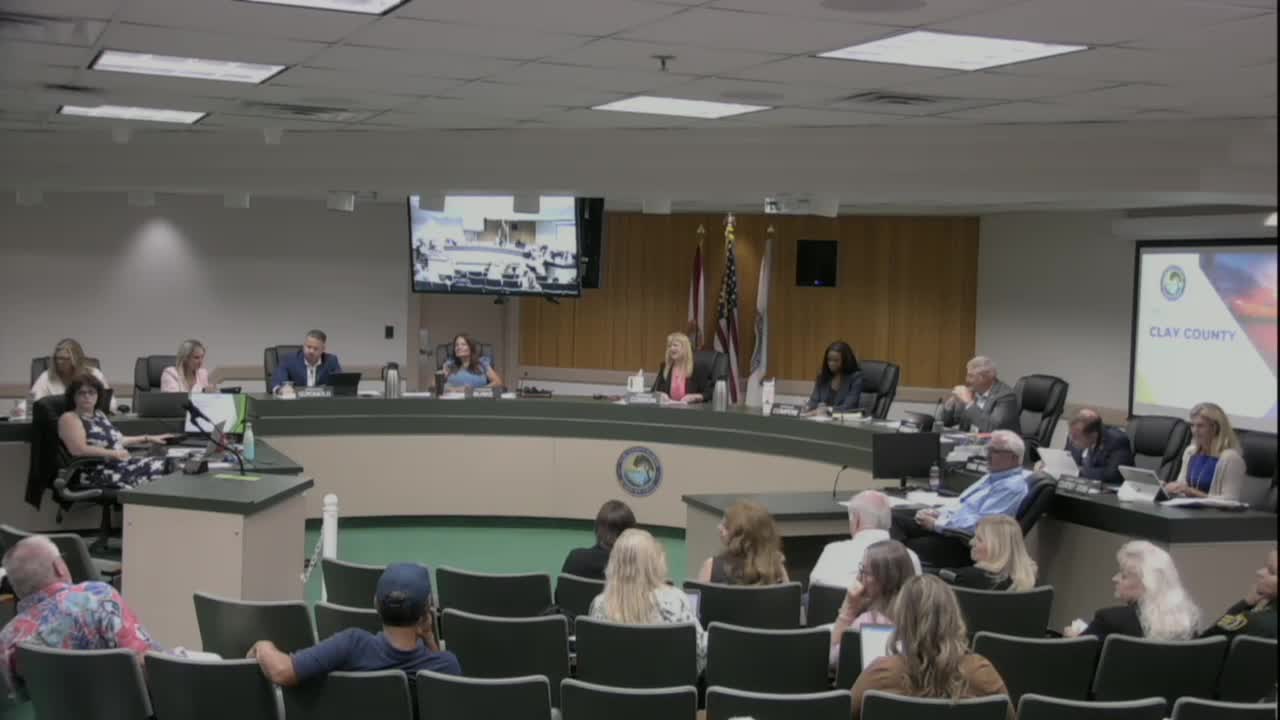
At a July 8 Clay County Board of County Commissioners workshop, residents urged commissioners to reject a proposed raise in the county's utility service tax or to narrow its scope, saying the increase would hit seniors and lower-income households hardest. County staff presented revenue estimates and said the proposal would appear on the board's agenda for a vote later that day at 5 p.m.
Many public commenters described fixed incomes and rising household costs and asked the board to designate any new revenue specifically for public safety instead of leaving the funds undesignated. Kenneth Remson, a retired math teacher, told the board, "a utility tax like this is a regressive tax, meaning that it's a tax that, basically lower income people pay a higher percentage of their overall income too." Other speakers called for alternatives, questioned why new development and property taxes could not cover the shortfall, and asked for more detail on how existing revenues have been spent.
The county's budget staff, led in the workshop by Troy Nagle, presented current collection figures and modeled outcomes under different rates. Nagle said the county presently collects about $4.6 million to $4.9 million annually at the current 4 percent rate and estimated that raising the rate to 6 percent (the example frequently discussed at the workshop) would increase total annual collections to roughly $7.4 million, adding about $2.4 million in new revenue. A smaller 2-percentage-point increase would yield about $2.0 million to $2.4 million, staff said. Because of statutory timing requirements the county would not begin collecting a voter-authorized change immediately; staff noted a January effective date would yield roughly 75 percent of the modeled revenue in the first year.
Commissioners and staff repeatedly framed the utility tax as one tool among several under consideration to close a remaining operating shortfall in the general fund. At the workshop staff reported roughly $3.9 million remained after an initial round of proposed reductions; adding court and clerk staffing requests and other new items raised the total additional need to about $4.7 million. Commissioners stressed they were still weighing choices between revenue options (including fees and impact/mobility fees studies) and further spending cuts before the final budget adoption in September.
Several speakers asked why the tax would apply to unincorporated areas while cities already impose their own utility taxes. Staff explained that because Clay County is a charter county it has authority to levy a utility service tax for unincorporated areas and that some municipalities within the county already assess their own utility taxes; the county cannot legally impose the county's utility service tax inside those municipalities.
The motion to place a utility-service-tax increase on the board's agenda for the July 8 5 p.m. public hearing was reflected in the workshop discussion. Commissioners clarified the item would be considered at the 5 p.m. meeting and, if adopted, changes would be implemented in January to meet statutory notice windows.
Staff said they will bring a fee-schedule review to the board in August and continue to identify additional budget adjustments ahead of the September tentative and final budget hearings.
Ending: The workshop closed with commissioners divided on the utility-tax approach; some said they would prefer to find further cuts or alternate revenue sources, while others emphasized funding public safety. The utility-service-tax increase was listed on the board's 5 p.m. agenda the same day for formal action.