Get Full Government Meeting Transcripts, Videos, & Alerts Forever!
Get email alerts on the Strategic Plan Implementation topic
No spam. Unsubscribe anytime.
Public and commissioners press for clearer Rockwall 2050 implementation; tax office kiosk debate deferred
Summary
Speakers at Tuesday's commissioners court urged faster, clearer implementation of the Rockwall 2050 strategic plan; commissioners discussed software implementation and postponed a decision on a $33,419 queuing system PCO (NemoQ) for the tax assessor until staff can seek a lower-cost option.
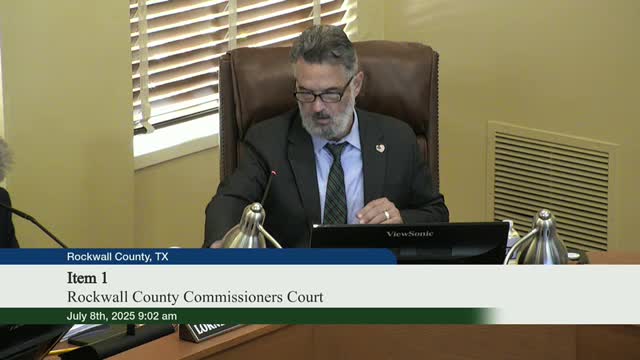
Residents and county officials on July 8 pressed the Rockwall County Commissioners Court for clearer, faster implementation of the Rockwall 2050 strategic plan, and the court debated a proposed queuing (NemoQ) kiosk for the new tax assessor office before choosing to take no action and revisit the matter in two weeks.
Public comments: Mark Kippett, speaking during the public forum, told the court it had been "90 days since the court adopted the Rockwell 2050 strategic plan and the pathway to implementation is unclear." He said the $300,000 the county spent on the plan, and the volunteer hours that supported it, risk being wasted unless the court sets a clear implementation path. Mayor Brian McNeal of (city, title given as "mayor") reported the city's ongoing cleanup and relief efforts after a sewer-line incident and described broad county-city cooperation delivering supplies to Kerrville in the Hill Country.
Strategic-plan implementation: Commissioner Maklick summarized prior consultant work and said the county has contracted with Envisio, a strategy and performance-management software provider, to host goals, objectives and performance indicators. Commissioners and staff discussed the need for a change-management leader or coordinator to drive implementation and for better internal communications and a countywide kickoff to secure departmental buy-in. Commissioner Maklick said training, identification of goal owners and a communications program were overdue; he proposed finalizing a leadership team and a work plan and returning with an implementation timeline.
Tax-office queueing system (NemoQ) debate: The court spent nearly two hours on a proposed change order (PCO 52) for a NemoQ queuing/kiosk system for the new tax office annex. Commissioner Stacy and Tax Assessor Kim Sweet described the system as an established solution other tax offices use; it is intended to improve customer flow, enable customers to check in and wait outside the lobby, and reduce staff additions. The PCO quoted $33,419 for the kiosk purchase with an ongoing annual licensing/hosting fee quoted at $17,836.
Several commissioners questioned whether the county needed the highest-cost package and said they found lower-cost alternatives online. Commissioner Lickty noted the vendor lists an "essentials" plan at roughly $290 per month (about $3,480 per year) and that the quoted plan included a large text-message bundle estimated at $12,265 annually. Commissioners asked tax-office staff for more competitive bids or a pared-down NemoQ configuration that removed expensive SMS capacity. Kim Sweet said the office had removed a requested new employee from the budget because they expected the queue system to increase efficiency; she reported the tax office processed about 12,043 transactions in June.
After extended discussion, Commissioner Maklick moved to take no action and direct staff to seek revised quotes (including options without bulk SMS) and return in two weeks. The court voted to take no action and deferred approval for two weeks; staff said the contractor does not plan to ship until the county approves, and the project team expects the delay will not imperil installation.
Ending: Commissioners asked staff to return with a lower-cost quote or options (including a basic plan, reduced SMS bundles, or other vendors), to identify whether SMS volume minimums could be reduced, and to confirm whether equipment procurement or scheduling would be jeopardized by a two-week deferral.