Get Full Government Meeting Transcripts, Videos, & Alerts Forever!
Get email alerts on the Regional Water Policy topic
No spam. Unsubscribe anytime.
Boerne staff recommend against joining GBRA's large regional water project; council weighs trade-offs of growth control and cost
Summary
City staff told council the Guadalupe-Blanco River Authority's proposed mega-project would be costly for Boerne ratepayers and would reduce the city's leverage over growth; staff recommended nonparticipation while continuing local options such as reclamation and ASR
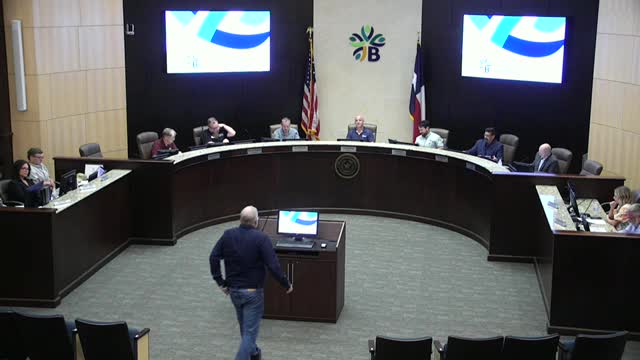
City staff advised the Boerne City Council on July 8 that the Guadalupe-Blanco River Authority's (GBRA) proposed, region-scale water project would be expensive for Boerne and could undermine the city's ability to use its municipal utility as a tool to influence local growth patterns.
Why it matters: The project offers large new water supplies for a fast-growing portion of central Texas but carries large capital and debt-service costs. Participation would require Boerne to commit to multi-decade payments and to plan capital work to move water from the I-35 corridor to Boerne's distribution system; staff said those costs could substantially increase local water rates and shift growth incentives.
What staff said
Mike Mann (presenting staff) explained that GBRA's project includes very large river intakes and aquifer storage-and-recovery components. The project's capital cost estimate presented to the city was about $5.96 billion overall; GBRA's per-acre-foot capital cost shown to council was approximately $62,896 compared with about $12,000 per acre-foot for the city's earlier Western Canyon source. Mann said the city could be asked to commit to multi-decade debt-service payments that would begin well before Boerne would need the additional water for normal growth.
Mann and City Manager Ben Thatcher said staff's recommendation, after running high-level financial scenarios with rate consultants, would be not to participate in GBRA's large, region-scale project because it would impose very large, long-term costs on the city's ratepayers and because Boerne currently has water supplies sufficient to serve the city for several decades under conservative growth assumptions and with stronger conservation and local options.
Council concerns and options
Council members asked detailed questions about: the length of time to design and build the GBRA project; whether GBRA would deliver water near I-35 or whether additional capital to move water to Boerne would be required (staff said substantial additional capital would be needed); the effect on municipal leverage over growth if private utilities secure nearby supplies; and the possibility of taking a smaller reservation of water to reduce cost exposure.
Council discussion highlighted two competing objectives: preserving affordable water rates and the city's ability to control growth patterns versus securing very large, long-term water supplies that would guarantee capacity but at a high upfront and ongoing cost. Council members also discussed locally controlled alternatives that are generally cheaper per acre-foot, including aquifer storage and recovery (ASR), reclaimed water (purple pipe) and conservation programs.
No formal vote
Council did not take a formal vote during the July 8 meeting. Mann said the city had until a July deadline to indicate interest on a memorandum of understanding from GBRA; staff asked council for policy feedback and recommended the city not participate in the GBRA project at this time, proposing instead to continue investing in local supplies and conservation measures.
Next steps
Staff offered to return with more scenarios if council asked for an intermediate option (a smaller reservation), and Mann said staff would update council on the implications for rates, capital needs (including the cost to move water from I-35 to Boerne) and timing if a different reservation size were desired.