Get Full Government Meeting Transcripts, Videos, & Alerts Forever!
Get email alerts on the Community Health Improvement Plan topic
No spam. Unsubscribe anytime.
Douglas County partners outline anti-poverty goals in Community Health Improvement Plan
Summary
Lawrence-Douglas County Public Health and community partners presented the anti-poverty focus of the Community Health Improvement Plan, highlighting ALICE data, a guaranteed-income pilot, childcare scholarship proposals and navigation services to increase benefits uptake.
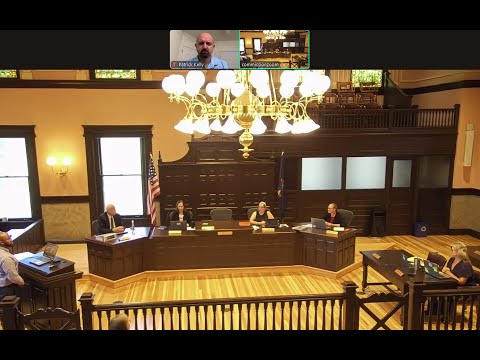
Lawrence-Douglas County Public Health and community partners presented an update on the Community Health Improvement Plan’s anti-poverty focus at the July 2, 2025 Board of Douglas County Commissioners meeting, outlining measurable targets and pilot strategies aimed at improving household economic stability across Douglas County.
The presentation, led by Jonathan Smith, executive director of Lawrence-Douglas County Public health, emphasized that the CHIP is a multi-partner roadmap rather than a single agency’s plan. “It’s not the health department’s plan, not the county’s plan, not the city’s plan. It’s truly everybody’s plan,” Smith said.
Why it matters: presenters pointed to ALICE (asset limited, income constrained, employed) data showing that many working households do not earn enough to meet a local “survival budget.” Sarah Obermeyer, a research associate with KU Medical Center working with Lawrence-Douglas County Public Health, said a survival budget example for a single adult with two children (an infant and a preschooler) in Douglas County is $69,420 a year, compared with a median income of $45,425 for single female-headed households with children.
Presenters said the anti-poverty focus seeks to reduce the share of single female-headed households living below the ALICE threshold from 64% to 50% by 2029. Strategies highlighted included: piloting a guaranteed-income program targeted to low-income women with children by 2027; creating a countywide community navigator/community health worker program to increase SNAP and WIC uptake among eligible households (a target increase from 10% to 50%); developing a communitywide childcare scholarship fund; and workforce and apprenticeship efforts to raise childcare provider wages.
Caitlin Piney of K-State Research and Extension described community engagement to date on guaranteed income, including data walks, a grant-funded sprint and a $10,000 grant used to host public conversations. “By 2027, we’re looking for our community to conduct a guaranteed income pilot program targeted to serve low-income women with children or expecting a child in Douglas County,” Piney said.
Brett Martin of United Way of Kaw Valley described the navigator strategy as cross-cutting across CHIP pillars, saying navigators would help residents access siloed human services. Marie Taylor, executive director of Positive Bright Start, walked commissioners through current childcare costs: roughly $825 per month for a typical 4-year-old program, about $900 for 3-year-olds, around $1,000 for toddlers and about $1,200 for infant care in local programs. Taylor said Positive Bright Start runs a scholarship program and that much of its administrative funding comes from the Kansas Children’s Cabinet block grant.
Kevin Kelly of Peaslee Tech discussed workforce pathways and a goal to professionalize early childhood careers so providers can pay wages above the ALICE threshold. Presenters noted that childcare workers’ median annual wage in local data is about $26,000, which would place many such workers under federal poverty thresholds for families of three.
The commissioners received the presentation as informational and opened the item to public comment before moving on. Jonathan Smith said the CHIP implementation teams plan annual community updates and continuing adjustments as federal and local circumstances change.