Senate banking committee advances bill to apply debt‑settlement rules to commercial borrowers
Loading...
Summary
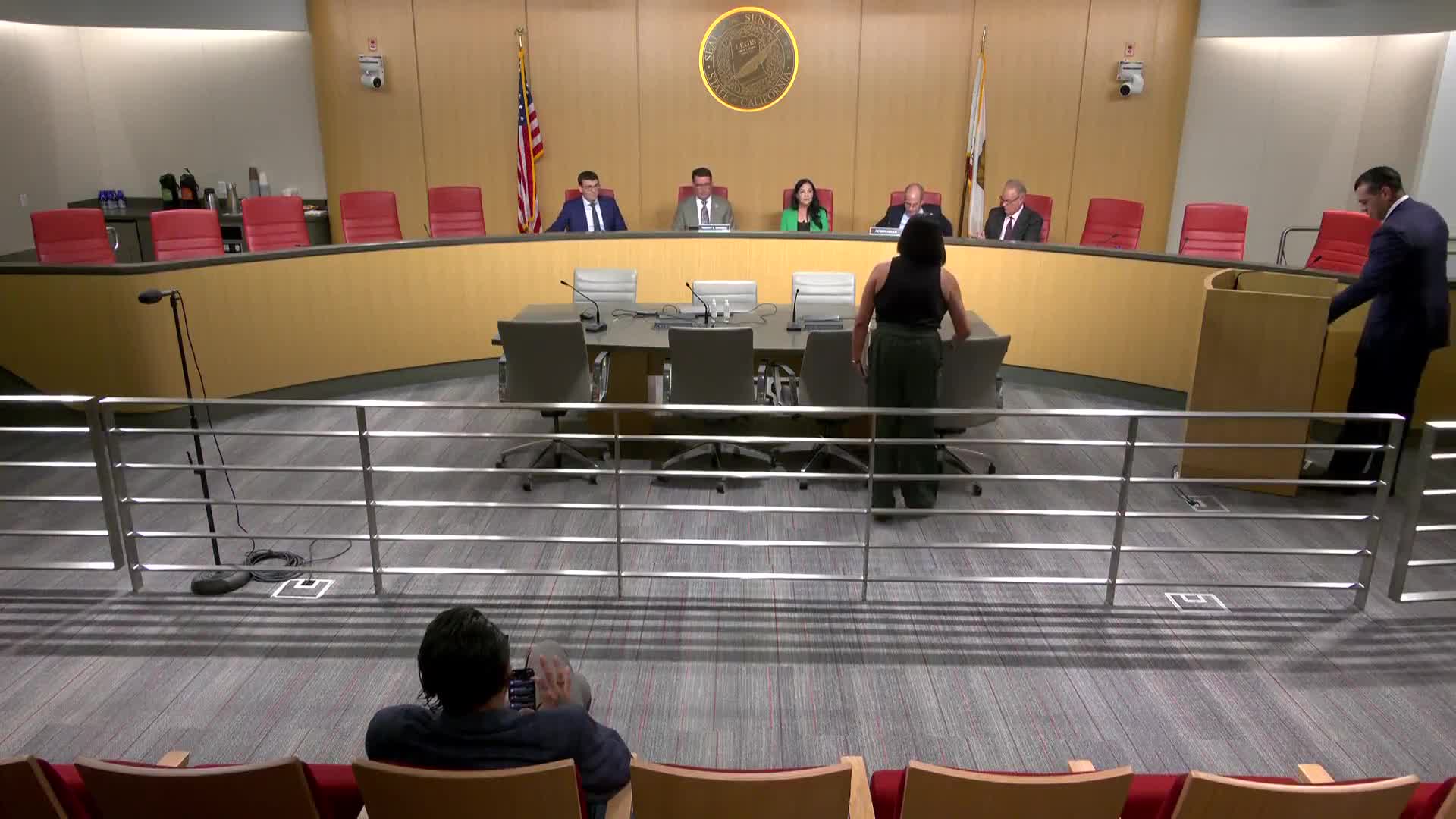
The California State Senate Committee on Banking and Financial Institutions advanced AB 1166, a bill by Assemblymember Valencia that would extend the Fair Debt Settlement Practices Act to cover commercial financing, on a motion to "do pass, but first amend and re‑refer to judiciary."
The California State Senate Committee on Banking and Financial Institutions advanced AB 1166, a bill by Assemblymember Valencia that would extend the Fair Debt Settlement Practices Act to cover commercial financing, on a motion to "do pass, but first amend and re‑refer to judiciary," receiving the five committee votes required to move out of the committee.
Assemblymember Valencia, the bill’s author, told the committee that "AB 1166 expands the Fair Debt Settlement Practices Act to cover commercial financing, ensuring that debt settlement providers must follow the same rules for business customers as they do for individual customers." She said the 2021 measure (AB 14005) established the Fair Debt Settlement Practices Act and created guardrails that, in her view, should also apply in some form to small businesses navigating complex lending markets.
The bill drew support from consumer advocates and at least two industry representatives. Danny Kando Kaizer spoke on behalf of the California Low‑Income Consumer Coalition and the National Consumer Law Center in support. Indira McDonald of KP Public Affairs said she appeared for Forward Financing in support.
Margaret Gladstein of Capital Advocacy described her clients as in a "tweener" position: she said the Association for Consumer Debt Relief did not object to protecting small businesses, but argued that applying consumer rules wholesale to commercial finance "fails to reflect the complexity of the business needs." Gladstein said businesses that seek restructuring are often close to insolvency and need flexibility; she said the legislation should allow "flexibility around time frames," permit "reasonable transparent fee structures" to support early intervention, and ensure that funders do not control or limit who businesses can work with.
Senator Nelof pressed the author on whether consumer‑oriented protections are appropriate for businesses, saying "consumers and businesses are just not the same thing" and asking whether restructuring—not the principal‑reduction model used for consumer settlements—would be more appropriate for business borrowers. Valencia replied that many small, family‑run businesses lack sophisticated access to financing and that the bill would address overlaps between consumer and small business experiences.
Committee members moved the bill on a motion described by the clerk as "do pass, but first amend and re‑refer to judiciary." Senator Hurtado made the motion. The clerk and roll calls recorded the chair voting aye; Senators Grayson, Hurtado, Lamone and Richardson were recorded voting aye as well, producing the five votes the committee required to advance the measure. The committee then referred AB 1166 to the Senate Judiciary Committee for further action.
Votes and next steps: The committee recorded the motion as "do pass, but first amend and re‑refer to judiciary." With five recorded ayes the bill was reported out of the Banking and Financial Institutions Committee and sent to the Senate Judiciary Committee for consideration.
The committee adjourned after completing its business.