Get Full Government Meeting Transcripts, Videos, & Alerts Forever!
Get email alerts on the Food Access topic
No spam. Unsubscribe anytime.
Committee approves SB 18 to create CDFA grant program for grocery stores in food deserts
Summary
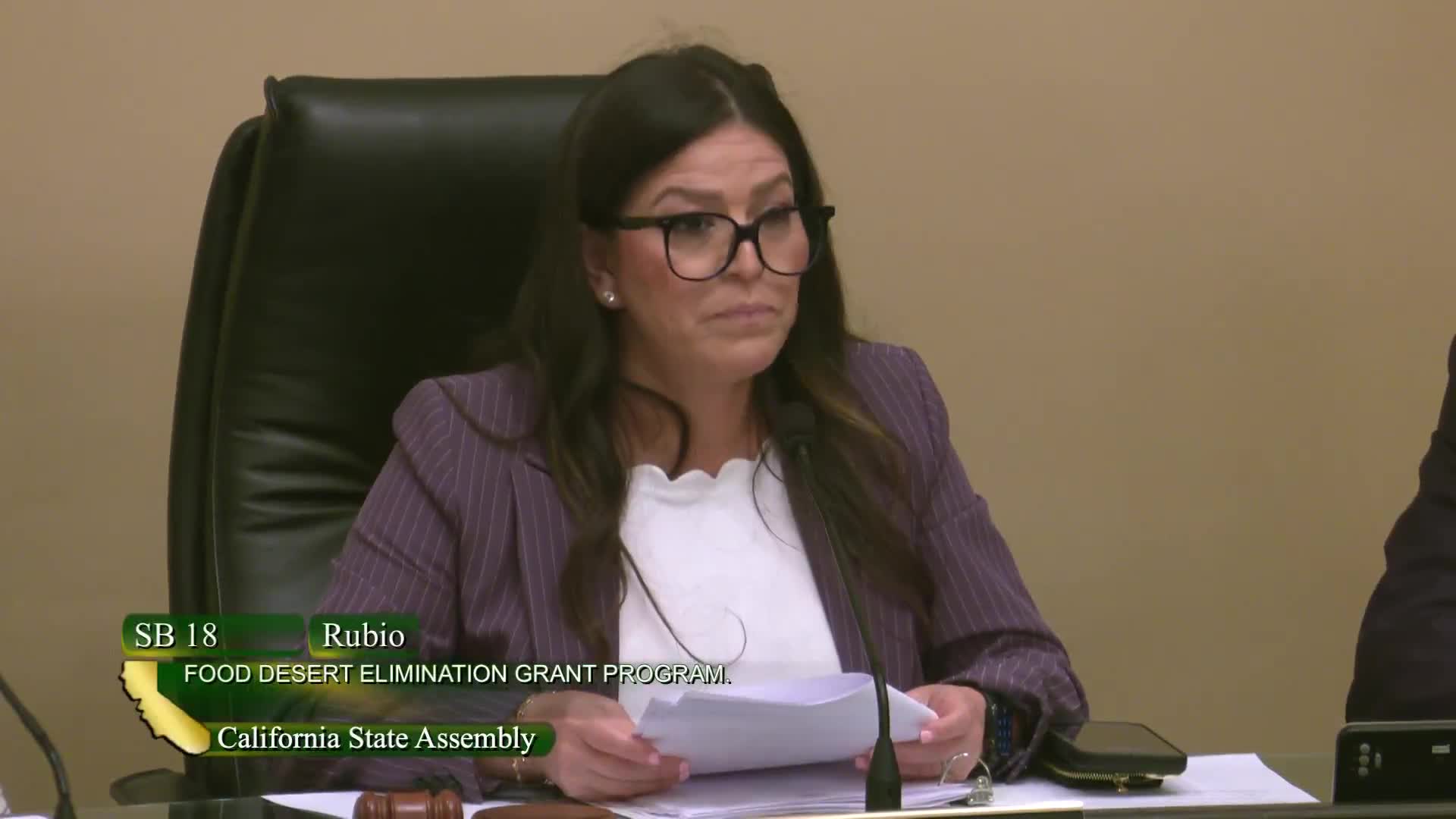
Sen. Rubio, presenting SB 18 — described in committee as the Food Affordability Act — told the Assembly Committee on Agriculture that the bill would create a statewide grant program to help open new grocery stores and improve existing stores in communities the bill identifies as food deserts.
Sen. Rubio, presenting SB 18 — described in committee as the Food Affordability Act — told the Assembly Committee on Agriculture that the bill would create a statewide grant program to help open new grocery stores and improve existing stores in communities the bill identifies as food deserts. "This important bill will help California families struggling with the cost of groceries by ensuring that Californians living in food desert communities have access to affordable healthy food options," Sen. Rubio said.
The bill would authorize the California Department of Food and Agriculture (CDFA) to award grants to grocery-store operators for siting, retrofitting or expanding stores in underserved neighborhoods. Taylor Triffel, representing the California Grocers Association (CGA), described the measure as a way to "fill this gap by supporting the siting and improvements of existing grocery stores and food deserts where access is limited or nonexistent," and said the program would build on CDFA efforts such as the healthy refrigeration program and existing farm-to-school work.
Why it matters: supporters framed SB 18 as a two-part public-interest measure — increasing access to fresh food while supporting local economic activity. Triffel told the committee that food insecurity affects "1 in every 5 Californians" and said urban and rural communities both have areas with little or no supermarket access. She also said the program is intended to help California compete for federal and private funds that support grocery development.
Opponents argued the bill as written risks unintended consequences and could favor large chains over community-led solutions. Ezer Pimentuan, for the Alameda County Community Food Bank and the California Food and Farming Network, testified in opposition unless amended, listing three central concerns: (1) food insecurity is driven by low wages and high costs, not only distance to stores; (2) the bill lacks required community input and accountability; and (3) grants to large chains could displace small grocers, farmers and community-owned markets.
Native American and tribal advocates described past cases where the arrival of a chain led to closures of local, independently owned stores and left communities with reduced options. One tribal witness said their tribe subsequently developed a locally run grocery that purchases from tribal and nontribal farmers, carries culturally relevant foods and holds prices on essential items.
Committee questions centered on guardrails, community engagement and federal funding. The author and witnesses said CDFA would develop the program details through an RFP and stakeholder process; they also said California would be competitive for federal Health Food Financing Initiative (HFFI) dollars and that the federal program remains available (witnesses said roughly $16,000,000 had been distributed in an initial federal round). The committee heard that the draft bill includes a 10% set‑aside for technical assistance to help smaller operators with feasibility, permitting and planning.
Outcome: The committee moved SB 18 out to the Appropriations Committee on a voice/roll-call vote. The clerk recorded seven recorded “aye” votes and zero “no” votes in committee.
Context and next steps: If adopted into law, CDFA would implement the program through grant guidance and an application process; supporters and opponents said they expect a rulemaking and stakeholder process at CDFA to define community engagement standards, scoring rubrics and long-term commitments from grantees. Several members asked the author and sponsors to continue negotiations with community groups and labor representatives on amendments to strengthen local ownership, tribal priorities and community input.
Ending: The committee recommendation advances SB 18 to the Appropriations Committee. Sponsors and opponents signaled willingness to continue talks about guardrails and equity priorities during the regulatory and appropriations stages.