Get Full Government Meeting Transcripts, Videos, & Alerts Forever!
Get email alerts on the Public Works topic
No spam. Unsubscribe anytime.
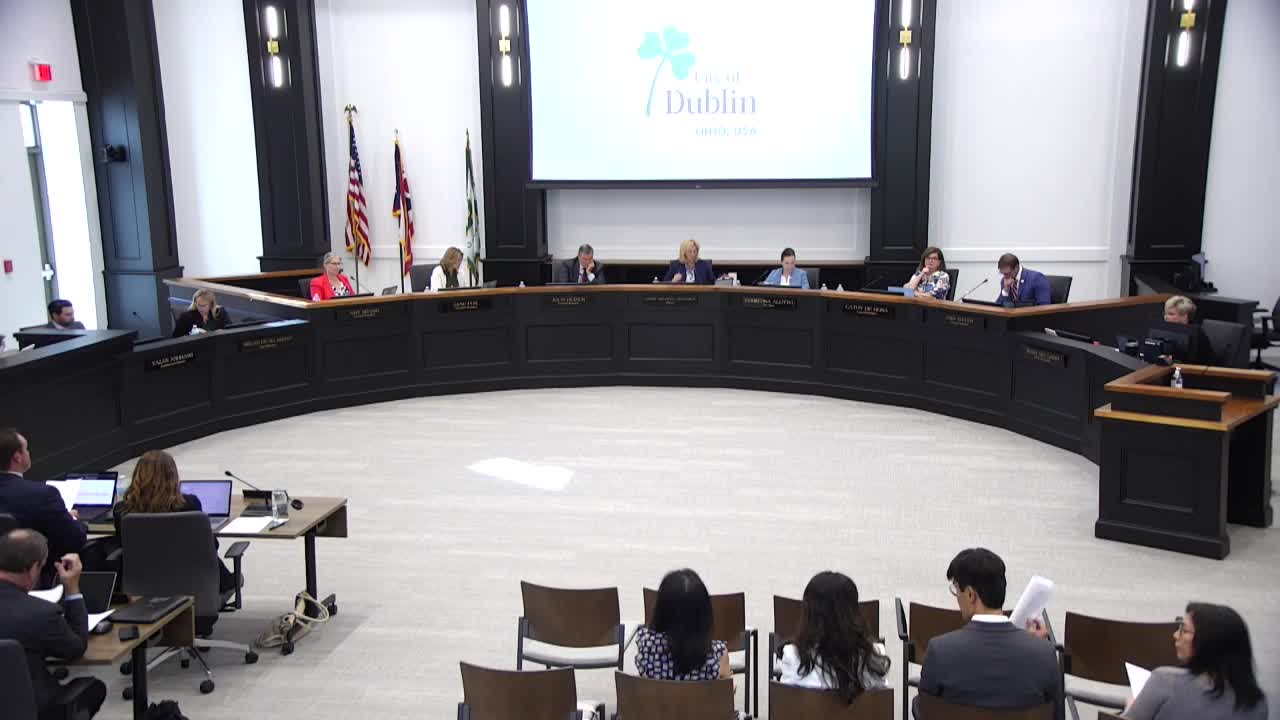
Council adopts easements for Waterways Maintenance Program after debate on rock, naturalized materials and access
Summary
Council approved four ordinances to acquire temporary easements for the Waterways Maintenance Program 2025 after staff presented cost comparisons and site-by-site treatment recommendations; council members pressed for durable rock armoring where feasible while staff defended one site’s use of a more naturalized material due to access constraints.
Dublin — Council on July 1 adopted four ordinances authorizing the city manager to acquire temporary easements from private properties to implement the Waterways Maintenance Program 2025. The ordinances cover eight project sites where staff proposed stream‑stabilization measures including rock armoring, anchored logs, slope erosion protection matting and a naturalized material composition at one site.
The decision followed a staff presentation on engineering cost estimates and site constraints. Michael Hendershot, who delivered the staff report, told council the engineer’s opinion of probable construction costs per linear foot ranged from about $26 for slope‑erosion matting to about $62–$82 per linear foot for rock armoring; the “naturalized material composition” was estimated at roughly $195 per linear foot for that site.
Why it matters: The temporary easements allow city crews and contractors to access private properties to perform stream stabilization and erosion control. Staff said the temporary easements would be in effect for one year from the start of construction and that project improvements are conservatively expected to provide stream stabilization for more than 30 years.
Key points from staff and council - Cost and approach: Hendershot said staff considered erosion severity, site access, long‑term maintenance and benchmarking with other communities when specifying treatment measures by site. "Rock armoring is approximately $62 to $82 per linear foot," he said, and "slope erosion protection matting is approximately $26 per linear foot." He added that the naturalized material option’s higher unit cost reflected a different composition and onsite harvesting of material for that constrained site. - Access constraints: Hendershot and staff emphasized that Site 28 is located in a heavily wooded area (Wyandotte Woods open space adjacent to Thaddeus Park) where hauling rock would be difficult. "A lot of that material we're actually going to be utilizing on‑site," Hendershot said of the naturalized approach for Site 28. - Council concern about durability and aesthetics: Multiple council members said rock armoring was generally preferable. One councilmember urged rock use "wherever possible," citing durability and long life; another warned that a naturalized material composition may not last 30 years and noted its higher cost on a per‑foot basis. - Evidence from earlier projects: Staff showed photos from a previous year‑1 project site 18 months after construction, with rock integrated and vegetation establishing between rock, as an example of a successful application. Hendershot said staff anticipates these improvements lasting 30+ years given proper installation and maintenance.
Council action and direction Council voted to adopt the ordinances authorizing the city manager to execute conveyance documents and accept necessary temporary easements for the Waterways Maintenance Program 2025. Staff said the temporary easements are intended to cover construction access and that post‑construction follow‑up inspections and minor maintenance could be performed from city rights‑of‑way or city‑owned parcels.
Next steps - Staff will proceed with bidding and construction scheduling; staff reported the project would be put out to bid in the next week or so. - Staff will evaluate the constructed site post‑installation and use the data to inform future decisions on treatment types and whether permanent easements will be necessary for later work.
Ending: The ordinances clear the way for the city to access private property for equipment maneuvering and construction at designated waterway sites this construction season; staff emphasized the program’s goal of stabilizing stream banks and reducing long‑term erosion risks.