Get Full Government Meeting Transcripts, Videos, & Alerts Forever!
Get email alerts on the Wastewater Septic Fees topic
No spam. Unsubscribe anytime.
Committee backs pursuing special charge on tax bills to fund county septic maintenance program
Summary
After a detailed staff presentation, the Marathon County Environmental Resources Committee directed staff to pursue an ordinance amendment and DSPS review to place a special charge on county tax bills to fund the private on-site wastewater maintenance program, with a full-fee option estimated at about $6 per year.
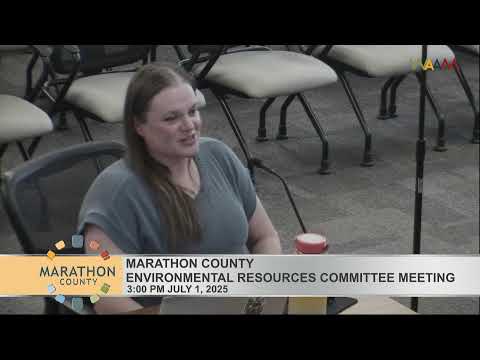
Marathon County’s Environmental Resources Committee on July 1 voted to pursue a special charge on property tax bills to fund the county’s private on-site wastewater (septic) maintenance program rather than continue funding it entirely from county levy.
The motion instructs county staff to draft a Chapter 15 ordinance amendment and fee schedule, send the draft to affected towns and the Department of Safety and Professional Services (DSPS) for review, hold a public hearing before the committee, and, if approved, forward the amendment to the County Board for adoption.
Why it matters: County staff presented that the maintenance program is a state‑mandated function but receives no dedicated state operating funds. Staff estimated the program’s operational cost at about $125,240 and said the program currently tracks 21,219 on-site wastewater systems. Using 2020 census–derived estimates, staff said roughly 43,808 residents (about 31% of the county population) use on-site systems. Staff presented several financing options, including a 100% fee-funded option estimated at about $6 per year per parcel with a system, a 75% special charge/25% levy option (~$4.50/year), and a 50/50 option (~$3/year).
Staff presentation and reasoning: Shad Harvey, Marathon County land resource manager (CPZ), told the committee that the proposed special charge is an efficient way to recover costs because the county already issues annual tax bills and many Wisconsin counties use a similar mechanism. Harvey said 31 of Wisconsin’s 72 counties currently charge a maintenance fee for their septic programs, and that charging through tax bills avoids higher administrative costs that would result from issuing separate bills (staff estimated a separate-billing approach could raise the per-parcel cost toward $10).
Board discussion: Supervisors raised equity and implementation concerns. Town representative Marilyn Bend said property owners who already pay large up-front costs for septic installation would be harmed and asked how the county would ensure money collected would remain dedicated to the maintenance program. Supervisor Kurth asked whether new construction could bear more of the cost; staff said permit-fee increases were less reliable as a funding source because maintenance obligations continue regardless of development cycles. Several supervisors, including Supervisor Robinson and Supervisor Kroll, supported the special-charge approach as a targeted, lower-cost way to require program users to pay for the service.
Implementation steps and timeline: Staff advised that the county would need to draft an ordinance amendment, send it to towns and DSPS for the statutorily required review, hold a public hearing, and obtain County Board adoption. Staff noted timelines could affect whether a fee could be placed on the 2025 tax bill and that DSPS review and town comment windows would need to be satisfied. The committee directed staff to proceed with the ordinance drafting and review process.
Ending: The committee’s direction begins a formal process that includes town notification, DSPS review, public hearing(s) and eventual County Board action before any fee is imposed.