Get Full Government Meeting Transcripts, Videos, & Alerts Forever!
Santa Clara reviews Saratoga Creek segment of Creek Trail master plan; tree loss and habitat mitigation drive feasibility questions
Summary
City of Santa Clara staff and consultants presented feasibility findings for the Saratoga Creek segment of the Creek Trail master plan, identifying two potential underpasses at Homestead Road and Kiley Boulevard, a pedestrian bridge at Stevenson and large habitat and property constraints that limit continuous creekside trail development.
City of Santa Clara staff and the project's consultant on Wednesday presented feasibility findings for the Saratoga Creek segment of a larger Creek Trail Network master plan, describing two potential underpasses, one pedestrian bridge and extensive environmental and property constraints that will shape whether and where an off‑street trail can be built.
Ralph Garcia, senior civil engineer and project manager for the City of Santa Clara Public Works Department, opened the presentation and said the meeting recording and project materials would be posted on the project web page. "This meeting will be recorded and posted online on the project web page at santaclaraca.gov/creektrailplan," Garcia said.
The consultant team led by Jana Sokal said the segment has a mix of areas with enough width to support a Class 1, off‑street, 10‑foot‑wide paved trail with 2‑foot gravel shoulders (14 feet total) and long stretches where there is effectively no top‑of‑bank available to build creekside trail. The team identified Homestead Road and Kiley Boulevard as locations where existing bridge geometry and channel clearances could allow underpasses; Stevenson was shown as a location for a pedestrian bridge. The presentation also identified five potential at‑grade crossings.
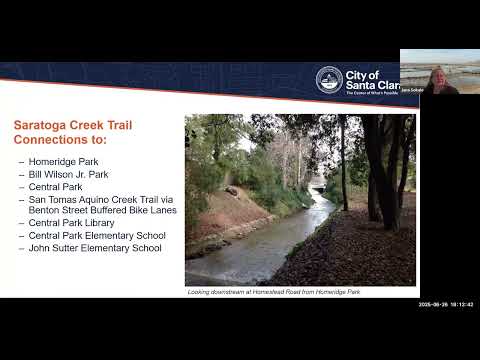
Why it matters: the creek corridor links parks, schools and the San Tomas Aquino Creek Trail and—if feasible—would improve walking and bicycling access to Central Park, the Central Park Library and nearby elementary schools. At the same time, much of the corridor is a regulated vegetation preserve under Valley Water ownership and contains wetlands and federally protected waters, which multiplies permitting and mitigation requirements and raises construction…
Already have an account? Log in
Subscribe to keep reading
Unlock the rest of this article — and every article on Citizen Portal.
- Unlimited articles
- AI-powered breakdowns of topics, speakers, decisions, and budgets
- Instant alerts when your location has a new meeting
- Follow topics and more locations
- 1,000 AI Insights / month, plus AI Chat