Get Full Government Meeting Transcripts, Videos, & Alerts Forever!
Get email alerts on the Cdbg Hsab topic
No spam. Unsubscribe anytime.
San Marcos council clears HSAB spring schedule, defers decision on automatic CDBG allotments for CASA and HCWC
Summary
City staff proposed moving Human Services Advisory Board (HSAB) application review to spring; council gave general support for the schedule and several application-scoring changes but deferred a proposal to automatically allocate half of annual CDBG public‑services funding to CASA and Hays Caldwell Women’s Center until January 2026.
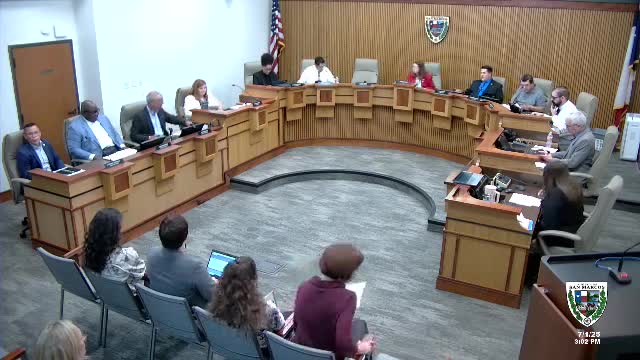
Carol Griffith, the city’s housing and community development manager, presented an update on Community Development Block Grant (CDBG) spending and a set of proposed changes to the Human Services Advisory Board (HSAB) process at the San Marcos City Council work session on July 1.
Griffith said the city receives $750,000 a year in CDBG funding and that “from August 2023 to July 2025, the city will have spent 2,400,000.0 in CDBG funding.” She told council the HSAB application review would move to spring in 2026, with applications due in March, board review in April and May, a board recommendation in June, and council consideration in July (CDBG allocations would be decided in August and HSAB recommendations in September under the proposed schedule).
Why it matters: the timing change is intended to reduce overlap and confusion for nonprofit applicants. Griffith said staff reviewed whether HSAB could also review CDBG public‑services applications and concluded the CDBG public‑input timeline would be pushed into late fall/holidays—“not the best time for public involvement”—so staff recommended separate application reviews but with HSAB receiving CDBG recommendations before making its own funding recommendations.
Councilmembers voiced support for the schedule as presented. Councilmember Lydia Rodriguez said she appreciated staff’s effort to avoid scheduling that “made it hurt people from actually participating.” The mayor and a majority of councilmembers indicated they were comfortable moving forward with the spring timeline.
The meeting included a substantive policy proposal from staff to designate two longtime local grantees—Court Appointed Special Advocates (CASA) and Hays Caldwell Women’s Center (HCWC)—to each automatically receive half of the annual CDBG public‑services allocation going forward, with any additional funding still available through the HSAB competitive process. Griffith explained the idea by noting that “these two have consistently...when you add CDBG and HSAB, they’re always over a 100,000,” and suggested making the annual CDBG portion predictable for those agencies while leaving HSAB to allocate supplemental funding.
Council reaction was mixed. Some members supported trying the change for a limited period, while others raised concerns about locking future councils into funding designations and about excluding other repeat grantees such as the Hays County Food Bank. Councilmember [first name not specified] Mendoza said he favored designating the two agencies for at least two years; Councilmember Sal Gonzales and others suggested revisiting the idea after one or two years. Several councilmembers asked staff to return with a formal resolution if council wanted to proceed; the mayor and multiple councilmembers asked that the topic be “asked again in January 2026” before any change would apply to the next application cycle.
On application administration, council gave staff direction on several HSAB application changes proposed by the board: approve moving from quarterly reporting to annual reporting and remove the word “quarterly” from payment language in the HSAB ordinance; delete one council‑priority scoring question about whether HSAB funding would create an increase in services (the board recommended shifting the 10 points into other scoring categories); and change the council‑priority question about having an office in San Marcos to a narrative outreach question. Griffith confirmed agencies would still be required to meet federal CDBG contract and reporting requirements even if designated for funding.
Norma Blackwell, who identified herself during public comment, described CASA’s funding sources: “We do receive funds through United Way, corporations, individual donors...federal funds, state funds through the attorney general’s office,” and noted CASA has fundraising efforts and events.
What council directed staff to do: (1) implement the HSAB spring schedule for 2026 as presented; (2) prepare ordinance updates to change reporting to annual reports and remove “quarterly” payment wording; (3) adopt the HSAB/ council‑priority scoring changes requested by the board, including deleting the increase‑in‑services points but adding a reporting question to the required annual report about whether applicants expanded services and how many San Marcos residents were served; (4) replace the “office in San Marcos” yes/no scoring prompt with a descriptive outreach question—“In what ways does your agency actively conduct outreach to engage San Marcos residents in its programs and services”—for scoring; and (5) return to council with a draft resolution if council wants to formally designate CASA and HCWC for CDBG public‑services funding (council majority opted to defer that resolution and revisit in January 2026).
Council and staff emphasized that any designated award would still require a contract and compliance with HUD/CDBG requirements. Griffith said staff will continue to notify agencies about application and reporting requirements and will forward quarterly (or annual) reports to council as requested.
Looking ahead: staff will bring ordinance language and any required resolutions back to council for formal action, and the HSAB timeline changes will be implemented for the spring 2026 application cycle unless council directs otherwise in January 2026.