Council approves solar zoning text amendment with rooftop standards, keeps larger farm-scale rules for further review
Loading...
Summary
Lexingtons General Government & Planning Committee voted to adopt a zoning ordinance text amendment (ZOTA) to clarify rules for rooftop and small- to intermediate-scale solar while directing further work and limits for large ground-mounted projects in agricultural areas.
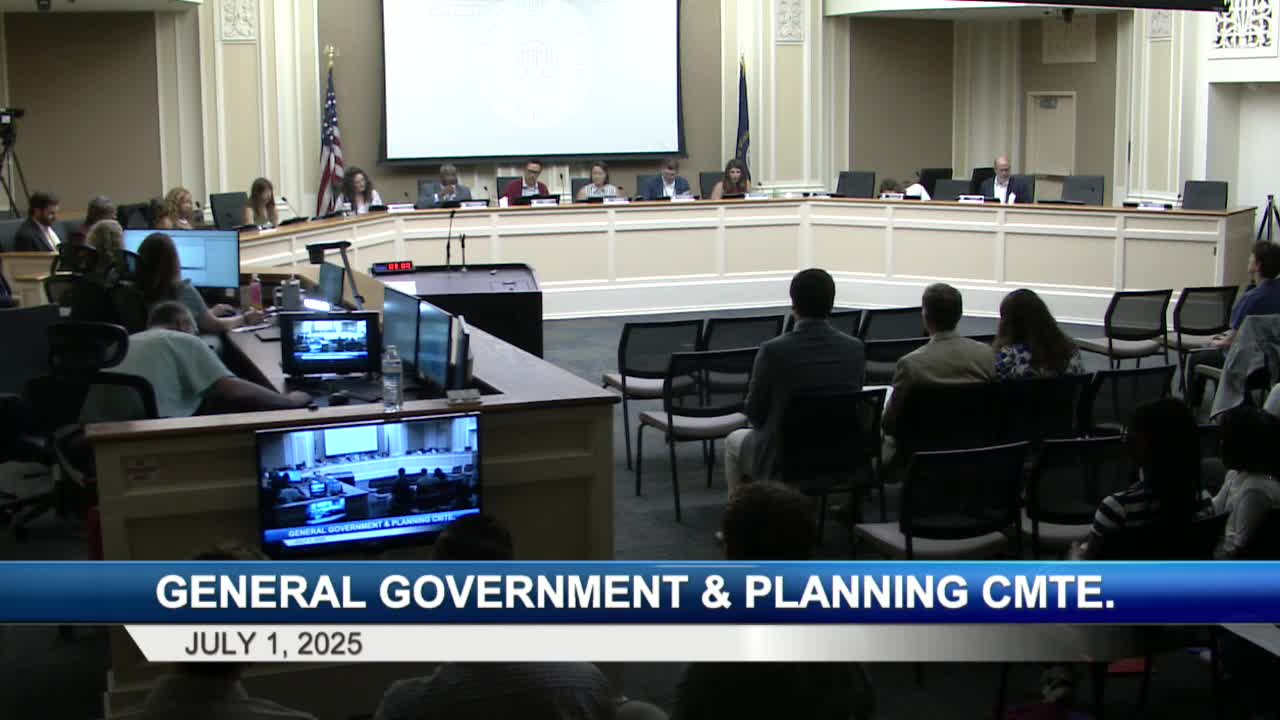
The Lexington City General Government & Planning Committee on July 1 adopted a zoning ordinance text amendment to clarify how solar energy systems will be regulated in the city, approving updated standards for rooftop and smaller ground-mounted systems while leaving a separate, more detailed process for large agricultural (AG) solar proposals.
The amendment, based on a planning commission recommendation and further edits from Councilmember Savigny and Chair Dr. Sheehan, establishes clear definitions and review processes for integrated (built-in), rooftop and ground-mounted solar; raises the intermediate ground-mounted threshold to 10 acres; and adopts new general requirements for integrated and rooftop systems that the committee added during the meeting. The committee voted to report the item to the full council for an August 19 work session.
The action matters because Lexington currently lacks a cohesive local framework for private solar projects outside utility-scale installations. Daniel Crum, the planning divisions principal planner, told the committee that public-utility scale solar is regulated by the Kentucky Public Service Commission and therefore is generally exempt from local zoning, but that privately developed rooftop and ground-mounted systems need local standards to remove ambiguity for property owners and reviewers.
Crum said the planning commissions draft divided ground-mounted solar by size: small (up to 2,500 square feet of panel area), intermediate (previously up to 5 acres in the planning commission draft) and large (greater than 5 acres). Councilmember Savignys edits, which the committee discussed at length, changed the intermediate threshold to 10 acres to align with a model ordinance from the Kentucky Resources Council and added definitions such as "prime farmland" and new criteria for height, glare, vegetative cover and decommissioning plans.
"There are two big issues here, equity and local governance," Councilmember Savigny said during her presentation, urging the committee to weigh both the countys agricultural land base and the interests of residents across Lexington. Savigny and other council members noted SolSmart designation language in the packet; staff said certain rooftop/integrated provisions were added to support Lexingtons application for a SolSmart recognition and potential future grant opportunities.
Committee members pressed staff and administration for several clarifications during the debate. Crum reiterated that public-utility solar projects fall under the Kentucky Public Service Commission's jurisdiction and are not bound to local zoning language in the same way that privately developed systems are. He also said practical constraints on large solar farms include proximity to transmission lines and contiguous acreage, which limits where large-scale projects are feasible in Fayette County.
Council discussion focused on three fault lines: whether large ground-mounted solar should be allowed in agricultural zones; how to protect prime soils and topography; and how to balance rapid action to support the citys sustainability goals with more extensive public engagement for rural areas. Savigny proposed a countywide cap for large-scale solar in agricultural zones of roughly 2% of the land outside the urban service boundary (about 2,600 acres), citing existing and proposed projects: an 800-acre proposal from Silicon Ranch, roughly 384 acres tied to a Kentucky rural electric cooperative project, and approximately 600 acres associated with the county landfills property that lies inside AG territory (figures discussed in committee).
Some council members urged a slower, separate public-process approach for AG-zone rules; others argued the county must provide guardrails now to avoid losing local influence when the Public Service Commission evaluates utility proposals. Several speakers favored a rooftop-first or urban-priority approach, while others emphasized rural landowners interests and potential economic opportunities.
Votes at a glance: - Approval of May 6, 2025 committee summary: motion approved (voice vote, carried). - Planning commission ZOTA, as amended in committee (accepting planning commission text plus committee additions and insertion of the committees section 31.5 provisions for integrated/rooftop systems): motion passed (electronic vote reported 8 yes, 2 no). - Amendment to adopt redlined changes only for Section 31.5 (general requirements for integrated and rooftop solar energy systems): motion passed (electronic vote). - Motion to report the item to the August 19 work session: passed. - Administrative referral: removal of a waiver notice requirements item from committee: passed.
What the ordinance does and does not do - Adopted and clarified: definitions for integrated, rooftop, small-scale and intermediate ground-mounted systems; permitting pathways for rooftop and smaller ground-mounted systems; screening, signage, vegetative cover and decommissioning plan requirements; and new height and glare language for integrated/rooftop systems included to support the SolSmart application. - Deferred or limited: committee retained a pathway for conditional use review for large ground-mounted solar in agricultural zones rather than adopting an across-the-board allowance; the committee added a proposed 2% cap on AG-area acreage in discussion as a policy guide, though the final ordinance language approved at committee focused on the urban/rooftop standards and the Section 31.5 additions while leaving large-AG policy to follow-up processes and council discussion.
What planning staff said about enforcement and review Daniel Crum explained that the Board of Adjustment would evaluate conditional-use applications for large ground-mounted systems in agricultural zones using specified criteria in the ordinances, including protection of soils and minimizing grading and tree removal. If a conditional use is approved, Crum said staff would compare submitted materials with conditions during subsequent inspections.
Stakeholders and next steps The planning commission had unanimously recommended the staff text in the fall but excluded agricultural ground-mounted systems from the expedited, applicant-initiated ZOTA so the rural questions could be addressed through a broader process. Savigny said the committees edits were informed by the Kentucky Resources Council model ordinance and by local priorities to protect prime soils while allowing potential agrivoltaic practices where feasible.
Jada Griggs, Lexingtons senior program manager for sustainability, advised that the rooftop/integrated provisions were important for the city's SolSmart application. Committee members asked for additional analysis on where utility-scale projects would be physically feasible (noting proximity to transmission lines) and for more robust public engagement when agricultural land is in play.
The committee voted to advance the amended ZOTA to the full council and directed staff to schedule the item for an August 19 work session. Councilmembers on both sides of the debate suggested a potential stakeholder work group or multi-stage public process to craft further AG-zone rules, decommissioning safeguards, agrivoltaics guidance and protections for prime farmland and historic or vulnerable neighborhoods.
Sources and attribution Quotes and attributions are taken from committee discussion and staff presentations at the July 1 General Government & Planning Committee meeting. Attributed speakers in this report include Councilmember Savigny; Daniel Crum, principal planner; Jada Griggs, program manager, sustainability; Councilmember Ellinger (motion); Councilmember Curtis (motions and amendments); Vice Mayor Wu; and other committee members who participated in the deliberations.
— End of report.